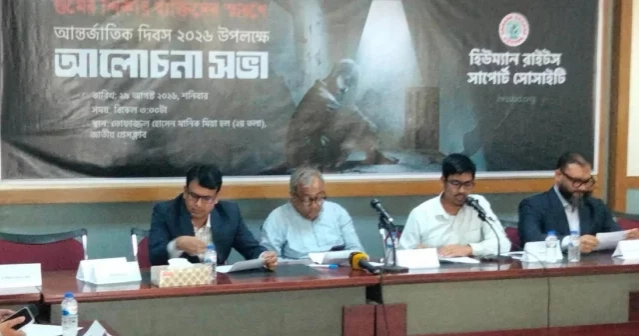
Human Rights Support Society (HRSS) has called for an independent mechanism to investigate allegations of enforced disappearances, saying agencies accused of such violations should not be allowed to investigate the cases themselves.
The rights organisation made the demand at a discussion at the Jatiya Press Club on Saturday, ahead of the International Day of the Victims of Enforced Disappearances, which will be observed on Sunday.
HRSS said investigations into allegations against law enforcement agencies should be conducted by an independent investigative body, an independent National Human Rights Commission or a specialised authority.
It also urged the government to reconsider provisions in the proposed Enforced Disappearance Prevention and Remedy Act, 2026 that could place investigations into allegations against law enforcement agencies within the law enforcement system.
The organisation said recognising enforced disappearance as a criminal offence under the proposed law is a positive development, but warned that the law would not achieve its objectives without ensuring independent investigations and adequate protection for victims and witnesses.
Referring to the final report of the Commission of Inquiry on Enforced Disappearances, HRSS said the commission had received 1,569 complaints and found evidence suggesting political motives behind most of the disappearances.
The commission also reported that the bodies of 36 people had been recovered after their disappearance, while 251 people remained missing. It believed the actual number of enforced disappearances could be higher, HRSS said.
HRSS called for prompt, independent and impartial investigations into allegations of enforced disappearance between 2009 and 2024 and demanded that all those responsible be brought to justice.
It said accountability should extend beyond field-level personnel to those who ordered, planned or authorised operations, stressing the need to clearly define “command responsibility” in the proposed law.
The organisation also urged the government to hold consultations with victims’ families, civil society representatives, lawyers, human rights defenders and experts before finalising the proposed legislation.
It further called for specific deadlines for investigations, accountability for delays, protection for complainants and witnesses, and regular updates to victims’ families on the progress of investigations.
HRSS also demanded that accused government officials not be granted special immunity during investigations or trials.
On the National Human Rights Commission, the organisation called for ensuring its genuine independence in line with the Paris Principles, including financial and administrative autonomy and the authority to conduct independent investigations.
It also demanded compensation, legal assistance, medical and psychological support, educational assistance and social rehabilitation, where necessary, for victims of enforced disappearance and their families.
The organisation stressed that families must have the “right to truth”, the right to know what happened to their missing relatives.