
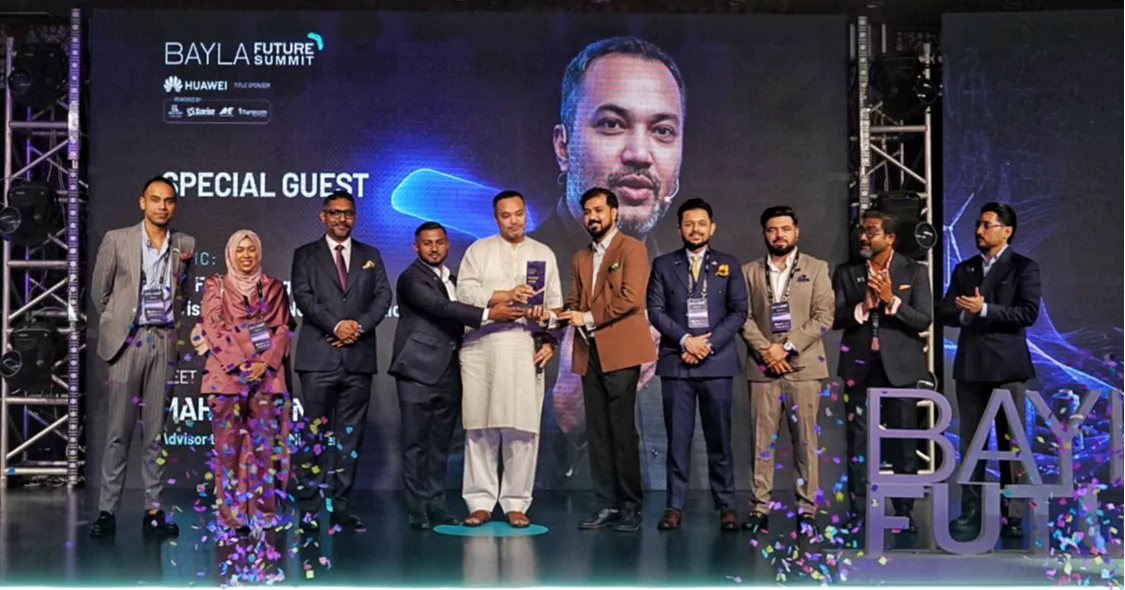
Prime Minister's Adviser Mahdi Amin on Tuesday said the government is giving the highest priority to ensuring reliable gas and electricity supplies to industries, describing energy security as critical to sustaining industrial growth.
Speaking as the chief guest at the “BAYLA Future Summit 2026” organised by the Bangladesh Apparel Youth Leaders Association (BAYLA) at a city hotel, he acknowledged that many industrial units are still facing gas and electricity disruptions. "We are working on this issue and are committed to resolving these problems within a realistic timeframe," he said.
Highlighting Bangladesh's core strengths in attracting investment – a large youth demographic, a massive domestic market, and an elected democratic government capable of ensuring policy continuity – Mahdi Amin stressed the need to ensure energy security, enhance port efficiency, and reduce the cost of doing business.
He informed that the government is executing structural reforms to set up new industrial parks, simplify bonded warehouse facilities, cut bureaucratic hurdles, and ensure transparency, accountability, and good governance.
Mahdi Amin, also Prime Minister’s Office (PMO) spokesperson, added that efforts are also underway to expedite incentive disbursements, encourage technology adoption, expand Public-Private Partnerships (PPP), attract Foreign Direct Investment (FDI), and implement supportive policies for genuine entrepreneurs, alongside investments in education, healthcare, and human resources.
At the event, Chairman and Chief Executive Officer (CEO) of Policy Exchange Bangladesh Dr M Masrur Reaz outlined a six-point strategy to elevate the country’s ready-made garment (RMG) export earnings to $100 billion.
He noted that while the RMG sector is one of the biggest success stories of Bangladesh's economy, over-reliance on limited products and markets poses future risks.
To reach the $100 billion export target, Masrur Reaz proposed a six-point roadmap – enhancing trade facilitation through customs, infrastructure, and regulatory reforms; boosting port capacity, implementing multimodal transport, and modernising supply chains; providing policy support for high value-added products, man-made fibre (MMF), and expanding exports to new markets; adopting a national strategy for sustainable development and the circular economy; strengthening PPPs for technology adoption and skill development; and making long-term investments in education, technical training, and human resource development.
Managing Director of Dhaka Stock Exchange (DSE) Nuzhat Anwar pointed out that only 1 percent of corporate financing in Bangladesh currently comes from the capital market.
She urged entrepreneurs in the apparel and textile sectors to utilise the capital market alongside bank loans for long-term financing needs.
The summit brought together policymakers, industry leaders, and next-generation business executives to discuss the future of Bangladesh's garment industry, competitiveness, technology, investment, capital markets, skilled human resources, and sustainable growth.
President of the Bangladesh Employers' Federation Fazlee Shamim Ehsan and Country Managing Partner of PricewaterhouseCoopers (PwC) Bangladesh Shams Zaman, among others, spoke on the occasion.
At the summit, BAYLA organised the “BAYLA Future Leaders” competition for the first time, a practical business problem-solving contest involving over 100 teams from various universities across the country.
Teams from North South University, BRAC University, Independent University, Bangladesh (IUB), and the Institute of Business Administration (IBA) of Dhaka University reached the final round.
State Minister for Primary and Mass Education Bobby Hajjaj attended the awards ceremony as the chief guest.