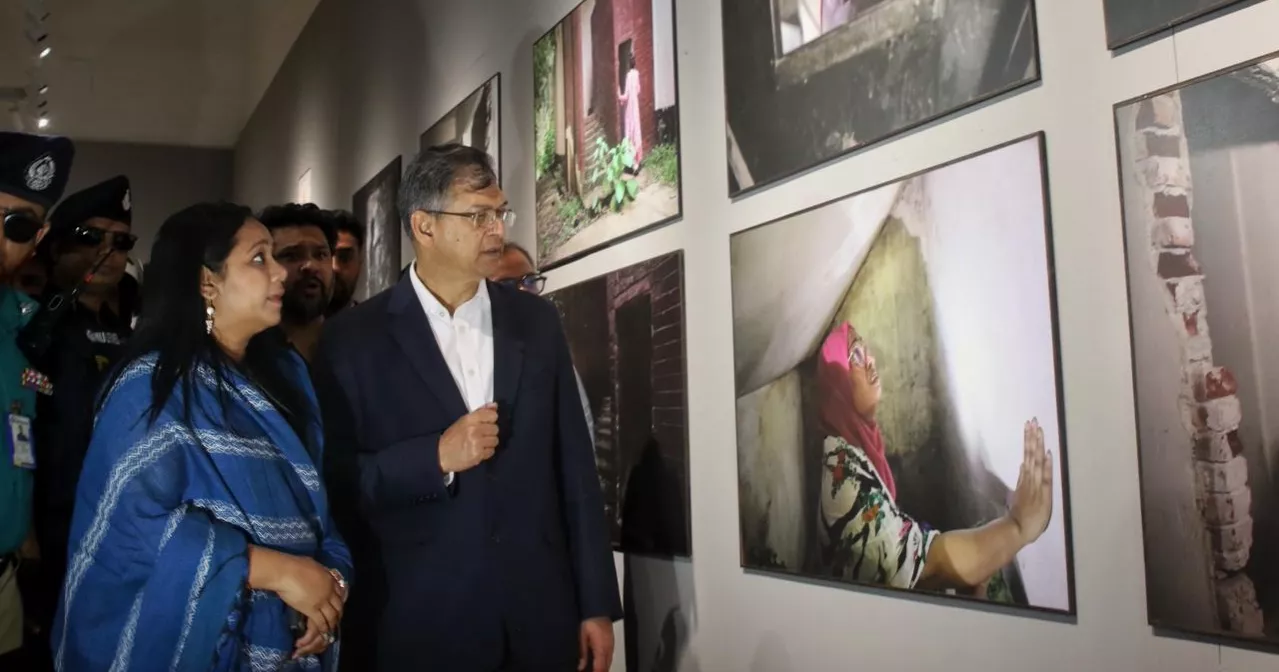
Home Minister Salahuddin Ahmed on Saturday said he does not want anyone else to be subjected to enforced disappearance in Bangladesh, as he recalled his own 61-day ordeal as a victim of enforced disappearance and called for a law ensuring justice and punishment for those responsible.
“I am the Home Minister. I myself am a victim of enforced disappearance. I do not want anyone else to be disappeared in Bangladesh. We want such a law under which every victim can go to court, get justice and ensure punishment for those responsible,” he said.
The Home Minister made the remarks as the chief guest at an exhibition and panel discussion organised by ‘Mayer Dak’ at the Sufia Kamal Auditorium of the Bangladesh National Museum in the capital in the afternoon, marking the International Day of the Victims of Enforced Disappearances.
Salahuddin Ahmed said the Enforced Disappearance Commission Ordinance was not passed during the first session because merely forming a commission would not solve the problem.
“The government has brought a law to Parliament under which a victim of enforced disappearance or their family can directly go to court and seek justice,” he said.
He said the law specifies the types of enforced disappearance, punishments for different offences, who will conduct investigations and what rights victims will have.
Even if a missing person cannot be found, their heirs will be entitled to their property rights, and provisions have also been made for compensation, he said.
Salahuddin Ahmed said those who have opinions on the proposed law can submit them to the parliamentary committee.
“There will always be opportunities to amend the law. There is no lack of sincerity on our part,” he said.
He said that in the past, enforced disappearance cases were limited to investigations, but the new law provides a mechanism for victims to seek redress directly from courts.
The law also includes a provision for the maximum punishment of death depending on the nature of the offence, he said.
Recalling his experience of being forcibly disappeared for 61 days, Salahuddin Ahmed said the ordeal was filled with uncertainty about whether he would live to see another morning.
“If I could write down every minute and every moment of those 61 days of my disappearance, it would become a book for a museum collection,” he said.
“Every moment I felt, would I see the next dawn? When breakfast was served, I understood that it was morning. And I used to count the days by scratching numbers on the wall with my fingernail,” he said.
The Home Minister said the room where he was kept was extremely small.
According to his description, it was approximately five feet by 10 feet.
“There was hardly any facility there except a blanket and a thin pillow,” he said.
He said there was a toilet facility in one corner of the room, from which a foul smell came, making it difficult to sleep in that environment.
Salahuddin Ahmed also recalled how he was taken to Shillong in India after his disappearance.
He said he was taken by car for a long time and eventually dropped off in a deserted area.
“They left me standing on the footpath and said, ‘You are free now,’” he said.
He then spoke to some local people and requested them to inform the police.
Police arrived and took him to a beat house before subsequently taking him to a hospital, he said.
The Home Minister said he was able to establish contact with his family through a telephone number provided with the help of a doctor at the hospital.
He said his wife returned a call from a foreign number.
“As soon as I said ‘hello’ on the phone, my wife screamed, ‘I knew you were alive,’” he recalled.
He then asked his family members to make arrangements to come to Shillong.
‘Do not make jokes about those who returned from enforced disappearance’
Salahuddin Ahmed urged people not to make jokes about individuals who returned after being subjected to enforced disappearance.
The programme was organised to demand justice, truth and accountability for victims of enforced disappearance and their families.
‘Mayer Dak’ Coordinator and reserved women’s seat parliament member Sanjida Islam Tuli chaired the event.