President Mohammed Shahabuddin resigned from office on Friday, citing ill health, bringing an early end to his five-year term that was due to expire in April 2028.
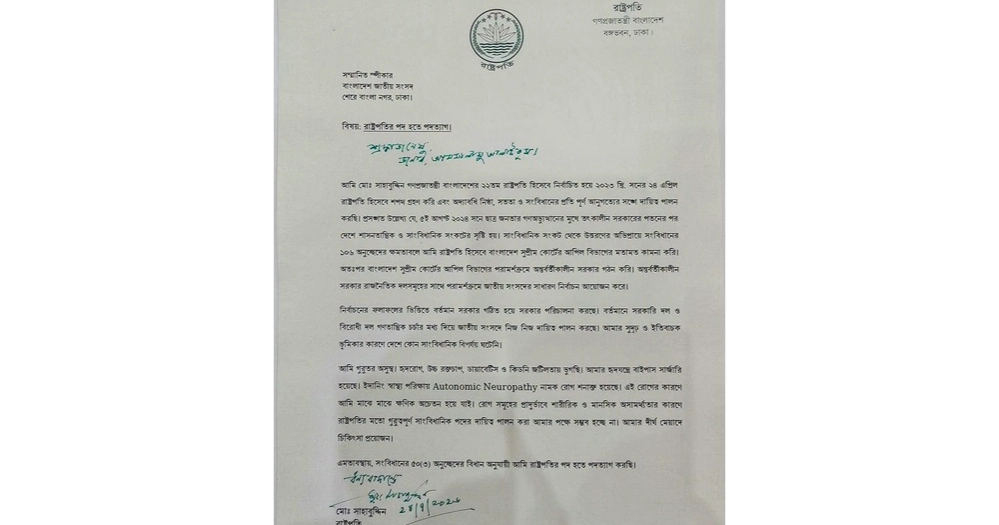
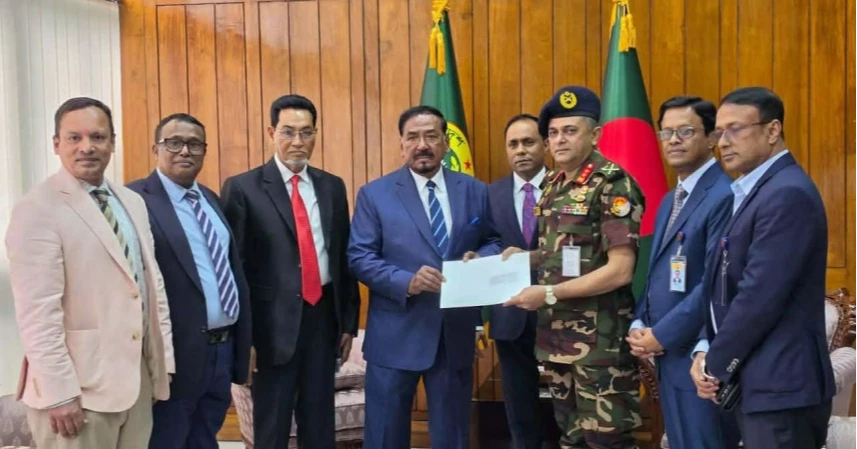
He submitted his resignation letter to Speaker Hafiz Uddin Ahmad in the afternoon, said his Press Secretary M Sarwar Alam.
Under Article 54 of the Constitution, the Speaker will now act as the acting President until a new head of state is elected.
Around 4:26pm, a vehicle designated for the acting President, along with two Special Security Force (SSF) protocol vehicles, arrived at the Jatiya Sangsad Bhaban.
In the letter, Shahabuddin stated that he is seriously ill. “I am suffering from heart disease, hypertension, diabetes and kidney complications. I have undergone coronary artery bypass surgery.”
Mentioning that he was diagnosed with a condition known as autonomic neuropathy, he said he occasionally loses consciousness for brief periods as a result of this illness.
“Due to these medical conditions and the resulting physical and mental incapacity, I am no longer able to discharge the responsibilities of the important constitutional office of the President. I require long-term medical treatment,” Shahabuddin said, adding that under these circumstances, he stepped down from the office of the President in accordance with Article 50(3) of the Constitution.
Shahabuddin claimed that he discharged his duties with sincerity, honesty and full allegiance to the Constitution.
Referring to the fall of the Awami League government in the face of the student-led mass uprising on August 5, 2024, he said the country faced a constitutional and governance crisis at that time.
“With a view to overcoming that constitutional crisis, I, in my capacity as President, sought the opinion of the Appellate Division of the Supreme Court of Bangladesh under Article 106 of the Constitution. Subsequently, acting on the advice of the Appellate Division, I formed the interim government,” Shahabuddin said.
The interim government, in consultation with political parties, held the general election, he said. “Based on the election results, the present government was formed and is now conducting the affairs of the state. At present, both the ruling party and the opposition are performing their respective responsibilities in Parliament through democratic practices.”