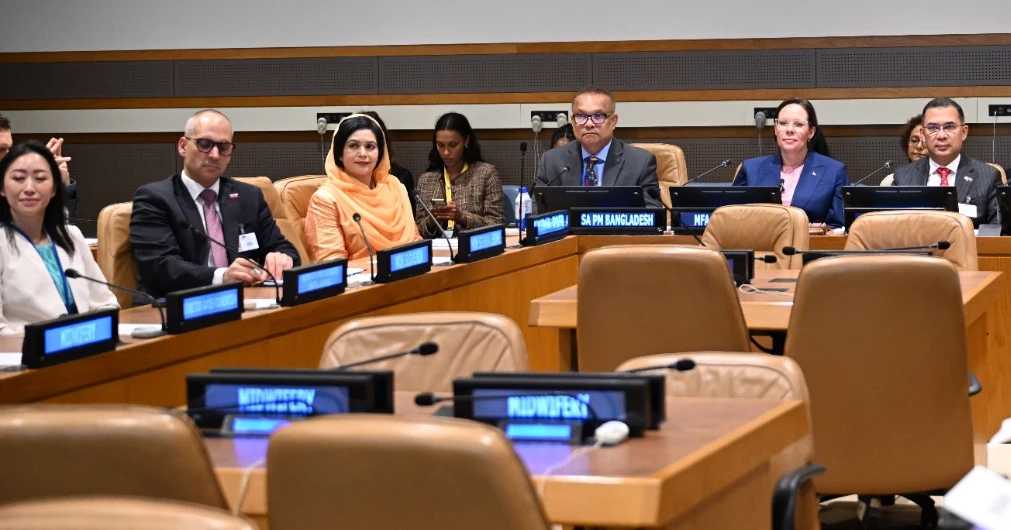
Prime Minister Tarique Rahman’s wife Dr Zubaida Rahman, on Thursday stressed the need to put professional midwives at the centre of primary healthcare to help end preventable maternal and newborn deaths.
She made the remarks while delivering the concluding remarks at a high-level side event titled “From Commitment to Action: Integrating Midwifery into Primary Health Care to End Preventable Maternal and Newborn Deaths” at the UN Headquarters here.
Zubaida said professional midwives save lives and stressed the need to build health systems that enable them to work effectively, equitably and sustainably.
“For Bangladesh, this discussion comes at an important moment. We are redesigning our Primary Health Care (PHC) system around a simple principle: prevention is better than cure,” she said.
Zubaida said Bangladesh’s vision of a “Healthy Bangladesh” is to move from a treatment-centred system to one that emphasises prevention, early identification and continuity of care, with services closer to people’s homes.
“This reflects a long-standing commitment to putting people at the centre of development,” she said, referring to the emphasis placed by late President Ziaur Rahman and former Prime Minister Khaleda Zia on reaching ordinary people, strengthening communities and expanding access to essential services.
Zubaida said Bangladesh is seeking to carry that people-centred spirit forward through a modern health system built around prevention, dignity and access.
“Women and children are at the centre of this transformation,” she said, adding that Bangladesh is working towards an integrated PHC network extending to rural unions and urban wards, supported by a stronger frontline workforce and digital health.
She said recruitment of 25,000 professional midwives has already begun. “Our objective is not simply to increase their numbers. We want to integrate them into multidisciplinary PHC teams and provide continuity of care from preconception and pregnancy through childbirth, postnatal and newborn care,” she said.
Zubaida said the PHC model discussed at the event places midwives at the centre of the maternal health journey and seeks to move the health system from fragmented services to an integrated and accountable platform.
“This platform will connect households and communities with primary facilities and, when necessary, with secondary, tertiary and specialised care through a functioning referral system,” she said.
She said midwife-led PHC could advance three priorities for Bangladesh — better access, stronger financial protection and better value in healthcare.
“It can bring essential care closer to women, reduce unnecessary interventions and out-of-pocket expenditure, and ensure respectful care at the right place and at the right time,” Zubaida said
She called for ensuring that every woman has access to a skilled professional midwife as part of her PHC team, close to where she lives.
Zubaida said the experiences shared at the event showed the value of countries learning from one another while developing solutions suited to their own health systems.
“Bangladesh looks forward to continuing this exchange and working with governments, UN agencies, development partners and the global health community to turn today’s dialogue into practical action,” she said.
Zubaida thanked the health ministers, distinguished delegates, UN agencies, development partners, professional organisations, civil society and the global health community for joining the dialogue.
The event was held on the sidelines of the 81st session of the UN General Assembly, with participation from health ministers and senior representatives of Sierra Leone, Nepal, Thailand, Indonesia, the Philippines and other countries.Z
Zubaida concluded the event by thanking all participants and wishing them a pleasant afternoon.