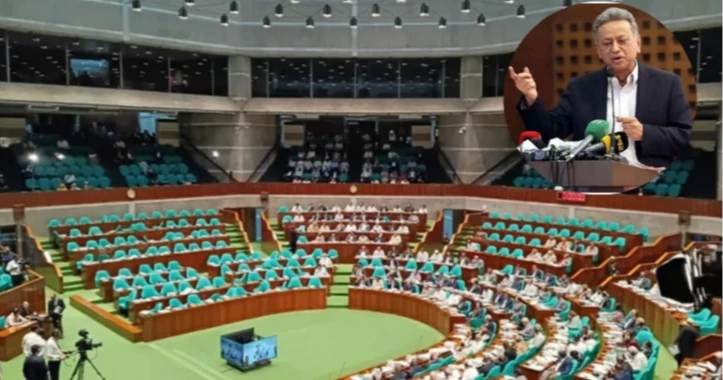
The government has formed 11 Joint Investigation Teams (JITs) led by the Anti-Corruption Commission (ACC) to probe priority money laundering cases as part of an intensified effort to trace, investigate and recover laundered funds, Finance Minister Amir Khosru Mahmud Chowdhury told Parliament on Wednesday.
Responding to a starred question from Jamaat MP Masum Mustafa elected from Netrakona-5, the minister said illegally acquired money is usually laundered abroad through highly secretive and complex methods, making it extremely difficult to determine the exact amount transferred out of the country.
The 11 teams also included officials from the Criminal Investigation Department (CID), the National Board of Revenue's Central Intelligence Cell and the Customs Intelligence and Investigation Directorate.
As of May 2026, courts had ordered the attachment and freezing of movable and immovable assets worth approximately Tk 76,814 crore at home and abroad in connection with the 11 priority cases, he said.
To implement court orders overseas, Bangladesh has sent 23 Mutual Legal Assistance Requests (MLARs) to relevant countries.
The minister said 142 cases have so far been filed in connection with efforts to recover laundered assets. Charge sheets have been submitted in 17 cases, while verdicts have been delivered in six cases.
To strengthen coordination among agencies involved in asset recovery, a Stolen Asset Recovery Division has been established under the Bangladesh Financial Intelligence Unit (BFIU), he said.
The government is also considering establishing a specialised asset recovery agency, following the example of several other countries, to improve the efficiency of efforts to trace and repatriate illicitly transferred wealth.
Amir Khosru said Bangladesh is receiving technical assistance, training and advisory support from a number of international organisations and foreign authorities, including the International Anti-Corruption Coordination Centre (IACCC), the World Bank and UNODC's Stolen Asset Recovery (StAR) Initiative, the International Centre for Asset Recovery (ICAR) and the US Department of Justice.
Bangladesh has also become a member of the Global Operational Network of Anti-Corruption Law Enforcement Authorities (GlobE Network) and the Asset Recovery Interagency Network-Asia Pacific (ARIN-AP) to facilitate international cooperation and information exchange.
The minister further said that, alongside criminal proceedings, the government has initiated civil recovery measures to bring back laundered funds.
Under this approach, around 30 banks affected by defaulted loans allegedly transferred abroad have begun the process of appointing nine international law firms under "No Win, No Fee" arrangements after signing non-disclosure agreements.
In the first phase, civil proceedings have been launched against six of the 11 priority cases involving Saifuzzaman Chowdhury, S Alam Group, Beximco Group, Sikder Group, Nassa Group and Orion Group.
The finance minister said plans are in place to further expand these recovery efforts.
He added that once the legal processes are completed and repatriated funds begin to return, the money will be allocated or spent in accordance with existing laws, relevant international agreements and government policies.
He said according to information compiled by the White Paper Committee formed by the Interim Government, the estimated volume of illicit financial outflows from Bangladesh during the 2009–2023 period stood at approximately $234 billion, averaging $16 billion annually, or about Tk 1.8 lakh crore.
The minister said the amount is equivalent to 3.4 per cent of Bangladesh's GDP in FY2023-24, around one-fifth of the country's export and remittance earnings, approximately 11.2 per cent of national savings, and nearly twice the volume of net foreign aid and foreign direct investment (FDI) inflows.
To recover the siphoned-off funds and prevent similar incidents in the future, the government has formed a 12-member inter-agency task force headed by the Governor of Bangladesh Bank, he said.
Based on the task force's recommendations, 11 priority cases have been identified under the Money Laundering Prevention Act, 2012. These involve former Land Minister Saifuzzaman Chowdhury, S Alam Group, Beximco Group, Sikder Group, Nassa Group, Orion Group, Bashundhara Group, former Prime Minister Sheikh Hasina and her family, Nabil Group, HBM Iqbal and Summit Group.