
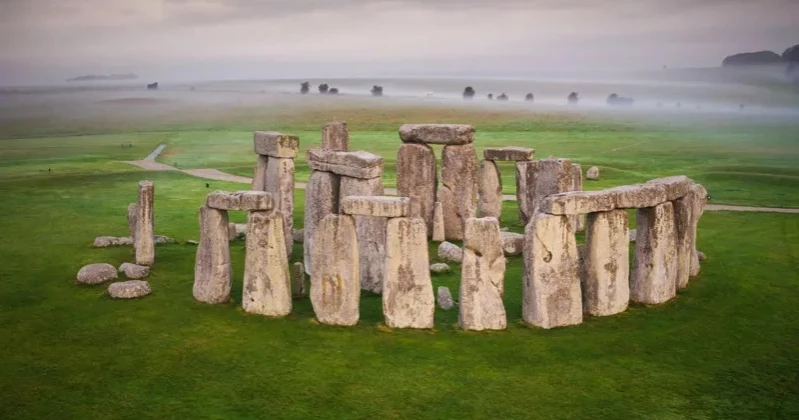
Archaeologists in the United Kingdom say they have uncovered evidence of a much earlier and simpler version of Stonehenge located about 3 miles (5km) from the world-famous prehistoric monument.
Researchers believe the site, found in Bulford, once consisted of just two wooden posts placed in the ground. Although the timber has long decayed, the remaining post holes suggest the structure was carefully aligned with the Sun during the summer and winter solstices, similar to Stonehenge.
The site has been dated to around 5,000 years ago, making it about 500 years older than Stonehenge itself.
Excavations at the location also uncovered pottery fragments, flint tools and animal bones, indicating that prehistoric communities may have gathered there for rituals or seasonal events.
Phil Harding of Wessex Archaeology, who led the excavation, described the discovery as one of the most significant of his career.
“Two post pits tell me much more about the people 5,000 years ago,” he said. “It shows how they thought, behaved and how they observed the sky.”
Stonehenge is well known for its precise alignment with the Sun. During the summer solstice, the sunrise appears over the Heel Stone to the northeast of the monument, while at midwinter the sunset aligns with the central structure to the southwest.
The newly discovered site appears to have followed a similar solar alignment, despite being far simpler in design. The two wooden posts are believed to have stood around 120 metres apart and may have been 2 to 4 metres tall.
Harding said the alignment became clear when he studied the layout.
“I got my pencil and ruler and joined them up, and I realised they were pointing in the direction of the midsummer sunrise,” he said.
The remains were originally discovered about a decade ago during land clearance for military housing in Bulford, but only recent analysis confirmed their astronomical alignment.
Experts say reconstructing the ancient sky was key to understanding the site. Dr Fabio Silva, an archaeoastronomer, said the position of the Sun and stars changes gradually over thousands of years, requiring scientists to recreate how the sky looked 5,000 years ago.
“When you factor in the width of the posts, the alignment is exact for the summer solstice sunrise and winter solstice sunset,” he said.
Researchers believe the Bulford site dates to the earliest phase of Stonehenge construction, before the famous stone circle was built.
Dr Jennifer Wexler of English Heritage said the discovery could suggest that early builders of Stonehenge may have lived nearby or gathered seasonally in the area.
Experts also say the findings highlight the importance of the Sun in the lives of early farming communities, who depended heavily on seasonal cycles for agriculture.
Today, Stonehenge is a major attraction during the summer solstice, drawing thousands of visitors to witness the sunrise. But researchers say the winter solstice may have held even greater significance for ancient people, marking the end of the dark season and the return of light and new growth.
Source: BBC