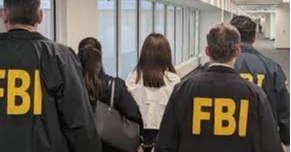
The FBI has arrested a California real estate agent as she was preparing to travel to China, accusing her of secretly working for Beijing to monitor the family of Taiwan’s president in the United States, federal officials said.
The case comes amid strained U.S.-China relations, with Taiwan remaining a major point of military and diplomatic tension between Washington and Beijing. China claims Taiwan as part of its territory.
Federal prosecutors and the FBI allege that Wanying Zhang monitored the home of the Taiwanese president’s son and provided a Chinese government official with photos, videos and license plate information from the vehicles used by the family member.
The federal criminal complaint does not identify the alleged target. However, the FBI’s rapid response account on X identified him as the president’s son. Ting-Yu Lai, the elder son of Taiwanese President Lai Ching-te, lives and works as an engineer in the Seattle area.
Zhang, 34, a naturalized U.S. citizen from Irvine who also uses the name Heather, was arrested Sunday at Los Angeles International Airport. She was charged with acting as an unregistered agent for China, First Assistant U.S. Attorney Bill Essayli said. Shawn Lewis, a spokesperson for the U.S. attorney’s office, confirmed her citizenship.
Zhang appeared in federal court in downtown Los Angeles Monday for an initial hearing to ensure she understood her rights. She has not been formally indicted.
Judge Steve Kim said Zhang did not qualify financially for a public defender and instructed her to obtain a private lawyer as soon as possible. A hearing on whether she should be released on bail or remain in custody was scheduled for Wednesday afternoon.
Her husband, Edric Ding, attended the hearing but declined to comment.
California records show Zhang has held a real estate license since 2016. According to a Zillow listing, she sold seven homes in Orange County over the past year.
Justice Department targets alleged Chinese agents
The case is the latest in a series of Justice Department prosecutions targeting alleged covert agents accused of advancing Beijing’s interests in the United States.
Many such cases have involved what the department describes as China’s efforts to identify and intimidate pro-democracy activists living in the U.S. and restrict their speech. The department has also accused Beijing of trying to influence American public opinion by developing relationships with political figures considered influential.
The Chinese Embassy in Washington did not immediately respond to a request for comment Monday, while China’s Foreign Ministry in Beijing was closed for holidays.
Taiwan’s Presidential Office confirmed that relatives of President Lai were targeted but did not specify whether the alleged target was his son. It described the incident as “a classic case of transnational repression.”
Taiwan strongly condemned the alleged surveillance, spokesperson Karen Kuo said, describing such actions as attempts to suppress, threaten or potentially harm people who support freedom and democracy and their families.
Surveillance allegedly took place in 2025
According to an affidavit accompanying the criminal complaint, Zhang and another person traveled to Seattle on Sept. 1, 2025, at the direction of Chinese officials and conducted surveillance outside the target’s home.
A nearby security camera reportedly captured the pair filming the target and family members from inside a vehicle.
Zhang allegedly later sent a Chinese official surveillance material, including photographs, videos and license plate information from the family’s vehicles. The affidavit said such information and the locations of close relatives of a senior Taiwanese official could potentially help China “obtain leverage” over President Lai during a possible conflict.
The affidavit also said Zhang attended Beijing’s University of International Relations, which the FBI agent who prepared the document described as having close ties to China’s intelligence apparatus. Many graduates reportedly go on to work for Chinese government ministries, including intelligence agencies.
Zhang and a former classmate who later became a Chinese government official reportedly remained in contact after graduating around 2014. The classmate introduced Zhang to another Chinese government official, and she was in contact with both officials in 2025, according to the affidavit.
In a Sept. 2, 2025, post on the Chinese-language social media app Xiaohongshu, Zhang complained about a lengthy security wait at Seattle airport and questioned whether it was the least efficient international airport in the United States.
She also frequently posted photographs of international trips and meals at expensive restaurants.
Tensions between Taiwan and China
Taiwan and China separated after a civil war in 1949, but Beijing continues to claim the island as its territory. Lai, who was elected president in 2024, has said Taiwan and China do not belong to each other and that the People’s Republic of China has no authority to represent Taiwan.
China considers Lai a separatist and has accused him of undermining peace.
Since taking office, Lai has increased Taiwan’s defense spending, including a pledge to raise it from 3% to 5% of gross domestic product. His government has also approved a special budget for developing a T-Dome air defense system.
The case follows another Southern California prosecution involving alleged Chinese influence. In May, Eileen Wang, the mayor of Arcadia, agreed to plead guilty to acting as an illegal agent for the Chinese government and resigned from her city position.
Wang was charged with acting in the United States as an illegal agent of a foreign government and accused of carrying out requests from Chinese officials, including sharing articles favorable to Beijing, without notifying the U.S. government as required by law.