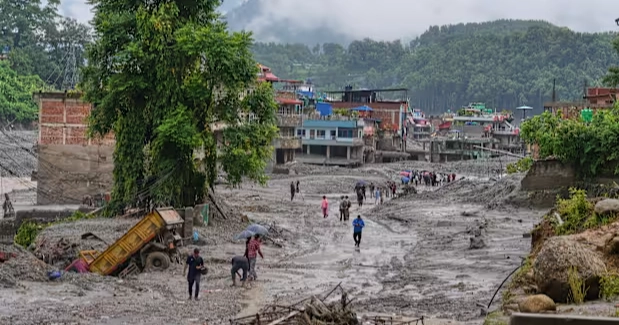
The death toll from devastating flash floods along the Nepal-China border has risen to 676, while nearly 3,000 people remain missing as rescue teams continue searching for survivors and evacuating people from the worst-hit areas.
Nepal’s disaster agency reported 669 deaths and 2,426 people missing in the country, while China has reported seven deaths and 554 people missing.
In Nuwakot, one of Nepal’s worst-affected districts, helicopters resumed rescue operations Saturday after bad weather temporarily disrupted aerial efforts.
Some helicopters carried relief supplies, including clothes, instant noodles, crackers and rice, to flood-hit communities, while others brought survivors to safety.
At relief centres, soldiers helped elderly people and carried babies who had been evacuated from the nearby community of Trishuli. Medical workers examined the survivors after their arrival.
While some residents were leaving Trishuli, others returned to their devastated homes to search for belongings they might be able to salvage.
One boy was seen carrying muddy sandals from his home, while resident Shoba Shretha returned to look for her dog, Sweetie, which she had been forced to leave behind when the flooding began.
In Kathmandu, relatives gathered outside the main government hospital, desperately searching for information about loved ones who remain missing.
Families moved between help desks and hospital notice boards, checking lists of injured people and putting up posters with photographs and contact numbers of missing relatives. Officials also displayed photographs of unidentified bodies in the hope that families or friends could recognize them.
Gajendra Rawat, a security official at the hospital help desk, said around 1,600 missing people had been registered there since the disaster.
“People are coming from all parts of Nepal,” he said.
At a relief centre in Nuwakot, military personnel posted lists of missing people on walls as families gathered to search for their relatives.
Rajesh Kumar Ram, who was looking for his son, said he remained hopeful that he might still be found alive.
“I’m hopeful, by chance, that my son is somewhere,” he said through tears. “Maybe they find him stuck somewhere. I’m waiting for that moment only.”
As the search continued, more people gathered at an army barracks seeking information about missing family members.
Priti Kharel was among them, holding a poster of her brother Milan Kharel, an engineering geologist working for Doosan Enerbility. His family has not heard from him since the floods.
Kharel said she believed her brother could be among those trapped inside a tunnel at a hydropower construction site, where rescuers have already recovered some survivors.
“We want the government to rescue him as soon as possible,” she said.
Search and rescue operations continued at several locations in Nepal and China’s Tibet, including the Upper Trishuli-1 Hydropower Project in Rasuwa district and the badly damaged Gyirong border crossing.
Nepali Army spokesperson Brig. Gen. Raja Ram Basnet said rescuers would continue operations at the hydropower project, where more than 100 people are believed to be trapped inside a tunnel filled with thick mud.
Rescuers have used ropes and baskets to reach some people, but the operation remains difficult because the tunnel is covered by up to 4 to 5 feet (1.2 to 1.5 metres) of mud and there are few suitable locations for helicopters to land.
Rescue teams have also been placed on alert over the possibility of another flood from a newly formed lake high in the Himalayas. The lake was created after a glacier collapse triggered Wednesday’s floods.
Chinese monitoring data showed the lake had shrunk by late Friday, with its water level falling about 10 metres (32 feet) from its peak on Thursday morning, according to state broadcaster CCTV.
On the Chinese side, rescuers reached the devastated Gyirong Port on Saturday by foot and raft, while some were lowered into the area from drones.
It remained unclear how many people were inside the border checkpoint building when the floods struck.
Nepal has so far rescued more than 3,700 people. Hundreds of those still missing are foreigners who were in the region for work, trekking or pilgrimage.
Nepalese Foreign Minister Shisir Khanal said the government had mobilised all available resources, with international support, for search, rescue, relief and recovery operations, particularly to locate those still missing.
“This is currently our national priority,” he told reporters Saturday.
He said rescue operations were particularly challenging because of the region’s steep mountains and narrow gorges.
Khanal said Nepal had requested specialised assistance from neighbouring countries for tunnel rescue, survivor-detection technology, rapid forensic and DNA analysis and morgue refrigeration facilities.
An 11-member tunnel rescue reconnaissance team from India has already been deployed, while a similar team from China is expected to arrive soon, he said.
Nepal has received more than 57 metric tons of relief supplies from India, with additional assistance coming from China, Japan, Australia and other countries, according to the minister.
Despite severe flood damage in four districts, Khanal said the rest of Nepal remained open and accessible to visitors.
“We welcome foreign nationals willing to visit Nepal,” he said.