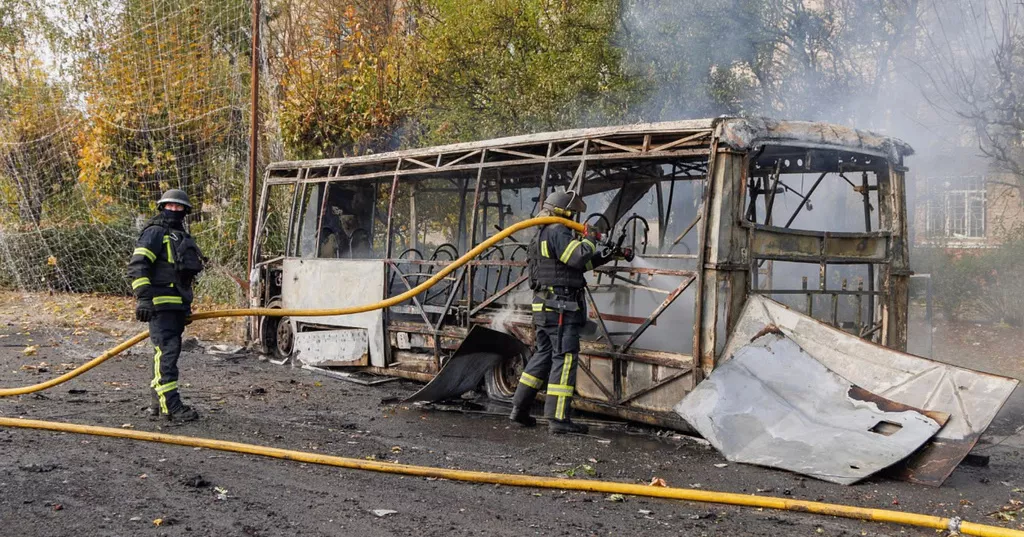
A Russian guided bomb exploded near public buses packed with passengers in eastern Ukraine, killing 30 people, authorities said Thursday, as a wave of Russian attacks also worsened power outages in the capital, Kyiv.
The morning strike hit near a bus stop in the war-ravaged city of Kramatorsk in the Donetsk region, prompting the suspension of public transport in the area.
“There is no doubt that Russia is cynically targeting civilians,” said Oleksandr Honcharenko, head of the city's military administration. He added that subsequent Russian attacks involving small drones hampered rescue operations.
Russia and Ukraine are engaged in a long-range aerial war, while their ground forces remain largely deadlocked along the front line, more than four and a half years after Moscow launched its full-scale invasion.
Russia has intensified its aerial attacks in recent weeks, putting further pressure on Ukraine ahead of winter and targeting infrastructure vital to its war-battered economy. Recent targets have included energy systems, major industries, railways, post offices, shopping centres, telecommunications networks, gas stations and grain exports.
Thursday's attack came a day after a Russian missile strike killed 22 people, including five children, in the northern Ukrainian town of Pryluky. Rescuers were searching through the rubble of a residential building, while at least 54 people were wounded.
Several survivors were sleeping in heavily damaged apartments because they had nowhere else to go.
Ukraine seeks more defence support from NATO
Ukrainian President Volodymyr Zelenskyy visited Pryluky on Thursday alongside visiting British Foreign Secretary Ed Miliband, who announced new sanctions against Russia.
Zelenskyy warned that Russia would likely intensify its daily missile and drone attacks as winter approaches and called on NATO countries to provide additional defence support.
“It is important that support in words takes concrete form in new packages for Ukraine's defense,” he wrote in an online post.
“Supplies of anti-ballistic capabilities, ammunition for our combat aircraft and investments in interceptors — all of this is directly helping save lives every day.”
In audio clips released in response to journalists' questions on Thursday evening, Zelenskyy said a Ukrainian delegation would meet representatives of US President Donald Trump, Jared Kushner and Steve Witkoff, in the United States for two days beginning Friday. The talks would focus, among other issues, on strengthening Ukraine's air defences.
Ukraine's energy company DTEK said national grid operator Ukrenergo had ordered emergency power cuts in Kyiv. During the emergency shutdowns, the regular scheduled rolling power outages imposed across the country would be suspended.
Authorities have urged families to prepare emergency kits, stock drinking water and maintain backup power supplies as Russia continues its intense attacks.
Kyiv police said bomb disposal experts had defused two unexploded ballistic missile warheads, each weighing about half a tonne, that landed near residential buildings.
Late Wednesday, Russian drones struck the city's Obolonskyi and Desnianskyi districts, killing four people and injuring 12 others, including four children, police said.
Ukrainian attacks damage data centre and oil refinery
Russian technology giant Yandex said one of its data centres in the western Ryazan region was damaged in a Ukrainian drone attack, forcing the facility offline.
Ukraine also said on Thursday that its forces had struck a major oil refinery complex in Salavat, about 1,200 kilometres (750 miles) east of Moscow.
Ukraine's General Staff described the complex as one of Russia's largest oil refining and petrochemical facilities. The claim could not be independently verified.
Ukrainian drones also reached Russia's Omsk region in western Siberia, more than 2,000 kilometres (1,242 miles) from the Ukrainian border.
Omsk regional Governor Vitaly Khotsenko said air defences had shot down most of the drones, but one “reached a northern industrial hub”. He provided no further details.
Russian independent news outlet Astra reported that the Omsk oil refinery was on fire following the attack, but there was no official confirmation.
Turkish Foreign Minister Hakan Fidan said his government had presented proposals to both Russia and Ukraine aimed at protecting civilian shipping in the Black Sea. He warned that escalating military offensives could disrupt commercial trade and grain exports.
Separately, Lithuania deployed around 100 additional soldiers to help secure its border with Russia's Kaliningrad exclave, the Baltic country's Defence Minister Robertas Kaunas said.
Located between Lithuania and Poland, Kaliningrad is separated from mainland Russia and remains a major security concern for NATO's eastern flank.