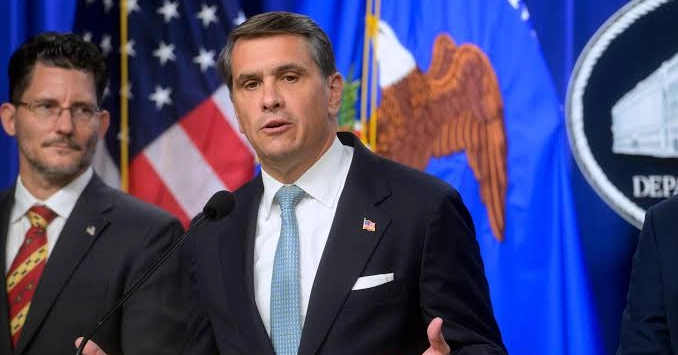
The US Senate early Saturday confirmed Todd Blanche as attorney general, giving President Donald Trump’s former personal lawyer full authority to lead the Justice Department.
The Republican-controlled Senate approved Blanche by a narrow 50-49 vote, making him the second confirmed attorney general since Trump returned to the White House last year.
Blanche had already been running the department in an acting capacity. His confirmation could now give him greater freedom to carry out the Trump administration’s agenda at the Justice Department.
“Deeply honored” by Trump’s trust, Blanche said on social media that he was grateful to senators who stayed late to complete the confirmation process.
His confirmation followed a difficult and divisive Senate battle, with both Democrats and some Republicans raising concerns about appointing a close Trump ally to lead an agency traditionally expected to operate independently of the White House.
Two Republicans — Senators Susan Collins of Maine and Lisa Murkowski of Alaska — joined all Democrats in opposing Blanche.
Dispute over controversial IRS settlement
Blanche’s confirmation faced an unusually difficult path, largely because of Republican concerns over a controversial settlement involving Trump and the Internal Revenue Service (IRS).
Under pressure from Republican senators, Blanche gave a written commitment that the Justice Department would drop Trump’s proposed $1.8 billion compensation fund for his allies, including people who attacked the US Capitol on Jan 6, 2021.
He also agreed to limit another part of the settlement that would have protected Trump and members of his family from IRS tax audits.
The commitments helped win the support of Republican Senator Bill Cassidy, whose vote proved crucial. Cassidy backed Blanche on Friday morning.
Cassidy said he believed Blanche was well positioned to run the department under Trump and argued that his previous experience as Trump’s criminal defense lawyer could help him resist presidential demands when they go beyond legal limits.
“This is not a referendum on President Trump. It is a decision regarding Mr. Blanche in very specific circumstances,” Cassidy said.
Senator Dick Durbin of Illinois, the top Democrat on the Senate Judiciary Committee, urged senators to reject Blanche, calling his confirmation a “serious mistake.”
Questions over Blanche’s loyalty to Trump
Blanche’s close relationship with Trump remained a major issue throughout the confirmation process.
Trump appointed Blanche as acting attorney general after firing Pam Bondi in April. Blanche quickly moved to advance Trump’s priorities, including investigations involving people viewed by Trump as political opponents.
The $1.8 billion “Anti-Weaponization Fund” became a major obstacle to his confirmation. The proposal was eventually withdrawn after Republican Senators John Cornyn of Texas and Thom Tillis of North Carolina pressured Blanche to abandon it.
The agreement allowed the Senate Judiciary Committee to move forward with his nomination earlier this week.
However, some Republicans remained opposed. Murkowski said Friday that she would vote against Blanche, arguing that the country needs an attorney general capable of checking what she called the administration’s “worst impulses.”
From federal prosecutor to Trump’s top legal defender
Blanche, a former federal prosecutor in New York, became widely known as one of Trump’s leading lawyers.
He represented Trump during the former president’s New York hush money trial and also defended him in two federal criminal cases brought by the Justice Department during the Biden administration.
Blanche has said those cases gave him firsthand experience of what he considers the misuse of the criminal justice system against Trump.
He joined the Justice Department last year as deputy attorney general under Bondi. He was responsible for much of the department’s day-to-day operations and became its public face on several high-profile issues, including the release of millions of investigative records linked to convicted sex offender Jeffrey Epstein.
Democrats have accused Blanche of putting his loyalty to Trump ahead of the department’s traditional independence. They have pointed to investigations targeting Trump critics, including former FBI Director James Comey, as well as major changes within the department.
Thousands of Justice Department employees have left through firings, resignations or voluntary departures since Trump returned to office.
Blanche’s supporters, however, say his background as a federal prosecutor and his close working relationship with Trump make him better positioned to explain the legal limits of presidential demands.
Republicans have also praised his record on fighting violent crime, illegal immigration, drug trafficking and violent cartels.
Senator Chuck Grassley, the Republican chairman of the Judiciary Committee, strongly backed Blanche, saying he had led the department effectively.
“Mr. Blanche is the right choice,” Grassley said.
Unclear whether Blanche can deliver Trump’s desired crackdown
It remains uncertain whether Blanche will be more successful than Bondi in carrying out Trump’s desire to pursue his political opponents.
Trump fired Bondi after she faced resistance from judges, grand juries and Justice Department employees as prosecutors pursued cases involving several of Trump’s perceived adversaries.
Soon after Blanche became acting attorney general, the Justice Department brought charges against former FBI Director Comey over a social media post featuring seashells arranged in a way that appeared to reference “86 47,” a phrase interpreted as a call to remove the 47th president.
Comey’s lawyers have asked a court to dismiss the case, accusing the Justice Department of misleading judges, filing documents containing false statements and withholding important information.
Blanche has also appointed Joseph diGenova, a former Reagan-era Justice Department prosecutor, to oversee an investigation in Florida into allegations that former law enforcement and intelligence officials worked together over the past decade to undermine Trump.
It remains unclear whether that investigation will lead to criminal charges.