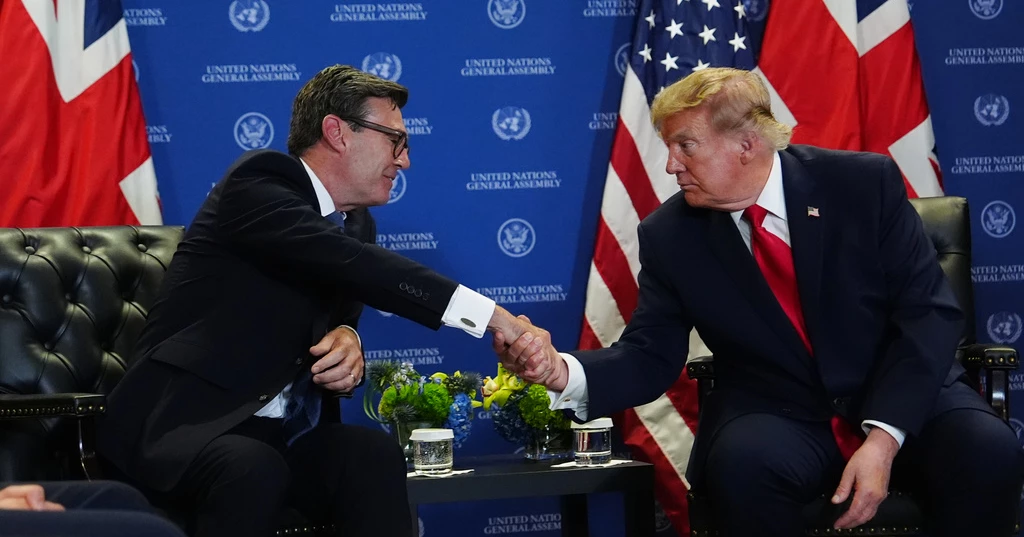
British Prime Minister Andy Burnham made a positive first impression on U.S. President Donald Trump at their first meeting on Tuesday, with Trump playing down differences over the Middle East and describing the new British leader as “a natural business person.”
The two leaders met for more than the scheduled 30 minutes on the sidelines of the U.N. General Assembly in New York, where Burnham, in his first address to the global gathering, warned about the dangers posed by unchecked artificial intelligence and socially damaging disinformation.
It was a baptism of fire for Burnham, who went from serving as mayor of Manchester in northwest England to leading a G7 country within weeks.
Despite British concerns about how the meeting would unfold, Trump said, as the two leaders sat before U.K. and U.S. flags, that trans-Atlantic relations were “more up than they were with your last prime minister.”
“Based on our relationship with the prime minister, Andy, I think we're doing very well,” Trump said.
British officials are aware that Trump can be unpredictable. He initially developed a warm relationship with Burnham's predecessor, Keir Starmer, before tensions emerged over Britain's refusal to join the U.S.-Israeli war on Iran. There was therefore relief among British officials that Burnham emerged largely unscathed from his first meeting with a president who had once dismissed him as “the mayor of a town.”
“We don't hold it against you,” Burnham said.
Burnham acknowledged differences between the U.S. and U.K., saying Trump had been “good enough to listen to us” on issues including trade and the Falkland Islands.
Trump has recently raised questions about the future of the British-controlled South Atlantic archipelago, which is also claimed by Argentina, where it is known as the Malvinas. Britain and Argentina fought a brief war over the islands in 1982.
On another potential source of tension, Britain's decision to ban trade with Israeli settlements in the West Bank, Trump said he was unaware of the issue.
Chagos Islands remain a point of contention
Trump's strongest criticism was directed at Britain's plan to transfer sovereignty of the Chagos Islands in the Indian Ocean to Mauritius.
The U.K. says the agreement would safeguard the future of the strategic U.S. military base on Diego Garcia, one of the islands. However, ratification of the deal has stalled after the Trump administration withdrew its support, and British officials acknowledge that the agreement is now in limbo.
Trump described it as “a terrible deal” involving “a very important piece of real estate, militarily and strategically.”
“I think the prime minister is going to be looking at it,” he said.
Burnham said Britain was working to reach an agreement and expressed confidence that it could do so with its U.S. partners.
Before the meeting, Burnham said he would discuss with Trump ways to end the on-and-off war between the U.S. and Iran, which has disrupted oil tanker traffic through the Strait of Hormuz and pushed global fuel prices higher.
Houthi attacks on Saudi energy infrastructure are adding to the problem, making Burnham's pledge to ease cost-of-living pressures for British voters more difficult.
As he traveled to New York for the annual gathering of world leaders, Burnham announced that he had authorized limited military support for Saudi Arabia to help repel attacks by Iran-backed Houthi rebels in Yemen.
He said a Royal Air Force plane would refuel Saudi jets involved in “defensive” operations to shoot down Houthi missiles.
Burnham also said he would urge Trump to increase U.S. support for Ukraine by providing air-defense missiles ahead of another winter of Russian attacks. It remained unclear whether he made progress on that issue.
Burnham focuses on AI in UN speech
In his address to the General Assembly, Burnham argued that Britain could play both a leading and cautionary role in the rapid development of artificial intelligence.
He said world leaders must heed warnings about AI and establish global standards to oversee the technology, because “fundamental decisions on this technology are too important to be left to chance.”
Burnham said AI has enormous potential but could also be “a source of disruption to the way we live and work – and a multiplier of risk.”
“We've all heard the warnings – which we must heed,” he said.
Burnham said the U.K. would seek to persuade other countries to adopt rules on transparency and access to AI models, while also pushing technology companies to sign up to such standards.
That could become another point of tension with Trump, who told the U.N. on Tuesday that the U.S. “totally rejects any attempt to construct a globalist scheme” to regulate AI.
Burnham also said Britain would “draw a line under the last decade” since the U.K.'s 2016 decision to leave the European Union.
He suggested that Brexit was a point when the country took a wrong turn, partly driven by misinformation.
Burnham said Russia and other states were using AI-enhanced misinformation and disinformation to undermine democracy. He said he had asked British security chiefs to establish a National Center for Information Defense to counter the threat.
“Over the last decade we have given too much ground to those who want to run a negative, corrosive narrative about life in Britain, which bears no resemblance to reality,” Burnham said. “Well, no more.”