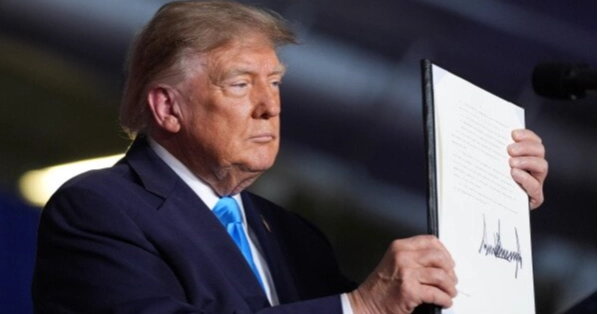
US President Donald Trump signed an executive order on Monday easing restrictions on the tax-free use of red-dyed diesel, saying the move would save farmers millions of dollars and help lower the prices of goods as Republicans face a tough midterm election campaign.
Trump signed the order during a rally in Grand Island, Nebraska, as part of his campaign to help Republican candidates ahead of the November 3 elections, now just four weeks away.
Addressing Republican Sen. Pete Ricketts and Gov. Jim Pillen, Trump said the move would strengthen their election prospects.
“Pete and Jim, this should absolutely ensure your election, I guarantee you that,” he said.
Diesel prices have surged following the war with Iran, increasing pressure on household budgets and creating challenges for Republicans ahead of the midterm elections.
Red-dyed diesel, intended for off-road uses such as farming, is exempt from federal and state excise taxes. The fuel is dyed to help law enforcement distinguish it from diesel used on public roads, according to a White House fact sheet.
The administration said temporarily easing restrictions would reduce costs for businesses that depend on diesel.
“The typical trucker will save more than $100 every time they fill up,” Trump said at the rally, adding that the order would save farmers millions of dollars and reduce the prices of goods.
However, Patrick De Haan of GasBuddy, a platform that tracks fuel prices, said last week that the proposed measure could save money for on-road users but would not benefit farmers, who already use red-dyed diesel.
“Taxes aren't the problem, supply is,” De Haan wrote on X.
Trump's Nebraska visit is part of what he described as a 32-day series of rallies ahead of the November 3 elections. His campaign has already taken him to Republican strongholds such as Oklahoma and Alabama. He is scheduled to visit San Antonio, Texas, on Wednesday for his second rally in the state within two weeks.
Republicans face voter frustration over rising costs
Republicans are facing growing dissatisfaction among voters over the administration's handling of the economy, particularly persistently high fuel and grocery prices.
The rising cost of living has become a major concern for rural voters who have supported Trump and his party in recent elections.
The administration's proposal to increase imports of foreign beef has also angered ranchers in Nebraska, a major agricultural state. Trump wants to lower beef prices for consumers, but ranchers argue that imported beef would hurt domestic producers.
“The plan to import low-quality foreign beef is not helping Nebraska ranchers,” Ricketts told The Associated Press.
He urged the White House to reconsider the policy and focus on long-term measures to expand cattle herds and eventually lower beef prices for consumers.
At the Grand Island rally, supporters said they trusted Trump to address the rising cost of living.
Marlene Abel of Garfield, Kansas, said she believed fuel and grocery prices would eventually decline if the situation in Iran was resolved and US reserves were rebuilt.
She expressed greater confidence in Trump than in any previous president.
David Kuncl, a Lincoln, Nebraska, resident who grew up on a farm, also said he expected conditions to improve over time.
He blamed what he described as a plot to undermine Trump and Republicans ahead of the midterm elections rather than the president's policies for the economic difficulties.
“It's hurting us. Gas prices. Diesel prices. Beef prices,” Kuncl said, adding that Trump could not immediately lower prices.
Democrats target competitive Nebraska House race
Republican Rep. Adrian Smith represents the Grand Island area in the House of Representatives, and his seat is not expected to be competitive.
However, a closely watched contest is taking place in Nebraska's 2nd Congressional District, centred on Omaha, which is often called the state's “blue dot” because it frequently votes Democratic in presidential elections.
Republican Brinker Harding and Democrat Denise Powell are competing for the seat being vacated by retiring Rep. Don Bacon.
The rally came as the Congressional Leadership Fund, a political action committee supporting Republican House candidates, cancelled $1.1 million in planned broadcast advertising for Harding's campaign, according to AdImpact, which tracks political advertising expenditure.
The decision could indicate that Republican leaders believe the money would be more useful in other competitive races. The group did not immediately respond to a request for comment.
Trump is also tentatively planning visits to other battleground states, including Michigan, North Carolina, Georgia, Ohio, Kansas, Montana, Pennsylvania, Alaska, Nevada and Arizona, before Election Day, according to a person familiar with the plans who spoke anonymously because they were not authorised to discuss them publicly. The person cautioned that the schedule could change.
Independent candidates complicate Senate races
Ricketts is seeking his first full six-year Senate term against independent candidate Dan Osborn, a former labour union leader who has received support from national Democrats.
Ricketts, a former Nebraska governor, was appointed to replace Sen. Ben Sasse after Sasse left the Senate in 2023 to lead the University of Florida. Ricketts later won election to complete the term.
Osborn previously challenged Republican Sen. Deb Fischer in 2024 but lost by seven percentage points. He has declined to say which party he would caucus with if elected in November.
Independent senators Angus King of Maine and Bernie Sanders of Vermont, however, work with Democrats for organisational purposes and committee assignments.
Osborn is among several independent candidates challenging Republicans in conservative states this year, where the Democratic Party remains unpopular.
In South Dakota, Brian Bengs is running as an independent against Republican Sen. Mike Rounds. Bengs previously ran as a Democrat in 2022 but lost heavily to John Thune, who is now the Senate majority leader.
In Idaho, independent Todd Achilles is challenging Republican Sen. Jim Risch.
Nebraska Democrats nominated Cindy Burbank, who campaigned on preventing Democratic votes from being diverted away from Osborn in the general election. She has since withdrawn from the race.
Osborn has travelled across Nebraska to hold meetings in all 93 counties and repeatedly criticised Ricketts for not holding town hall meetings with constituents.
Ricketts, whose family founded TD Ameritrade and owns Major League Baseball's Chicago Cubs, served as Nebraska governor from 2015 to 2023.
Vance campaigns for Republicans in Alaska
Meanwhile, Vice President JD Vance travelled to Fairbanks, Alaska, to campaign for Republican candidates, including Sen. Dan Sullivan, who is facing Democrat Mary Peltola in a closely watched race that could help determine control of the Senate.
Speaking to a crowd at the airport, Vance praised Sullivan, saying the two-term senator frequently contacted Cabinet members, even in the middle of the night, to advocate for Alaska's interests.
Vance criticised Peltola, who served in the House from late 2022 before losing her re-election bid in 2024, describing her as ineffective and calling her a “servant of the far left.”
Peltola has sought to distance herself from national Democrats and emphasise that she prioritises Alaska's interests. Alaska Democrats described Vance's visit to support Sullivan as an act of desperation.
Sullivan was at the White House last week when Trump announced that South Korea planned to invest around $54 billion in a natural gas project in Alaska.
However, South Korean officials adopted a more cautious position, saying they needed to assess the project's commercial viability before committing to the investment.
Vance also endorsed Republican Rep. Nick Begich, describing him as a hard worker.
Begich, first elected in 2024, is facing independent candidate Bill Hill, a commercial fisherman and former educator, as his main challenger.