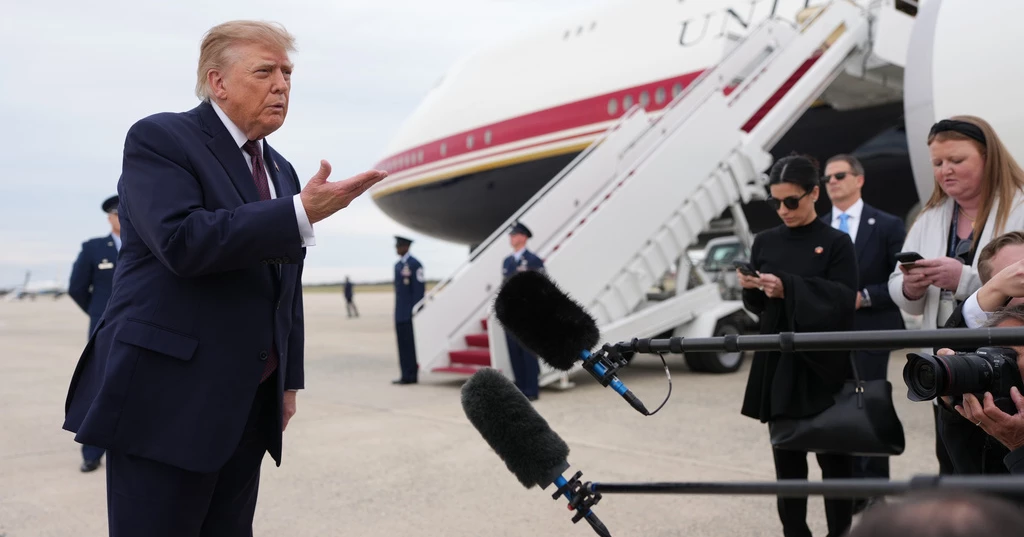
US officials have urged several Middle Eastern countries and regional allies to prepare for possible renewed military strikes against Iran after next week's US midterm elections, as well as potential Iranian retaliation against them, according to two diplomats briefed on the matter.
The diplomats spoke on condition of anonymity because they were not authorised to disclose the sensitive warnings conveyed by US diplomatic and defence officials.
They stressed that President Donald Trump has not made a final decision on whether to launch fresh strikes against Iran. However, Trump has repeatedly said he is considering renewed military action after the crucial November 3 elections in the United States.
The warnings and fresh US calls for regional allies to prepare for possible retaliation have heightened concerns that a return to major military operations could be imminent.
The White House and US officials declined to comment.
Iranian Foreign Minister Abbas Araghchi said in a post on X on Wednesday that Tehran was continuing to give diplomacy a chance and working with mediators to review proposals included in an initiative it floated last month.
Trump rejected the proposal outright, but Iran still wants it to serve as the basis for renewed efforts to restore a ceasefire.
Meanwhile, the United Arab Emirates' Foreign Ministry urged all parties to exercise restraint and pursue political solutions to contain tensions and prevent a return to full-scale military operations in the war that began in late February.
According to the two diplomats, the US has informed regional allies that any new military campaign could continue for several days. However, regional officials are preparing for the possibility that Iran and its proxy groups could retaliate, potentially prolonging the conflict.
US officials have also advised allies to take precautionary measures against possible Iranian attacks on energy facilities and other critical infrastructure.
US military readiness remains uncertain
It remains unclear how quickly the US military could resume strikes after Election Day.
Although Washington has not attacked Iran since early September, the regional situation has become increasingly complicated.
The conflict has expanded, with Iran-backed Houthi rebels launching attacks on Saudi Arabia's oil infrastructure and airports. A Saudi-led coalition has responded with deadly strikes on Houthi-controlled areas in Yemen.
The Wall Street Journal earlier reported that Gulf countries had been briefed about preparations for a possible escalation involving the United States.
Late last month, the Pentagon deployed the USS Theodore Roosevelt aircraft carrier, along with several amphibious landing ships carrying Marines, from San Diego to the Persian Gulf to reinforce the US military presence in the region. The deployment involved approximately 9,000 troops.
At the time, a US official said the move could result in an unusually large regional deployment of more than 20,000 sailors and Marines, alongside hundreds of aircraft. Such a concentration of US military forces has occurred only a handful of times over the past two decades.
In April, the US Navy had three carrier strike groups in the Middle East for the first time since 2003.
Trump, who has focused in recent weeks on campaigning for Republican candidates ahead of the November 3 elections, has remained vague about his next steps regarding Iran.
The war has become a major burden for Republican candidates as they seek support from voters increasingly frustrated by rising gasoline prices. The conflict has driven up costs across nearly every sector of the global economy.
The cost of the war to American taxpayers has risen to $47.1 billion, according to the latest estimate the Pentagon provided to Congress.
While campaigning for Republicans, Trump has repeatedly assured voters that the conflict is nearing an end, while also warning that another round of bombing could follow the elections.
During a campaign stop in Lubbock, Texas, on Tuesday, Trump suggested that a definitive end to the eight-month-old conflict could come within weeks.
"In a couple of weeks, if you don't mind," he said when discussing the possible end of the war.
Earlier in the same address, Trump said the conflict would end whenever he decided to end it, adding that the process could be swift but must ensure that Iran would never obtain a nuclear weapon.
Although Trump may be considering a post-election timeline for military action, concerns remain that Tehran could take provocative steps before then, particularly if it believes a US attack is imminent, said Jonathan Schanzer, executive director of the Foundation for Defense of Democracies, a Washington-based think tank known for its hawkish positions.
"Why would they wait until after the elections here ... if they could initiate it and potentially gain the upper hand?" he said.