
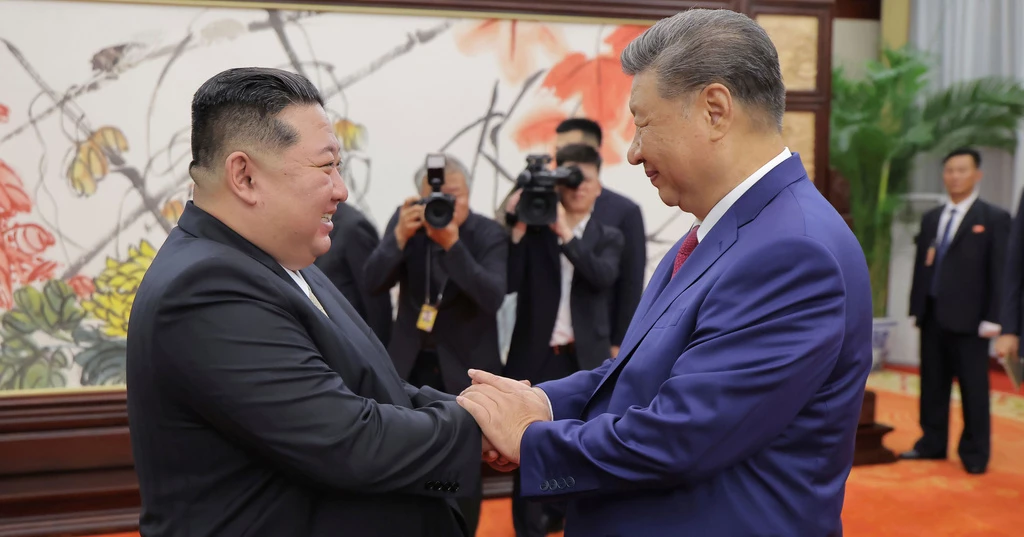
Chinese President Xi Jinping and North Korean leader Kim Jong Un pledged to strengthen bilateral cooperation during a summit in Pyongyang on Monday, as Xi made his first visit to North Korea in seven years amid shifting regional dynamics and growing competition with the United States.
Xi received an elaborate welcome upon arrival in the North Korean capital, where he and his wife, Peng Liyuan, were greeted by Kim and his wife, Ri Sol Ju. A large-scale ceremony later took place in Pyongyang’s main square, featuring military honors, thousands of spectators and displays highlighting the long-standing friendship between the two countries.
During their talks, Xi expressed China’s willingness to expand cooperation with North Korea in areas including trade, agriculture, construction and technology, according to Chinese state media. He also stressed the need for stronger strategic coordination and the protection of both countries’ sovereignty and security interests.
Kim described Xi’s visit as proof of the enduring strength of ties between the two neighbours and said advancing friendship with China remains a key strategic priority for North Korea.
The meeting comes at a time when both countries are navigating separate tensions with Washington. Analysts believe the summit could have broader implications for regional politics as Beijing seeks to reinforce its influence over Pyongyang.
Xi’s trip follows recent meetings with US President Donald Trump and Russian President Vladimir Putin. Observers say maintaining strong ties with North Korea could provide China with additional leverage in its dealings with the United States, particularly as Trump has repeatedly expressed interest in reviving diplomacy with Kim.
China remains North Korea’s largest economic partner and most important diplomatic ally. Although relations between Pyongyang and Beijing have faced questions in recent years due to North Korea’s growing military and economic cooperation with Russia, experts say Kim still relies heavily on Chinese support.
Analysts expect China to provide North Korea with economic assistance, including food and agricultural supplies, and possibly expand tourism and economic cooperation projects.
The issue of North Korea’s nuclear programme also remains central to the relationship. Experts suggest Xi is unlikely to publicly pressure Kim on denuclearisation, focusing instead on broader themes of peace and stability on the Korean Peninsula.
North Korea has continued to expand its nuclear and missile programmes. Last week, Kim unveiled a new facility for producing nuclear materials and pledged to accelerate the growth of the country’s nuclear forces. He has also called for speeding up efforts to develop a nuclear-armed navy.
South Korean President Lee Jae Myung said Monday that North Korea is producing enough nuclear materials each year for an estimated 10 to 20 nuclear weapons and is nearing completion of key intercontinental ballistic missile technologies.
Since the collapse of his diplomacy with Trump in 2019, Kim has focused on expanding and modernising North Korea’s nuclear arsenal. While expressing positive memories of his past interactions with Trump, Kim has repeatedly rejected calls for denuclearisation as a condition for renewed negotiations with the United States.