Arts-&-Culture
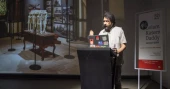
Drik hosts Golam Kasem Daddy Lecture 2026: Tanzim Wahab on our July Museum
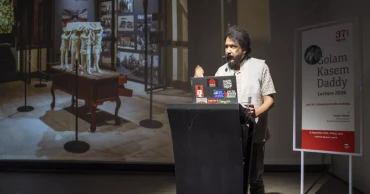
Drik Picture Library organised the Golam Kasem Daddy Lecture 2026 at DrikPath Bhaban in the capital earlier Friday evening, with Bangladesh National Museum Director General Tanzim Wahab delivering the lecture titled ‘July 36: A museum in the making’.
The lecture was organised as part of Drik’s 37th anniversary celebrations and focused on the transformation of the former prime minister’s residence, Ganabhaban, into the July Mass Uprising Memorial Museum.
At the beginning of the event, photographer, activist and Drik Managing Director Shahidul Alam paid tribute to Golam Kasem Daddy, highlighting his contribution to the history of photography in Bangladesh.
Shahidul said Drik has been organising the lecture series annually since 2009 as part of its anniversary celebrations to honour Daddy’s memory and legacy. He described Daddy as not only a pioneering photographer but also a writer and lifelong learner, recalling that he continued to embrace new technologies even at the age of 101.
1 day ago

‘Dhora Taru Kabyo’ at Chhayanaut: Tagore’s ode to nature gets new life in Pooja Sengupta's choreography
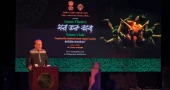
The Indira Gandhi Cultural Centre (IGCC) of the High Commission of India in Dhaka organised a special dance theatre performance, ‘Dhora Taru Kabyo - Nature’s Tale’, inspired by Kobi Guru Rabindranath Tagore’s celebrated poem ‘Brikkho Bondona’ (Ode to Trees), at the Chhayanaut Auditorium on Thursday.
Led by acclaimed dance exponent and choreographer Pooja Sengupta, Turongomi Repertory Dance Theatre presented the production, which explored the enduring relationship between nature, humanity and the environment through dance and theatre.
The event was attended by Cultural Affairs Minister Nitai Roy Chowdhury, senior officials of the Ministry of Culture and Ministry of Foreign Affairs, eminent personalities from the field of Rabindra Sangeet, renowned dancers, cultural enthusiasts, students and young professionals.
1 day ago
Stolen Renoir paintings worth millions could be nearly impossible to sell
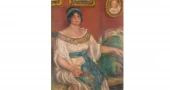
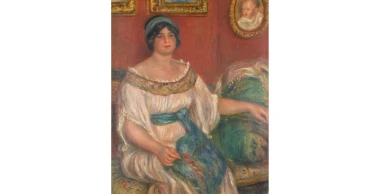
Two paintings by Pierre-Auguste Renoir stolen from a small museum in southern France remain missing, but experts say the thieves are unlikely to make much money from the high-profile artworks because selling them openly would be nearly impossible.
The paintings were among four Renoir works taken Tuesday from the Renoir Museum in Cagnes-sur-Mer, the last home of the French Impressionist painter on the French Riviera.
Cagnes-sur-Mer Mayor Bryan Masson said a group of “well-equipped” burglars carried out the theft. Two of the paintings — “Portrait of Madame Pichon” and “Coco Reading” — were abandoned in the museum garden as the thieves fled, according to prosecutors.
The two remaining works, “Portrait of Madame Colonna Romano” and “Young Woman at the Well,” are still missing.
Masson estimated the combined value of the four stolen paintings at 9 million euros ($10.5 million).
However, art crime experts say the thieves would struggle to find buyers willing to take the legal and financial risks associated with stolen artwork.
“People always think that there is this kind of ‘Dr. No’ type from the James Bond movie,” said Arthur Brand, a Netherlands-based private art detective who has investigated art crimes for about two decades. “But that’s Hollywood. In the real world, there are no collectors like that.”
Brand said stolen works, particularly famous paintings, often become virtually worthless once removed from their legitimate owners because “nobody will touch” them.
Erin Thompson, an art crime professor at John Jay College of Criminal Justice in New York, said the chances of the thieves profiting from the Renoir theft were “extremely low.”
She said criminals sometimes try other ways to benefit from stolen art, including demanding ransom or seeking insurance payments. But many museums do not insure their collections because of the high cost, making such schemes difficult.
If the works are not recovered or voluntarily returned, stolen paintings may remain hidden for years. In some cases, Thompson said, criminals may eventually destroy them to eliminate evidence.
Brand said he has encountered limited cases in which stolen paintings circulated in criminal networks, including being used as partial payment for illegal goods such as drugs.
He also noted that, depending on local laws, criminals have sometimes used the promise of returning stolen artwork to seek reduced sentences for other offences.
Christopher Marinello, a lawyer and founder of Art Recovery International, said stolen artworks can also become bargaining chips for criminals facing prosecution.
Paintings harder to profit from than jewels
Experts say stolen paintings are more difficult to monetize than valuable jewelry because they cannot easily be broken down and sold in pieces without losing most or all of their value.
Jewelry and other objects made of precious metals can potentially be melted down or dismantled and incorporated into new pieces, although experts warn that gems and other components can sometimes still be identified.
Paintings do not offer the same opportunity.
“It’s a canvas with some old oil paint on it,” said James Ratcliffe of the Art Loss Register. “You can’t touch it up. You can’t resell it other than for what it is.”
The comparison comes as museums around the world face continued theft risks. Last year, experts warned that jewels stolen during a high-profile heist at Paris’ Louvre Museum could potentially be dismantled and resold in different forms.
Apart from an emerald-set imperial crown recovered outside the Louvre on the day of the October 2025 robbery, the stolen jewels remain missing.
Security concerns at smaller museums
The Renoir theft is the latest in a series of high-profile art crimes involving museums and collections.
Earlier this year, three paintings by Renoir, Paul Cézanne and Henri Matisse, worth millions of euros, were stolen in Italy. They were recovered last month.
Ratcliffe said smaller museums can be particularly vulnerable because they often lack the resources to install sophisticated security systems. Historic buildings can also make it more difficult and expensive to introduce modern security measures.
Experts warn that such vulnerabilities could lead to more art thefts unless museums improve their security.
“We need to change the way we treat small and country house museums before we lose our cultural heritage permanently,” Marinello said, calling for stronger security and enforcement.
“We’re supposed to be preserving our cultural heritage, not allowing criminals to take what they want and using them as shopping malls,” he said.
2 days ago
Symphony of Life’: Shilpo Bangla’s 8th group art exhibition begins Thursday
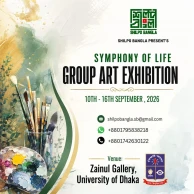
Shilpo Bangla is set to organise its 8th group art exhibition titled ‘Symphony of Life’ at Zainul Gallery of the Faculty of Fine Arts, Dhaka University, from September 10 to 16.
The exhibition will bring together 160 artists, presenting diverse artistic perspectives and visual expressions centred on different dimensions of life and society.
The opening ceremony will be held at 5 pm on Thursday at the Osman Jamal Auditorium of the Faculty of Fine Arts.
Eminent artist and Ekushey Padak-winning Professor Dr Abdus Sattar, honorary teacher of the Department of Oriental Art at the Faculty of Fine Arts, Dhaka University, will attend the opening ceremony as the chief guest.
Professor Kawsar Hasan Togor of the Department of Sculpture at the Faculty of Fine Arts, Channel i Chief Executive Producer Shanto Mahmud, and Associate Professor Habiba Akter Papia of the Department of Fashion Design at Shanto-Mariam University of Creative Technology will attend as special guests.
Professor Dr Azharul Islam Sheikh Chanchal, Dean of the Faculty of Fine Arts and Chairman of its Department of Ceramics, will preside over the ceremony.
According to the organisers, the exhibition has been conceived as a platform for artists to share their individual visions while contributing to a collective artistic experience.
Through their works, participating artists explore different dimensions of life and society, encouraging viewers to observe, reflect and engage with the stories embedded in the artworks.
Shilpo Bangla said it views art not only as an aesthetic experience but also as a means of connecting people, ideas and emotions. The exhibition aims to create an opportunity for audiences to experience the richness and diversity of visual art while providing artists with a platform to present their creative practices.
Minne Art Gallery and Mahfuz Canvas are supporting partners of the exhibition.
3 days ago
Ancient Rome's largest fresco and mosaic complex opens to public
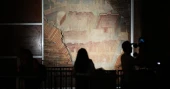
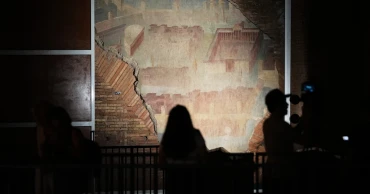
One of the largest known fresco and mosaic complexes from ancient Rome has been opened to the public for the first time, nearly three decades after its discovery beneath the remains of the Baths of Trajan.
Rome Mayor Roberto Gualtieri on Tuesday unveiled the recently restored “Painted City” fresco and “Great Mosaic,” which were found in an underground gallery during archaeological excavations in the 1990s on Oppio Hill near the Colosseum.
The fresco, dating to the first century AD, portrays a walled maritime city from an aerial perspective and is believed to be the largest surviving wall fresco of its kind from ancient Rome.
Its vivid blue and terracotta shades remain visible despite centuries underground, although the colours have faded over time.
Gualtieri described the works as exceptional both for their artistic value and their historical significance.
The cultural superintendent of Rome, Claudio Parisi Presicce, said the fresco is particularly well preserved, showing buildings, a theatre, temple, public squares and towers.
“We don’t know what city it refers to, but it must have been a particularly well-known one,” he said.
The restoration involved removing accumulated surface deposits, strengthening the mortar and using conservation techniques to improve the visibility of the decorated surfaces while protecting them from further deterioration.
The site is initially being opened under a limited trial programme, with groups of up to 15 visitors allowed in on weekends. Authorities will monitor the impact of increased humidity and other environmental conditions on the fragile artworks before expanding public access.
The accompanying mosaic stands about 15 metres high and contains elaborate columns, architectural features and human figures arranged across four levels.
The upper sections feature detailed figures and scenes resembling theatrical performances, while the lower portions provide an overhead view of the layout of a port city.
The Baths of Trajan were inaugurated by Emperor Trajan in 109 AD and covered around six hectares, making them the largest bathing complex in the ancient world at the time.
The vast complex incorporated an earlier bathing facility associated with the Domus Aurea. Its design was altered to make better use of varying water temperatures and enhance the bathing experience.
The area now accessible to visitors also includes a large semicircular upper-level structure believed by archaeologists to have served as a library.
The baths were not only a place for bathing and physical exercise but also provided space for cultural and intellectual activities.
3 days ago

Wildlife, biodiversity conservation take centre stage at soft launch of ‘The Bangladesh Sundarban’
The conservation of the Sundarbans and its rich natural heritage took centre stage at the soft launch of the second edition of Enayetullah Khan’s ‘The Bangladesh Sundarban’ at the Cosmos Centre Auditorium in the capital on Monday.
The event brought together conservationists, wildlife experts and photographers with Dr Yanan Wu, Chairman and CEO of Surfin Meta Digital Technology Pte. Ltd, a Singapore-headquartered financial technology solutions provider for the underserved, attending as the chief guest.
Published by WildTeam and supported by Surfin, the second edition of the book features two new chapters, adding to its documentation of the Sundarban’s wildlife, biodiversity, natural history and the lives and livelihoods of communities closely connected with the mangrove forest.
All proceeds from its sale will go towards tiger conservation.
The programme began with a short video showcasing the activities of WildTeam.
Enayetullah Khan, Founder of WildTeam, Prof Dr Md Anwarul Islam, CEO and General Secretary of WildTeam, renowned ornithologist, wildlife photographer and also Chairman of WildTeam Enam Ul Haque addressed the gathering before prominent global investment and fintech executive Dr Wu spoke as the chief guest.
Dr Wu said he was honoured to be associated with the project and described the conservation of the Sundarbans as a meaningful contribution to Bangladesh and humanity.
"It is my honour and privilege to be part of such a great project, such a meaningful contribution to our great nation, especially to a UNESCO World Heritage Site," he said.
5 days ago
Abdul Alim: The immortal voice of Bengal’s folk heritage
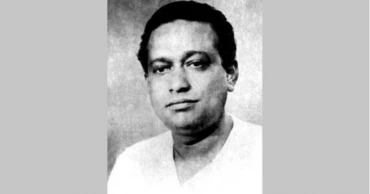
Few voices in the region's folk music have carried the soul of rural Bengal quite like Abdul Alim, whose deeply moving songs turned the experiences of ordinary people into an enduring musical legacy.
The legendary folk singer died on this day 52 years ago (September 5, 1974) at the erstwhile PG Hospital in Dhaka, aged 43. He has been dead longer than he lived, yet songs including 'Naiya Rey Nayer Badaam Tuila', 'Holudia Pakhi Shonar Boron', 'Porer Jaiga Porer Jomi' and 'Shorbonasha Padma Nodi' continue to resonate across generations.
Born on July 27, 1931, in Talibpur village of Murshidabad, Alim developed an interest in music during childhood. His first two recorded songs, 'Tor Mostafa-ke De Na Mago' and 'Aftab Ai Baslo Pate', were recorded in 1943, when he was only 12.
After Partition, he settled in Dhaka, where he became associated with radio and television while continuing his training under noted musicians including Ustad Mohammad Hossain Khasru and Momtaz Ali Khan.
Alim recorded more than 300 gramophone records and lent his voice to over 100 films. He was also among the singers associated with Mukh O Mukhosh, the first feature film produced in the then East Pakistan.
His repertoire covered diverse folk traditions, including bhatiali, murshidi, marfati, jari and sari. His distinctive voice and emotional delivery brought songs of love, separation, devotion, rivers and rural life to a much wider audience.
His reputation extended beyond Bengal. At the All Pakistan Music Conference in Lahore, he received five gold medals for his performances and contribution to music.
He received the Ekushey Padak posthumously in 1977 and the Independence Award in 1997. He also received the National Film Award for Best Male Playback Singer posthumously for his performance in Khan Ataur Rahman’s Sujan Sakhi.
Yet preserving his musical legacy remains a concern. His family has said that of more than 500 songs associated with him, only around 250 to 300 have been documented, while some recordings held in archives outside Bangladesh remain difficult to recover.
The preservation challenge makes Alim’s legacy more than a story of remembering a legendary singer. Every lost recording potentially means the loss of a unique musical interpretation and performance tradition.
Despite the gaps, his voice continues to live through younger performers, his children and cultural organisations working to preserve his repertoire.
More than five decades after his final journey, Abdul Alim’s songs are still travelling, keeping his unmistakable voice alive in Bangladesh’s musical heritage.
7 days ago

Ancient dragon boat racing finds new home in Xinjiang's desert region
In Yutian County, on the edge of the vast Taklamakan Desert in northwest China's Xinjiang Uygur Autonomous Region, water is scarce. But every summer, the sound of drums and paddles brings a small pond to life as local villagers take part in dragon boat races.
The ancient Chinese sport, traditionally associated with the rivers and lakes of southern China, has found an unlikely home in this dry inland region.
Teams race in long dragon-shaped boats, paddling in rhythm to the beat of a drum. Success depends not only on individual strength but also on teamwork and coordination.
For many local participants, dragon boat racing was a completely new experience.
“Most of us used to play football or basketball,” said 25-year-old participant Adiljan Abduegni. “Before trying dragon boats, we didn’t know how to row. Some people couldn’t even swim.”
Yutian County, far from China's major rivers and coastal areas, had little opportunity for water sports. That began to change in 2022 when local authorities launched the county's first annual summer dragon boat race.
Nearly 20 townships soon formed teams, with participants including farmers, taxi drivers and construction workers. In the early days, villagers even built their own boats and paddles, often in different shapes and sizes.
The races were held on a small fishpond, one of the few suitable venues in the area. Although the competitions were initially far from professional, they quickly became popular among both participants and spectators.
As interest grew, local authorities provided standard dragon boats and paddles, helping the sport become more organised.
Last year, more than a dozen paddlers from Yutian travelled to Miluo in central China's Hunan Province to compete in the national Dragon Boat Super League. Despite limited experience and less advanced equipment, the team gained valuable exposure by competing against stronger and more experienced crews.
Dragon boat racing has since continued to spread across Xinjiang. In areas without suitable waterways, organisers have introduced land-based events, while frozen lakes in northern Xinjiang have hosted winter races using specially modified boats fitted with blades and brakes.
The sport reached another milestone in August when dragon boat racing was included in the Xinjiang Ethnic Traditional Sports Games in Kashgar, where 12 teams from across the region took part.
Adiljan's team finished fourth in the 200-metre race, but he said winning was not the only goal.
“The result is not the most important thing,” he said. “One person may paddle fast, but cannot go far alone. Only when everyone works together can we move faster and farther.”
8 days ago
'Discovering A Doyenne': Documentary on writer Nahar Kamal Ahmed premieres in Dhaka
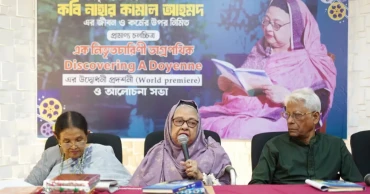
A documentary chronicling the life, literary journey and social engagement of veteran writer and social worker Nahar Kamal Ahmed premiered at Bishwa Sahitya Kendra in the capital on Thursday evening.
Titled 'Discovering A Doyenne', the 1-hour-42-minute documentary was directed by Dr Mahmud Nurul Momen. A new edition of Ahmed's book Ei Prithibi was also launched and unveiled at the event.
Prominent filmmaker Mosihuddin Shaker, director of the acclaimed film Surja Dighal Bari, attended the programme as chief guest, while Kamal Quadir, CEO of bKash, and mountaineer Nishat Mazumder, the first Bangladeshi woman to summit Mount Everest, attended as special guests.
Former Bangla Academy Director Rahima Akhter Kalpana conducted the programme.
9 days ago
'Poet of the soil' Al Mujahidi remembered at Bangla Academy seminar
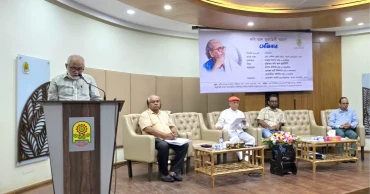
Noted poet Al Mujahidi was remembered at a seminar at the Bangla Academy on Wednesday, with speakers recalling his distinctive contribution to Bangla poetry and lifelong engagement with the soil, people and struggles of Bangladesh.
The Bangla Academy organised the seminar at 4pm at the Kobi Shamsur Rahman Seminar Room of the academy.
Bangla Academy Secretary Dr Md Selim Reza delivered the welcome address, while poet and essayist Dr Mahbub Hasan presented a paper titled ‘Mrittikar Kobi Al Mujahidi’.
National Press Club President and poet Hasan Hafiz and Dainik Jugantor Editor and poet Abdul Hai Shikder took part in the discussion. Bangla Academy Director General Professor Mohammad Azam chaired the event.
The programme began with a one-minute silence in memory of the late poet.
"Al Mujahidi is an unforgettable name in Bangla poetry. In his poems, the soil and people of this country have been illuminated with exceptional artistry," Dr Selim Reza said.
Presenting his paper, Dr Mahbub Hasan said, "One way to know Al Mujahidi is through his poetry. His inner world is reflected there, and we can experience its fragrance."
He said Al Mujahidi devoted himself to a long poetic journey through his works on Hiroshima and Nagasaki.
"It began in 1963 with ‘Kaado Hiroshima, Kaado Nagasaki’, written while he was imprisoned at Dhaka Central Jail," he said.
"From 1988 to 1999, he sharpened his pen to portray the brutality of imperialist destruction and crimes against humanity. This poetic journey proves how, with immense vitality, he used his sharp thoughts against the naked violence of human history," Dr Mahbub said.
Referring to Al Mujahidi’s widely recognised identity as the ‘poet of the soil’, Dr Mahbub said, "He created the soil in his poetry in many ways and in many forms. He felt a profound attraction towards that primordial soil from which this earth was formed, as well as towards the golden gateways of Gaur and the attics of civilisation."
"Although he sometimes spoke of living among heaps of stars, ultimately he spoke of returning to the soil," he added.
The discussants said Al Mujahidi was simultaneously a poet, translator, essayist, editor and intellectual fighter who gave Bangladesh and its people distinctive expression through his poetry.
They said he portrayed the fighting spirit and unique heritage of the people of this land throughout his literary career. As the literary editor of Dainik Ittefaq for many years, he also played a legendary role in nurturing and guiding many talented writers.
They further stated that the fearless fighter of the national liberation struggle consistently used his poetic voice to speak of peace, humanity, equality and a modernity rooted in the soil.
Poet’s daughter Paroma Al Mujahidi said, "My father always illuminated the country and its people through his poetry. Undoubtedly, his literary works will inspire the new generation in language, literature and patriotism."
Professor Mohammad Azam said, "Al Mujahidi was a unique personality in the field of poetry in Bangladesh. Alongside illuminating indigenous modernity in his poetry, he also explored foreign mythology for expressions of human fellowship."
"He left his distinctive mark through prose writings on poetry, translations of important poems from different languages into Bangla, and children’s literature," he said.
"His contribution to the history of literary magazine editing in this country can never be forgotten," Bangla Academy Director General added.
Sayera Habib, Bangla Academy Deputy Director, moderated the programme.
10 days ago