Campus
JUCSU holds job fair with over 700 jobs on offer
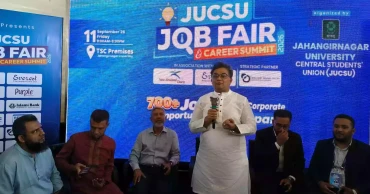
Jahangirnagar University Central Students’ Union (JUCSU) organised a day-long job fair and career summit on Friday to connect students with corporate employers and create employment opportunities for them.
‘JUCSU Job Fair and Career Summit 2026’ held at the university’s Central Sports Ground, with more than 25 leading corporate organisations taking part. The participating companies offered over 700 job opportunities, organisers said.
JU Vice Chancellor and JUCSU President Prof Dr Mohammad Kamrul Ahsan inaugurated the fair.
Speaking at the opening, Prof Ahsan said such initiatives would help students gain practical interview experience and build confidence while interacting directly with potential employers.
1 day ago
Experts, activists call to scrap law that criminalises attempted suicide
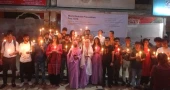
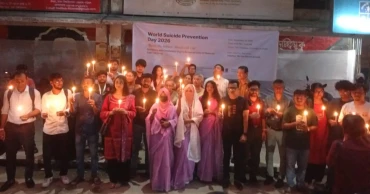
Mental health experts and activists on Thursday called for repealing a colonial era law that criminalises attempted suicide, at a gathering and candlelight vigil held at TSC, Dhaka University, to mark World Suicide Prevention Day.
The event, themed "Changing the Conversation, Strengthening Prevention, Saving Lives," was organised by the Innovation for Wellbeing Foundation (IWF), the Student Guidance Office of TSC, and the Nasirullah Psychotherapy Unit, Department of Clinical Psychology, Dhaka University.
Awareness, compassion: Two most important traits in suicide prevention
Citing police records, organisers said 76,361 people died by suicide in Bangladesh between 2020 and 2024, and 13,491 more between January and November 2025. Media-identified cases showed 513 students died by suicide in 2023, 310 in 2024, and 403 in 2025. At least 10 student suicides were reported nationwide after the 2026 SSC results were published on August 10, though organisers cautioned the media-based figure is incomplete.
Speakers repeatedly pointed to Section 309 of the Penal Code, 1860, which remains in force and punishes attempted suicide with up to a year's imprisonment, a fine, or both.
Kamal Uddin Ahmed Chowdhury, professor at Dhaka University's Department of Clinical Psychology, said the law criminalises people already in deep distress, and called for suicide-prevention centres in all 503 upazilas.
Imdadul Haque Talukdar, a public mental health specialist, also urged reform of the law, noting its colonial origin.
He cited WHO estimates that Bangladeshi households bear the large majority of health costs out of pocket, and pointed to New Zealand's "wellbeing budget" as a model for prioritising mental health spending.
Mahmuda Rahman Khan, chief operating officer of the Global Center of Excellence, described Suicide First Aid, an international training programme teaching laypeople to assess risk using a framework she called CPR, current plan, previous attempts, resources.
Drawing on her own experience with postpartum depression, she said people rarely announce suicidal intent directly but often signal it indirectly. "No one who attempts suicide truly wants to die," she said. "They cannot see a way out of the problem consuming them."
Organisers called on the government, institutions, health professionals, media and families to strengthen prevention strategies, support pathways, responsible reporting and open conversation, linking the effort to SDG target 3.4. The event ended with a candlelight vigil.
2 days ago
Teachers continue sit-in for day 4 demanding removal of Sylhet Agricultural University VC
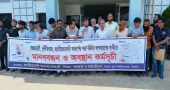
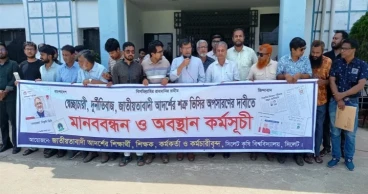
A section of teachers backed by BNP-backed “White Panel” at Sylhet Agricultural University continued their sit-in for the fourth consecutive day on Thursday, demanding the removal of Vice-Chancellor Prof Dr Alimul Islam over allegations of irregularities, autocratic conduct and corruption.
A section of university officials has also joined the protest programme.
The protesters locked the main gate of the university’s administrative building and staged a human chain and sit-in in front of it.
Leaders and activists of the university unit of Jatiyatabadi Chhatra Dal (JCD) also joined the protest.
Earlier on Monday, 11 teachers and officials including five teachers resigned from 11 administrative posts, alleging irregularities and corruption against the VC.
They also submitted a memorandum to the President seeking his removal.
Prof Mozammel Haque, general secretary of the university teachers’ association backed by the “White Panel” and a former proctor, said teachers and officials resigned from 11 administrative posts in protest against the VC’s irregularities and autocratic conduct.
The resigning officials included provosts of several residential halls and teachers and officials holding other important administrative positions.
The resigning teachers and officials alleged that irregularities occurred in development and construction works, procurement processes and teacher recruitment since the current administration took charge.
They said they decided to step down from their administrative responsibilities after their objections to the irregularities failed to bring any effective action.
They claimed that development and construction activities at the university largely remained stalled.
Although some development and repair works were carried out with funds from the revenue budget, the Public Procurement Rules (PPR) were not properly followed in some cases, they alleged.
They also alleged that repair work was carried out at the university auditorium before it was formally taken over by the university.
Questions have been raised over the necessity and implementation process of the work, they said, adding that proper tender procedures were not followed for some projects.
They said under government procurement rules, the lowest bidder should be awarded the work if the bidder meets the required qualifications and has submitted all necessary documents for the purchase of electronics and furniture.
But in several cases, the lowest bidders were excluded and the work was awarded to preferred individuals, they claimed.
They also alleged irregularities and favouritism in teacher recruitment.
They claimed that graduates of Sylhet Agricultural University were given comparatively less importance in the recent recruitment of eight teachers, while most of the positions were given to candidates from other universities.
Prof Md Kawser Hossain, a resigning provost, said, “It has become difficult to maintain an academic environment and discipline under the current administrative situation at the university. That is why we were forced to step down from our administrative responsibilities.”
However, Vice-Chancellor Prof Dr Alimul Islam rejected the allegations of the teachers and officials as baseless.
He said they sought release from their administrative posts and that their terms have already expired, adding that they no longer wanted to continue in those positions.
“There are many of teachers at the university who believe in nationalist ideology. Their resignations will not create any problem. Their main target is to remove me,” he said.
The VC further said, “The government appointed me. If the government asks me to leave, I will leave.”
Rejecting allegations of irregularities or corruption in teachers’ recruitment, he said only qualified candidates have been appointed to teaching positions.
“All those recruited have first-class academic records, and the appointments were made in accordance with the law,” he said.
2 days ago
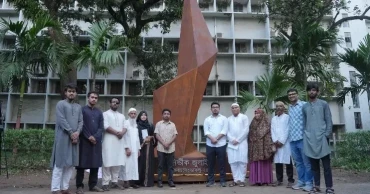
DUCSU accused of building ‘July Nirbhik’ memorial without proper clearances
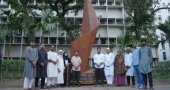
The Dhaka University Central Students’ Union (DUCSU) has been accused of constructing a permanent memorial titled ‘July Nirbhik’ (Fearless July) on the Dhaka University campus without obtaining written approval from the university authorities.
Officials of the university administration said DUCSU did not seek or obtain any written permission before constructing the structure while, while DUCSU are saying that the decision was taken at a meeting in the presence of the previous VC, Prof. Niaz Ahmed Khan.
According to university rules, permission from the administration is required for constructing any permanent structure on campus. The matter is then placed before the university’s Site Selection Committee, which examines the proposal and submits a report before any further decision is taken.
However, no such written approval was obtained by DUCSU for the construction of the ‘July Nirbhik’ memorial, university officials said.
The memorial, located beside the DUCSU building and Madhur Canteen, was inaugurated by DUCSU Vice-President Sadik Kayem on September 2 in the presence of families of several victims of the July Uprising. Its foundation stone had earlier been laid on August 5 in the presence of family members of 50 martyrs and injured participants of the movement.
VC: DUCSU did not obtain approval
Dhaka University Vice-Chancellor Professor A B M Obaidul Islam said DUCSU did not obtain approval from the university administration before constructing the memorial.
He said the university has a specific procedure for constructing any structure inside the campus.
“According to the university’s rules, anyone seeking to construct a structure inside the campus must first apply to the university administration. Then a meeting of the Site Selection Committee is held, and subsequent decisions are taken based on the committee’s report,” the Vice-Chancellor said.
“But DUCSU did not obtain any approval for constructing this structure. On August 5, when we inaugurated our July Memorial, we held an emergency meeting of the Site Selection Committee,” he added.
“Besides, I instructed the proctor to take necessary measures in this regard. The matter will be addressed in consultation with the proctor,” he said.
DUCSU's explanation
DUCSU, however, rejected the allegation that it had proceeded without the university authorities’ consent.
DUCSU General Secretary S M Farhad said the decision to construct the memorial had been taken at an EC meeting of DUCSU in the presence of the the previous VC, Prof. Niaz Ahmed Khan, who was in the post from August 2024 to February 2026.
“The issue of permission applies to student organizations or third parties who are not primary stakeholders or decision-makers of the university. When they undertake something, the question of permission arises as a matter of procedure,” Farhad said.
He argued that the Vice-Chancellor is the university’s highest decision-making authority and also serves as the president of DUCSU.
“The Vice-Chancellor is the head of the university’s decision-making process and is also the president of DUCSU. When the Vice-Chancellor is present, constitutionally serves as its head, and is informed about all the decisions, it is difficult to understand whether there is any authority above the Vice-Chancellor whose permission would still be required after his knowledge and consent,” he said.
Farhad said the then Vice-Chancellor had been present throughout the decision-making process, from the initial planning to the adoption of the plan.
He also said the project was later placed on the agenda of a DUCSU Executive Committee meeting during its implementation.
“Even then, the current Vice-Chancellor, Prof. ABM Obaidul Islam, did not express any negative concern regarding the discussion, review or decision. Not raising any objection means that he agreed with the decision-making process and the earlier steps,” Farhad said.
“Therefore, if someone expresses a different opinion after the project has been implemented, that would not be the proper process. Rather, the Vice-Chancellor’s decision, consent to the implementation and cooperation should be considered the university’s final decision,” he added.
University’s separate July Memorial initiative
Meanwhile, the Dhaka University administration has separately undertaken an initiative to construct a ‘July Smriti Stambha’ (July Memorial) on campus to commemorate those who were killed during the July mass uprising. A committee was formed in July to oversee the project, and the foundation stone of the proposed memorial was laid at Mal Chattar on August 5.
The DUCSU-initiated ‘July Nirbhik’ memorial is a separate structure from the university administration’s proposed memorial.
3 days ago
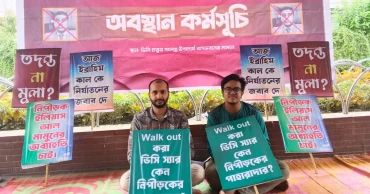
Students demand provost’s resignation, probe report over alleged harassment
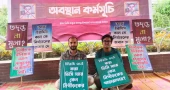
A student of Dhaka University, who alleged that he was subjected to intimidation and harassment by the provost of Fazlul Huq Muslim Hall, has been staging a sit-in for the past three days in front of the vice-chancellor’s office, demanding the provost’s resignation and immediate disclosure of an investigation report into the incident.
The victim, Md Ibrahim, a student of the Department of Robotics and Mechatronics Engineering from the 2020-21 academic session, had made a Facebook post criticizing Fazlul Huq Muslim Hall Provost and Professor of the Department of Pharmaceutical Technology Dr Md Elias Al-Mamun, highlighting various problems at the hall.
According to Ibrahim, the provost summoned him to his office on August 16 over the post, where he was allegedly subjected to mental harassment, intimidation and threats of being sued under a cybercrime case for around one and a half hours in a closed room.
Ibrahim also alleged that the provost and hall staff forcibly checked his mobile phone and made him sign a document against his will.
Following the incident, students of the hall launched protests demanding the provost’s resignation and locked the hall office indefinitely.
The university authorities subsequently formed an investigation committee, headed by University Proctor Md Israfil PK (Israfil Ratan), to look into the allegations.
“I have been staging a sit-in for the last three days, but no responsible official has come here yet. The university administration is sheltering the provost,” Ibrahim said.
“Although an investigation committee has been formed, they are trying to divert the issue by delaying the investigation. They were supposed to submit the report much earlier, but they have repeatedly delayed it, pushing the deadline from one day to the next,” he added.
Ibrahim said he would continue the sit-in until justice was served.
Asked about the investigation report, committee convener Israfil Ratan gave a noncommittal response, saying, “It could be released at any time. It could be disclosed today. It could be disclosed tomorrow.”
6 days ago
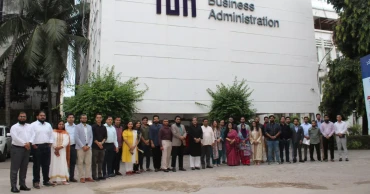
Orientation held for 44th batch of Executive MBA at DU IBA
The orientation program for the 44th batch of the Executive Master of Business Administration (Executive MBA) program at the Institute of Business Administration (IBA), University of Dhaka, was held on Saturday.
The program began at 5pm at the IBA. Professor Dr. Abu Yousuf Mohammed Abdullah, Director of IBA, presided over the event while Professor Dr. Md. Iftekharul Amin, Coordinator of the Executive MBA program, delivered the welcome address.
A total of 389 candidates applied for admission to the 44th batch of the Executive MBA program. Following the completion of the prescribed admission process, including a written examination and viva voce, 39 students were finally selected for admission to the program.
At the beginning of the program, the students of the 44th batch introduced themselves. A student from the 43rd batch of the Executive MBA program then shared their experience with the new students.
Later, Professor Dr. Md. Mohiuddin, Coordinator of IBA’s Research Program, briefed the students on the rules, regulations and academic requirements of the Executive MBA program.
Professor Abu Yusuf Md. Abdullah subsequently addressed the students.
Regular classes began at 6:45pm following the conclusion of the orientation program.
7 days ago
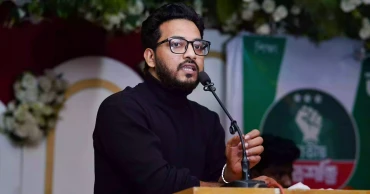
JU student Ahsan Labib made acting president of Jatiya Chhatra Shakti
Jahangirnagar University (JU) student and senior vice president of Jatiya Chhatra Shakti Ahsan Labib has been named acting president of the organisation, following the sudden resignation of its central president Zahid Ahsan.
Zahid resigned citing personal reasons, said a statement signed by the organisation’s Office Secretary Mahfuzur Rahman on Wednesday night.
According to the statement, Zahid announced his resignation at the organisation’s fifth general meeting. Later, the members present at the meeting unanimously decided to assign the acting presidency to Labib, the organisation’s senior vice president.
Speaking after taking charge, Labib said he received the responsibility to ensure continuity in the organisation’s activities following Zahid’s resignation.
“We will announce a new full-fledged committee through a council following a democratic process very soon,” he added.
Labib is a student of the Department of Biotechnology and Genetic Engineering at JU. He previously served as a coordinator of the JU unit of the Anti-Discrimination Students’ Movement.
He also serves as the Social Welfare Secretary of the Jahangirnagar University Central Students’ Union (JUCSU) and an elected student representative to the JU Senate.
10 days ago
JU hall playground renovation resumes defying admin order
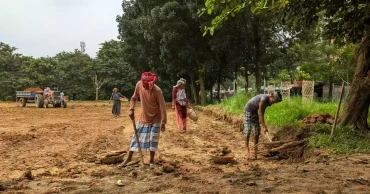
Renovation work on the playground adjacent to Bishwakabi Rabindranath Tagore Hall at Jahangirnagar University (JU) resumed on Friday despite an administrative order to suspend the work pending an investigation into alleged irregularities.
University security officials faced resistance from some students when they went to the site to stop the work. Later, an assistant proctor also visited the spot but failed to halt the renovation.
The contractor resumed the work on Friday. After receiving information, university security officials went to the playground and tried to stop the work, but some students present there prevented them from doing so.
An argument also broke out between the security officials and the students during the incident.
15 days ago
BUET to face 5 hours of scheduled load shedding amid energy crisis
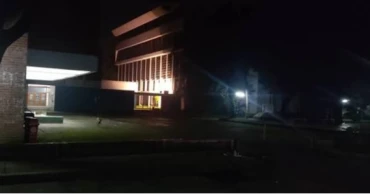
Bangladesh University of Engineering and Technology (BUET), the country’s premier engineering university, will face five hours of scheduled load shedding every day amid the ongoing energy crisis.
According to a notice issued by the BUET Chief Engineer’s Office, Dhaka Power Distribution Company Ltd (DPDC) has informed the university of the load-shedding schedule due to a shortage of electricity supply.
The notice lists five separate one-hour power cuts, from 6:00–7:00am, 10:00–11:00am, 2:00–3:00pm, 12:00–1:00am and 3:00–4:00am.
The university authorities said that due to extremely low gas pressure during the daytime, it may not always be possible to ensure electricity supply through BUET’s own generators during the load-shedding periods.
They sought cooperation from all concerned in dealing with the situation.
Bangladesh continues to grapple with an energy crisis that has affected electricity generation and resulted in increased load shedding across the country.
20 days ago
DU female students demand complete abolition of ‘evening curfew’
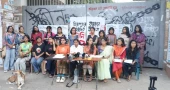
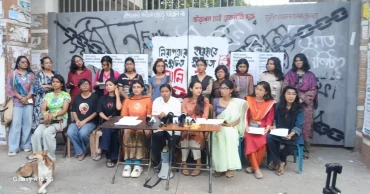
Dhaka University's female students, who now comprise a majority of the student body, have once again demanded the complete abolition of the ‘evening curfew’ imposed in their residential halls, rejecting a proposal to relax the restriction by an hour.
At a press conference in front of Rokeya Hall on Thursday afternoon, students under the banner of ‘Oborodhbasini’ said ensuring the safety of female students is the responsibility of the university administration, but doing so by restricting their movement in the name of security is not a solution.
'Evening curfew' at DU women's halls: Provost Standing Committee recommends 1-hour extension
The students have been protesting for the past several days under the banner of ‘Oborodhbasini’, demanding the withdrawal of the ‘evening curfew’ in female halls and unrestricted access to the halls 24 hours a day.
They have been carrying out a continuous movement with three demands since July 30. As part of the campaign, they have distributed leaflets, put up posters, held processions and organised signature campaigns among female students.
Their demands include the immediate abolition of the existing “discriminatory evening curfew” from 10pm to 6am in female residential halls and ensuring the overall security of female students while allowing them to move freely 24 hours a day; allowing female students to enter any female residential hall by showing a valid identity card and stay there overnight with proper permission; and ensuring female students have the right to allow their female relatives to enter the halls.
At the press conference, Shamsun Nahar Hall student Ishrat Jahan Imu said more than 1,200 female students submitted a memorandum to the Vice-Chancellor on August 9 with their signatures. On August 10, they also issued a specific ultimatum to the administration through a solidarity rally demanding the abolition of the evening curfew.
However, she said, the administration ignored all their demands and instead proposed relaxing the curfew by only one hour. According to the students, such a proposal undermines the civil and fundamental rights of female students, and there is no scope for compromise with the administration on the issue.
Earlier, a meeting of the Provost Standing Committee proposed extending the entry time for female students by one hour on Wednesday. The proposal is still slated to be placed before the university’s Syndicate meeting.
According to the students, if a female student needs to go out at night or return late to the hall for an emergency or academic research, she is required to submit a written undertaking to the administration. The undertaking states ominously that the university or hall administration will not be responsible for the student’s safety.
They described the absence of such conditions for male students at the same university as “extreme discrimination.”
The students said their programmes would continue until the discriminatory evening curfew is completely abolished and female students are guaranteed unrestricted movement and security at every part of the campus 24 hours a day. They said various hall-based programmes, including sit-ins and street meetings, would be organised as part of the movement.
Under the existing rules, female students at the University of Dhaka are not allowed to enter or leave their residential halls between 10pm and 6am. If they need to go out or return late, they are required to obtain prior permission through a late pass from the house tutors, which is not always possible. In emergencies, the hall authorities contact the students’ local guardians before allowing them to leave.
23 days ago