Wahiduddin Mahmud
Banking sector destroyed by culture of default and loot: Wahiduddin Mahmud
One of the country's most renowned economists, Wahiduddin Mahmud, who was also an adviser to the interim government, has said that Bangladesh's banking sector was initially crippled by a culture of default loans, which later evolved into a destructive "bank looting culture" following 2010, ultimately plunging the financial sector into its current crisis.
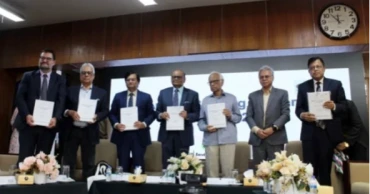
He made the remarks on Wednesday while speaking as the chief guest at the inaugural session of the two-day annual banking conference organized by the Bangladesh Institute of Bank Management (BIBM) at its Mirpur campus in the capital.
Reflecting on his past experiences with banking sector reforms, Mahmud noted that restoring discipline previously required stringent regulations and hard work, which successfully elevated several private banks to international standards.
However, the subsequent era of "bank looting" bypassed all rules and regulations, allowing individuals to siphon money straight out of banks unchecked.
Urging stakeholders to learn from past mistakes, Mahmud pointed out that inadequate regulatory frameworks during the initial authorization of private banks in the past allowed entrepreneur-directors to siphon off nearly one-third (equivalent to 35 percent) of total deposits as loans.
He further emphasized the need for "antitrust" or anti-monopoly legislation to regulate whether a single group or family should be permitted to control multiple banks, noting that Bangladesh still lacks such a legal framework.
Criticizing political patronage, Mahmud observed that politically influential figures have consistently used state-owned banks to distribute undue favors.
He stated that if political administrations wish to dispense political favors, they should choose sectors that do not inflict major damage on the national economy, stressing that utilizing the financial sector for political patronage is entirely inappropriate and a reality political leaders must recognize, as central bankers alone cannot stop it.
Attributing the collapse of several banks to the indiscriminate approval of new banks without proper scrutiny after 2010, Mahmud highlighted the plight of vulnerable depositors. He noted that bankrupt banks had accepted deposits from government entities—including teachers' salaries, welfare, and pension funds—resulting in millions of takas belonging to impoverished MPO-registered teachers remaining trapped.
Describing the extreme relaxation of banking regulations over the past 15 years as a primary driver of the current distress, Mahmud cautioned that while regulations may temporarily need to be eased to rescue weak banks, there is currently no guarantee against repeating past mistakes.
Outlining a path forward, Mahmud stressed that banks must be given the opportunity to stand on their own feet while maintaining adequate safeguards. He called for thorough vetting to ensure that funds reach honest, genuine entrepreneurs and business operators, warning that failure to secure this mechanism will cause the sector to regress into past pitfalls.
The event was also addressed by Bangladesh Bank Deputy Governor Md. Kabir Ahmed, Bangladesh Association of Banks (BAB) Chairman and Dhaka Bank Chairman Abdul Hai Sarker, World Bank Country Director for Bangladesh and Bhutan Abdoulaye Seck, and Association of Bankers, Bangladesh (ABB) Chairman and City Bank Managing Director and CEO Mashrur Arefin. The keynote paper was presented by Policy Research Institute (PRI) Chairman Dr. Zaidi Sattar.
2 hours ago

EFT system eliminates inconvenience of MPO-enlisted teachers: Education Adviser
Education Adviser Prof. Wahiduddin Mahmud has said that the long-standing hassle and inconvenience faced by MPO-enlisted teachers and employees of private educational institutions under the Directorate of Secondary and Higher Education have been resolved.
"This has been achieved through the introduction of the Electronic Fund Transfer (EFT) system, which directly transfers salaries, retirement and welfare benefits to their bank accounts," he said.
The adviser was speaking today at an event organised by the Directorate of Secondary and Higher Education at the International Mother Language Institute in Dhaka.
Dhaka's ties with Delhi won’t get stuck on single issue: Foreign Adviser
Earlier, he inaugurated the online EFT-based transfer of MPO funds for teachers and staff.
He also unveiled the online version of textbooks for the 2025 academic year on the NCTB website.
The Education Adviser said, "Out of 523 books, we had to make corrections and additions to 431. Additionally, this year we opted to print the books domestically instead of outsourcing them abroad. As a result, it took some additional time."
“We hope to ensure that all educational institutions receive the books within January,” he said.
Bilquis Jahan Rimi, Additional Secretary, Budget-1 and National Programme Director of the Strengthening Public Financial Management Programme to Enable Service Delivery (SPFMS), made a presentation of EFT, while the session was presided over by Professor A B M Rezaul Karim, Director General of DSHE.
"This initiative will eliminate delays, save time, and ensure financial transparency and accountability in the payment process," Bilquis Jahan Rimi said.
Education Adviser warns of conspiracies in textbook distribution
Future plans include integrating iBAS++ with the Madrasa and Technical Education Directorates and creating Personal Ledger (PL) accounts for public universities to facilitate salary payments via the EFT system.
For the 2024-25 fiscal year, a budget allocation of TK 13,495.16 crore has been made for the Directorate of Secondary and Higher Education. Of this, TK 4,329.97 crore has been allocated for private colleges and BDT 9,165.19 crore for schools.
Additionally, TK 5,073.58 crore and TK 450 crore have been allocated to the Madrasa Education Directorate and the Technical Education Directorate, respectively.
Currently, there are 19,847 MPO-listed institutions in the country, with a total of 398,068 MPO-listed teachers and staff. These include: 2,828 colleges with 68,949 MPO-listed teachers and 28,257 staff; 17,478 schools with 211,443 MPO-listed teachers and 89,419 staff; 8,229 madrasas with 138,559 MPO-listed teachers and 42,134 staff; and 2,282 technical education institutions with 16,557 MPO-listed teachers and 5,564 staff.
1 year ago

Bangladesh to see political govt next year: Wahiduddin Mahmud
The people of the country will see a political government next year, Planning and Finance Adviser Dr Wahiduddin Mahmud has said.
"Personally, I believe we will see an elected government next year," he said while speaking at the opening session of the Annual BIDS Conference on Development (ABCD) at a hotel in the capital on Saturday.
Bangladesh "unfairly portrayed" in int'l media, parliamentary hearings in influential nations: CA's Press Secretary
The Bangladesh Institute of Development Studies (BIDS) organised the event.
Dr Mahmud, however, pointed out that income inequality remains one of the country’s most pressing concerns. "To tackle this disparity, quality education is paramount, an area where Bangladesh still has a long way to go," he said.
Diplomats of 27 European countries to meet CA Dec 9
As Bangladesh transitions from its status as a Least Developed Country (LDC), Dr Mahmud referred to the ongoing efforts to retain some benefits associated with the LDC status.
“We no longer have the option of remaining an LDC. Discussions to sustain certain privileges from developed nations are ongoing, with positive responses from many,” the adviser said.
Homeless protesters block highway in Natore alleging corruption in housing allocation
In a separate session, Indermit S Gill, Chief Economist at the World Bank, provided insights into how Bangladesh could escape the middle-income trap.
Investment and job creation should be the focal points, he stated, urging the country to foster entrepreneurship and expand the use of technology.
1 year ago

Govt to assess vehicle fleet to curb wastage: Wahiduddin Mahmud
The government has decided to carry out an assessment of its fleet of vehicles to determine the exact number it owns and the current condition of those vehicles.
The decision was made at the ECNEC meeting held at the Chief Adviser’s Office, presided over by Chief Adviser Prof Muhammad Yunus.While briefing reporters at the NEC Conference Room about the outcome of the meeting, Planning Adviser Dr Wahiduddin Mahmud said that the government possesses a large number of vehicles, with each project having its own fleet.
Family planning, not microcredit, drove women’s workforce participation in the 1980s: Adviser Wahiduddin
"Where do these vehicles go after a project is completed?" he questioned.Mahmud mentioned that many vehicles remain unused after the projects end."Often, other ministries take over these vehicles and it is not uncommon for a single public servant to hold 3-4 vehicles under his or her jurisdiction," he said.
Employment generation takes priority over GDP growth: Planning Adviser Wahiduddin
The adviser added that these vehicles do not last as long as those procured personally.“But since they belong to the government, their longevity is not like that of personal vehicles, which is another issue,” he mentioned.The advisers have decided to start identifying all government vehicles, starting from the upazila level, to understand their current usage and lifespan. “We will look into how these vehicles are being used and how long they last,” he stated.Prof Wahiduddin Mahmud said that the government aims to utilise these vehicles in other government offices to reduce public expenditure.
2 years ago

Economist Wahiduddin Mahmud criticizes proposed budget
Renowned economist Professor Wahiduddin Mahmud said it is ridiculous that the low-income people have been kept under income tax in black and white avoiding any effective measures to tackle the tax dodging of tens of thousands of middle class and rich people and stop the corruption of the tax administration.
At first, the government has to separate the amount of zero tax and minimum income amount of tax to fix the rate of income tax.
Professor Wahiduddin Mahmud made his post-budget reaction on a Facebook post on Friday.
Also Read: Budget: Dr Atiur for reconsidering some tax proposals
He wrote, “In the proposed budget, tax-free lowest income has been proposed unchanged at Tk 3 lakh despite a skyrocket of the daily necessaries.”
Finance Minister AHM Mustafa Kamal on Thursday unveiled the Tk 678,064-crore national budget for the financial year 2022-2023 with a special focus on economic recovery from uncertainties caused by Covid-19 pandemic and the Russia-Ukraine war.
4 years ago