east coast
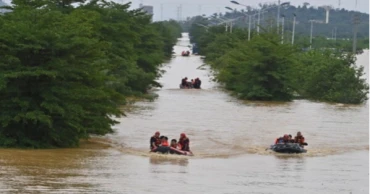
Floods in southern China kill 39 as another typhoon heads toward east coast
Flooding caused by days of heavy rain in southern China has killed at least 39 people, authorities said Thursday, as another powerful storm approaches the country's eastern coast and Taiwan.
Most of the deaths occurred in Hengzhou, where part of a reservoir dam collapsed, sending floodwaters into nearby communities and killing 26 people, said Ding Wei, vice mayor of Nanning, which oversees the area. Nine people are still missing across the Guangxi region.
Tropical Storm Maysak brought record rainfall to Guangxi from Saturday, causing reservoirs to overflow, flooding homes and leaving many people stranded for days. Authorities had earlier reported six deaths on Tuesday, but the toll has since risen sharply.
Meanwhile, Typhoon Bavi is moving northwest across the sea and is expected to pass near remote Japanese islands before moving north of Taiwan and making landfall in China's Fujian or Zhejiang province on Saturday.
Fishing boats crowded ports in northern Taiwan on Thursday as residents prepared for heavy rain and strong winds.
Although Bavi weakened from a super typhoon on Thursday, Taiwan's Central Weather Administration said it was still packing maximum sustained winds of 184 kilometres (114 miles) per hour.
In the Philippines, classes were suspended in several cities and towns, while ships were barred from leaving northern ports as the storm passed east of Luzon.
In flood-hit Guangxi, military rescue teams completed the evacuation of more than 10,000 students and teachers trapped in several schools in Guigang city, about 60 kilometres northeast of Hengzhou.
Footage aired by state broadcaster CCTV showed students wearing orange life jackets boarding rescue boats as floodwaters surrounded school buildings.
The flooding also affected wildlife and domestic animals.
A zoo in Guigang reported that more than 100 animals, including two zebras, four porcupines and dozens of tropical birds, were missing after the flood.
In Hengzhou, authorities warned residents about snakes believed to have escaped from a farm. They stocked up on anti-venom and issued safety advice on snake bites.
An animal shelter in Binyang County, around 75 kilometres northwest of Hengzhou, worked to rescue about 200 cats and dozens of dogs. Shelter workers carried dogs through deep floodwater while cats climbed onto roof beams to escape the rising water.
Authorities said drones and around 5,700 boats have been used in large-scale rescue efforts to deliver drinking water and other emergency supplies and evacuate stranded residents. Around 130,000 people have been moved to safer places.
Ding said floodwaters are gradually receding, but more rain is forecast in some areas over the next two days.
Cleanup crews have been deployed to remove mud and debris and disinfect affected towns in Hengzhou. Road repairs are continuing, while electricity has already been restored to more than 60,000 households.
China's National Meteorological Center said parts of Guangxi received between 10 and 40 centimetres (4 to 16 inches) of rain over the past several days, with some of the worst-hit areas recording more than 90 centimetres (35 inches).
Severe weather also struck central China's Hubei province earlier this week, where thunderstorms and tornadoes killed 11 people and left many others homeless.
Elsewhere in Asia, landslides triggered by monsoon rains have killed at least 13 Rohingya refugees in camps in Bangladesh this week, with authorities continuing efforts to move vulnerable families to safer locations.
3 months ago
.jpg)
Blizzard buffets East Coast with deep snow, winds, flooding
A nor’easter with hurricane-force wind gusts battered much of the East Coast on Saturday, flinging heavy snow that made travel treacherous or impossible, flooding coastlines, and threatening to leave bitter cold in its wake.
The storm thrashed parts of 10 states, with blizzard warnings that stretched from Virginia to Maine. Philadelphia and New York saw plenty of wind and snow, but Boston was in the crosshairs. The city could get more than 2 feet (61 centimeters) of snow by the time it moves out early Sunday.
Winds gusted as high as 83 mph (134 kph) on Cape Cod in Massachusetts. More than 22 inches (45 centimeters) of snow had fallen by midafternoon on part of Long Island, and Bayville, New Jersey, had 19 inches (48 centimeters).
The wind scoured the ground bare in some spots and piled the snow into huge drifts in others.
Forecasters watched closely for new snowfall records, especially in Boston, where the heaviest snow was expected later Saturday. The Boston area’s modern snowfall record is 27.6 inches, set in 2003.
New York City and Philadelphia were far from setting all-time records but still saw significant snowfall, with at least 7.5 inches (19 centimeters) in New York’s Central Park and at the Philadelphia airport.
Many flights at airports serving New York, Boston and Philadelphia were canceled Saturday, according to FlightAware. More than 4,500 flights were canceled across the U.S., though airports in the Northeast didn’t report evidence of mass strandings, given that the storm was anticipated and many airlines called off flights in advance.
Amtrak canceled all its high-speed Acela trains on the busy Boston-to-Washington corridor and canceled or limited other service.
In suburban Boston, a bundled-up Nicky Brown, 34, stood at the doors of Gordon’s liquor store in Waltham, waiting for it to open.
“My boyfriend is out driving a plow, and I had a bunch of cleaning to do at home, and I want a drink while I’m doing it,” she said, as she called the store to find out if it planned to open at all. “It’s a good day to stay inside and clean.”
Video on social media showed wind and waves battering North Weymouth, south of Boston, flooding streets with a slurry of frigid water. Other video showed a street underwater on Nantucket and waves crashing against the windows of a building in Plymouth.
Over 120,000 homes and businesses lost power in Massachusetts, with failures mounting. No other states reported widespread outages.
Climate change, particularly the warming ocean, probably influenced the strength of the storm, atmospheric researchers said.
Much warmer ocean waters “are certainly playing a role in the strengthening of the storm system and increased moisture available for the storm,” said University of Oklahoma meteorology professor Jason Furtado. “But it isn’t the only thing.”
The storm had two saving graces: Dry snow less capable of snapping trees and tearing down power lines, and its timing on a weekend, when schools were closed and few people were commuting.
Parts of 10 states were under blizzard warnings at some point: Maine, New Hampshire, Massachusetts, Rhode Island, Connecticut, New York and New Jersey, along with much of the Delmarva Peninsula in Delaware, Maryland and Virginia.The National Weather Service considers a storm a blizzard if it meets the following conditions: It has snowfall or blowing snow and winds of at least 35 mph (56 kph) that reduce visibility to a quarter-mile or less for at least three hours. In many areas, Saturday’s storm met those criteria.
Rhode Island, all of which was under a blizzard warning, banned all nonemergency road travel.
In West Hartford, Connecticut, a tractor-trailer jackknifed on Interstate 84, closing several lanes. Massachusetts banned heavy trucks from interstate highways.
READ: Cold kills 22 stuck in cars in heavy snow at Pakistan resort
Ocean City, Maryland, recorded at least a foot (30 centimeters) of snow. Maryland State Police tweeted that troopers had received more than 670 calls for service and responded to over 90 crashes by midmorning.
New York Gov. Kathy Hochul advised people to stay home and warned of below-zero windchills after the storm passes. The state had declared a state of emergency Friday evening.
“This is a very serious storm, very serious. We’ve been preparing for this. This could be life-threatening,” Hochul said. “It’s high winds, heavy snow, blizzard conditions — all the elements of a classic nor’easter.”
Police on Long Island said they had to help motorists stuck in the snow. In Philadelphia, few drivers ventured onto streets covered in knee-high drifts.
Hardy New Englanders took the storm in stride.
Dave McGillivray, race director for the Boston Marathon, jokingly invited the public to his suburban Boston home on Saturday for a free snow-shoveling clinic.
“I will provide the driveway and multiple walkways to ensure your training is conducted in the most lifelike situation,” he said.
READ: Major storm dumps snow, closes mountain routes in California
Washington and Baltimore got some snow but were largely spared. The worst of the nor’easter was expected to blow by Sunday morning into Canada, where several provinces were under warnings.
4 years ago

Storms bring relief and danger to Australian wildfires
Thunderstorms and showers brought some relief for firefighters battling deadly wildfires across Australia's drought-parched east coast on Wednesday, but also raised concerns that lightning will spark more fires before dangerous hot and windy conditions return.
6 years ago