air pollution
Bangladesh steps up air, plastic pollution control under new green plan
The government has unveiled a five-year environmental and climate action plan centred on planting 25 crore trees, restoring degraded forests, expanding mangrove coverage, creating green jobs, promoting climate-resilient agriculture and tightening pollution monitoring.
The measures, outlined in the budget document for fiscal 2026-27, seek to combine nature-based climate adaptation with stronger environmental governance, digital monitoring and new financing mechanisms, including carbon trading.
The plan comes as Bangladesh faces rising temperatures, increasing salinity in coastal areas, extreme weather and severe air pollution.
According to a World Bank report, Bangladesh’s average maximum temperature increased by about 1.1 degrees Celsius between 1980 and 2023, while the heat index increased by 4.5 degrees Celsius. Extreme heat in 2024 was estimated to have caused about 250 million lost workdays and cost the economy up to $1.78 billion, or around 0.4 percent of GDP.
The government estimates that its planned environmental initiatives could generate around 3.5 lakh green jobs, directly and indirectly, over the coming years.
Nearly 10cr saplings targeted in FY27
Under the five-year programme, afforestation will be strengthened on marginal lands along roads, highways, embankments, riverbanks and canal banks. Government forest areas will be restored, while mangrove plantations will be expanded in coastal char areas.
The government also plans to intensify afforestation in institutions and homesteads, agroforestry and urban forestry programmes.
Degraded sal forests in the hilly areas of Chattogram, the Chittagong Hill Tracts and Sylhet, as well as forests in the central region, will be brought under restoration programmes.
For FY2026-27 alone, the Ministry of Environment, Forest and Climate Change has set a target of planting 4.28 crore saplings on 25,960 hectares under block plantations.
Another 3.27 crore saplings will be planted along 3,727 kilometres under strip plantations, while 1.77 crore saplings will be planted over 4,000 hectares under mangrove plantations.
A further 56 lakh saplings are targeted under homestead afforestation programmes.
Taken together, the four programmes amount to almost 9.9 crore saplings in a single fiscal year, equivalent to nearly 40 percent of the government’s five-year target of 25 crore trees.
The government has also finalised an action plan under the “One Child, One Tree Programme” to facilitate the planting of 1 crore trees at the homes and homesteads of students enrolled in government primary schools.
Focus on restoring forests and biodiversity
The plan goes beyond tree planting, with the government intending to restore 4,500 hectares of encroached forest land and expand protected areas by another 300 hectares.
Digital technology will be used to improve transparency in afforestation. GPS- and GIS-based information on areas planted by the Forest Department will be collected and maintained, while a Tree Monitoring App is being developed for maintenance and digital surveillance.
The emphasis on biodiversity also comes as Bangladesh updates its assessment of threatened species.
The Bangladesh Forest Department and IUCN Bangladesh formally launched a project in January 2026 to update the country’s Faunal Red List, using the latest IUCN categories and criteria. Bangladesh had earlier launched its first Plant Red List in 2024, assessing 1,000 plant species.
Under the new government plan, assessments will cover 2,200 wildlife species, including marine species, as part of the updated wildlife Red List.
Mangroves enter carbon market strategy
The government also plans to bring 50 percent of coastal mangrove forests under carbon trading mechanisms, linking ecosystem conservation with climate finance.
Eleven new carbon-trading projects are being pursued under Article 6 of the Paris Agreement, according to the budget document.
Bangladesh has already established institutional arrangements for an Article 6 carbon market, including a designated national authority and a readiness roadmap.
The Environment, Forest and Climate Change Ministry has also been working on a national carbon-market framework, with the government stressing the need for transparency and accountability in carbon-market activities.
Climate-resilient agriculture gets priority
Agriculture will be another major pillar of the plan, particularly in southern Bangladesh where salinity and water-related stresses increasingly affect farming.
The government plans to excavate canals adjacent to rivers in the southern region to reduce soil salinity and improve freshwater availability.
Financing will also be provided for developing new crop varieties through organic agriculture, safer fertiliser use and environmentally sustainable production practices.
The plan includes promoting salinity-tolerant agriculture and strengthening climate resilience in coastal areas through safe water supplies, sustainable embankments, riverbank protection and cyclone shelters.
The World Bank has identified salinity intrusion, water stress and temperature changes as major threats to Bangladesh’s agriculture and has called for greater adoption of climate-smart agricultural practices.
In coastal Bangladesh, rising sea levels and changes in freshwater flows are also intensifying river salinity, affecting livelihoods, fisheries and food security, according to recent World Bank research.
Plastic waste targeted under circular economy model
On waste management, the government is moving towards what it calls a “Circular Future Model”, under which waste would increasingly be treated as a resource through energy generation, organic fertiliser production and plastic recycling.
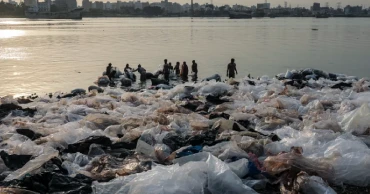
The government aims to reduce plastic waste by 30 percent over the next five years under the 3R policy — Reduce, Reuse and Recycle.
Seventeen single-use plastic items have already been identified and banned through official notification, while broader efforts are under way to strengthen sustainable plastic management.
The government also plans to update regulations and formulate new guidelines for the environmentally sound management of electronic waste.
Air pollution remains major challenge
Air pollution control is another major component of the environmental programme.
The government will continue monitoring air quality through 15 Continuous Air Monitoring Stations and 16 Compact Continuous Air Monitoring Stations.
2 hours ago

Dhaka's air 4th most polluted in the world this morning
With an air quality index (AQI) score of 194 at 9:15 am today (April 10, 2023), Dhaka ranked 4th in the list of cities worldwide with the worst air quality.
Pakistan’s Lahore, India’s Delhi, and Thailand’s Chiang Mai, occupied the first three spots on the list, with AQI scores of 238, 231 and 204, respectively.
An AQI between 151 and 200 is considered “unhealthy” while between 201 and 300 is “very unhealthy”, and 301–400 is “hazardous”, posing severe health risks to residents.
Read More: 8 vehicles, 6 institutions, and 6 brick kilns fined Tk 20.57 lakh for air pollution in Dhaka
In Bangladesh, the AQI is based on five criteria pollutants -- Particulate Matter (PM10 and PM2.5), NO2, CO, SO2 and Ozone.
Dhaka has long been grappling with air pollution issues. Its air quality usually turns unhealthy in winter and improves during the monsoon.
Air pollution consistently ranks among the top risk factors for death and disability worldwide.
Read more: Environment Ministry will conduct month-long mobile court drive to curb pollution in Dhaka from Wednesday
As per the World Health Organization (WHO), air pollution kills an estimated seven million people worldwide every year, largely as a result of increased mortality from stroke, heart disease, chronic obstructive pulmonary disease, lung cancer and acute respiratory infections.
3 years ago