chandpur hilsa
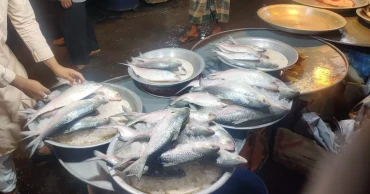
Hilsa glut brings relief as prices fall in Chandpur
For fish lovers in Chandpur, the wait for affordable hilsa appears to be ending.
After months of relatively low supplies, the arrival of hilsa at the city’s century-old Boro Station fish landing centre has increased sharply in recent days, pushing prices down and bringing renewed activity to the bustling riverside market.
Fish traders said only around 50 to 70 maunds of hilsa used to arrive at the landing centre each day over the past four months but supplies have now risen to around 200-250 maunds a day.
As a result, prices have fallen by around Tk 400 a kg in just three days, traders said.
A 1-kg hilsa that sold for Tk 2,900-3,000 three days ago is now selling for around Tk 2,500 at the landing centre. At Biponi Bag, one of the city’s busiest kitchen markets, the same size fish is selling for around Tk 2,600.
Similar prices were seen at Wireless Bazar, Naya Bazar and Purana Bazar.
Hilsa weighing 800-900 grams is selling for around Tk 2,000 a kg, down from Tk 2,500, while 500-gram fish is available for Tk 1,400-1,500, compared with Tk 1,800-1,900 earlier.
Traders said the fish are fresh hilsa caught in the Padma River.
The scene at Boro Station reflected the changing market.
Workers were busy unloading, sorting, weighing and packing fish as buyers moved between stalls looking for the best catch.
A 2-kg hilsa, locally known as raja ilish, fetched Tk 4,500 a kg, with the fish selling for Tk 9,000 in total.
Hilsa researcher Dr Anisur Rahman said the fish is now entering the peak phase of its season.
“Hilsa catches have increased since August 28, partly due to the effect of the new moon,” he said.
He expects supplies to remain strong through October, when fishermen are likely to find more hilsa in the rivers.
Shabeborat Sarker, general secretary of the Chandpur Fish Traders’ Association, said supplies has increased substantially over the past few days.
“On average, 200 to 250 maunds of hilsa are now arriving at the landing centre every day. Today, around 350 maunds arrived,” he said.
With the peak season underway, he expects prices to fall further if supplies continue to rise.
The increased arrivals have also brought more work for day labourers at the landing centre.
Workers Al Amin, Mofiz and Anwar Hossain said they are busier than they were in recent months.
The sound of ice-crushing machines has also grown louder as large quantities of fish are packed in ice before being transported by truck to different districts.
The lower prices have drawn buyers from both Chandpur and beyond.
Zahirul Alam, assistant headteacher of Santoshpur High School in Faridganj, bought fresh hilsa with Saifur Rahman Jibon, a young man from Noakhali, and his elder sister and younger brother.
“We got fresh hilsa at a reasonable price,” they said.
The business beyond the fish
But hilsa is not the only commodity generating business at the landing centre.
In a room beside the fish market, workers were seen removing roe from rejected hilsa and processing it for sale.
Foysaluzzaman and Mintu Howlader were among those involved in the work.
A packet typically contains one kilogram of hilsa roe and sells for around Tk 3,500, the workers said. Roe from larger hilsa can fetch Tk 5,000-5,500 a kg.
The demand remains strong, they said, with processed roe also being sent to Chattogram.
The value of hilsa roe has risen considerably in recent years. Three or four years ago, it sold for around Tk 1,200-1,500 a kg, traders said.
Some of the fish also undergo another traditional form of processing. After the roe is removed, shallow cuts are made along the body of the fish and salt is rubbed into them. The fish is then mixed with turmeric and dried.
Known locally as kata ilish, the salted fish sells for around Tk 1,200-1,300 a kg.
Traders said the product is particularly popular in northern districts including Manikganj, Tangail, Jamalpur, Kishoreganj and Netrokona, where many consumers prefer its salty, preserved flavour.
A hub with a century of history
Boro Station is the largest fish landing centre in Chandpur and one of the district’s oldest trading hubs.
According to traders, around 150 businessmen are involved in hilsa and other fish trading there, while about 350 day labourers depend on the landing centre for work.
For the moment, the increased supply has brought a rare combination of benefits: lower prices for consumers, more work for labourers and greater business for traders.
And if the river continues to yield hilsa through the peak season, shoppers may see even lower prices in the weeks ahead.
Hilsa catch declines as climate pressures intensify
Bangladesh’s hilsa catch is showing a worrying downward trend, with fishermen and researchers pointing to rising temperatures, erratic rainfall and changes in river flows as growing threats to the fish’s breeding and migration patterns.
Even during the peak hilsa season, fishermen in different parts of the country say they are finding significantly fewer fish in rivers than in previous years. The decline is raising concerns over the future supply of Bangladesh’s national fish, a GI-certified product and a crucial source of livelihood for thousands of fishing families.
According to the latest data from the Department of Fisheries, hilsa production fell to 512,000 metric tonnes in fiscal year 2024-25, from 529,000 tonnes in 2023-24 and 571,000 tonnes in 2022-23.
The continued decline has prompted researchers to warn that climate change, coupled with changes in river flows and degradation of breeding grounds, could further undermine hilsa production unless effective adaptation and river-management measures are taken.
1 month ago