Hilsa price
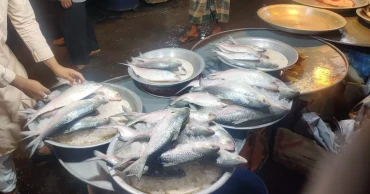
Hilsa glut brings relief as prices fall in Chandpur
For fish lovers in Chandpur, the wait for affordable hilsa appears to be ending.
After months of relatively low supplies, the arrival of hilsa at the city’s century-old Boro Station fish landing centre has increased sharply in recent days, pushing prices down and bringing renewed activity to the bustling riverside market.
Fish traders said only around 50 to 70 maunds of hilsa used to arrive at the landing centre each day over the past four months but supplies have now risen to around 200-250 maunds a day.
As a result, prices have fallen by around Tk 400 a kg in just three days, traders said.
A 1-kg hilsa that sold for Tk 2,900-3,000 three days ago is now selling for around Tk 2,500 at the landing centre. At Biponi Bag, one of the city’s busiest kitchen markets, the same size fish is selling for around Tk 2,600.
Similar prices were seen at Wireless Bazar, Naya Bazar and Purana Bazar.
Hilsa weighing 800-900 grams is selling for around Tk 2,000 a kg, down from Tk 2,500, while 500-gram fish is available for Tk 1,400-1,500, compared with Tk 1,800-1,900 earlier.
Traders said the fish are fresh hilsa caught in the Padma River.
The scene at Boro Station reflected the changing market.
Workers were busy unloading, sorting, weighing and packing fish as buyers moved between stalls looking for the best catch.
A 2-kg hilsa, locally known as raja ilish, fetched Tk 4,500 a kg, with the fish selling for Tk 9,000 in total.
Hilsa researcher Dr Anisur Rahman said the fish is now entering the peak phase of its season.
“Hilsa catches have increased since August 28, partly due to the effect of the new moon,” he said.
He expects supplies to remain strong through October, when fishermen are likely to find more hilsa in the rivers.
Shabeborat Sarker, general secretary of the Chandpur Fish Traders’ Association, said supplies has increased substantially over the past few days.
“On average, 200 to 250 maunds of hilsa are now arriving at the landing centre every day. Today, around 350 maunds arrived,” he said.
With the peak season underway, he expects prices to fall further if supplies continue to rise.
The increased arrivals have also brought more work for day labourers at the landing centre.
Workers Al Amin, Mofiz and Anwar Hossain said they are busier than they were in recent months.
The sound of ice-crushing machines has also grown louder as large quantities of fish are packed in ice before being transported by truck to different districts.
The lower prices have drawn buyers from both Chandpur and beyond.
Zahirul Alam, assistant headteacher of Santoshpur High School in Faridganj, bought fresh hilsa with Saifur Rahman Jibon, a young man from Noakhali, and his elder sister and younger brother.
“We got fresh hilsa at a reasonable price,” they said.
The business beyond the fish
But hilsa is not the only commodity generating business at the landing centre.
In a room beside the fish market, workers were seen removing roe from rejected hilsa and processing it for sale.
Foysaluzzaman and Mintu Howlader were among those involved in the work.
A packet typically contains one kilogram of hilsa roe and sells for around Tk 3,500, the workers said. Roe from larger hilsa can fetch Tk 5,000-5,500 a kg.
The demand remains strong, they said, with processed roe also being sent to Chattogram.
The value of hilsa roe has risen considerably in recent years. Three or four years ago, it sold for around Tk 1,200-1,500 a kg, traders said.
Some of the fish also undergo another traditional form of processing. After the roe is removed, shallow cuts are made along the body of the fish and salt is rubbed into them. The fish is then mixed with turmeric and dried.
Known locally as kata ilish, the salted fish sells for around Tk 1,200-1,300 a kg.
Traders said the product is particularly popular in northern districts including Manikganj, Tangail, Jamalpur, Kishoreganj and Netrokona, where many consumers prefer its salty, preserved flavour.
A hub with a century of history
Boro Station is the largest fish landing centre in Chandpur and one of the district’s oldest trading hubs.
According to traders, around 150 businessmen are involved in hilsa and other fish trading there, while about 350 day labourers depend on the landing centre for work.
For the moment, the increased supply has brought a rare combination of benefits: lower prices for consumers, more work for labourers and greater business for traders.
And if the river continues to yield hilsa through the peak season, shoppers may see even lower prices in the weeks ahead.
Hilsa catch declines as climate pressures intensify
Bangladesh’s hilsa catch is showing a worrying downward trend, with fishermen and researchers pointing to rising temperatures, erratic rainfall and changes in river flows as growing threats to the fish’s breeding and migration patterns.
Even during the peak hilsa season, fishermen in different parts of the country say they are finding significantly fewer fish in rivers than in previous years. The decline is raising concerns over the future supply of Bangladesh’s national fish, a GI-certified product and a crucial source of livelihood for thousands of fishing families.
According to the latest data from the Department of Fisheries, hilsa production fell to 512,000 metric tonnes in fiscal year 2024-25, from 529,000 tonnes in 2023-24 and 571,000 tonnes in 2022-23.
The continued decline has prompted researchers to warn that climate change, coupled with changes in river flows and degradation of breeding grounds, could further undermine hilsa production unless effective adaptation and river-management measures are taken.
1 month ago

Hilsa prices soar further putting this beloved fish beyond reach
Hilsa, the pride of Bangladesh’s rivers and the heart of its culinary culture, has once again slipped beyond the reach of ordinary consumers as prices surged dramatically at the century-old Mir Kadim wholesale fish market in Munshiganj.
Within just 48 hours, hilsa prices have jumped by up to Tk 700 per kilogram, leaving both buyers and traders frustrated — each side pointing fingers over the sudden spike.
During a visit to the bustling Mir Kadim market on Friday, the scene was as lively as ever. Buyers and sellers packed into narrow lanes, where freshly caught silver hilsa shimmered under bright lights. Yet, for many who travelled long distances hoping to savour the seasonal delicacy, the excitement quickly turned to disappointment.
A one-kilogram hilsa is now priced at Tk 2,600–2,700, while the larger 1.5-kg fish are selling for Tk 3,200 per kg — a price bracket that has become a luxury for most households. Even the smallest hilsa, weighing just 150–200 grams, now cost Tk 650–700 per kg.
Hilsa returns to Khulna markets after 22-day ban
Consumers allege that syndicates are manipulating prices, while traders argue that the root of the crisis runs deeper.
Sand Extraction and Illegal Nets Blamed
Al Helal Royel, president of the Mir Kadim Fish Traders’ Association, said rampant and unplanned sand extraction is destroying natural breeding grounds, while the widespread use of illegal current nets is depleting fish stocks at an alarming rate.
“Fish stocks have fallen. Demand is high but supply is low — that’s why prices are increasing,” he explained.
According to the district fisheries office, Munshiganj produced 31,348 metric tonnes of fish in the past year. However, fish availability typically dips during winter, amplifying the strain on supply and pushing prices upward.
Delicious hilsa slips from table to luxury list
Other Fish Prices Also on the Rise
It isn’t just hilsa causing concern. Almost all fish varieties at Mir Kadim have seen significant price hikes.
A survey of the market revealed the following rates:
· River Pangas: Tk 800–1,000 per kg
· Farmed Pangas: Tk 150–200
· Rui: Tk 350–450
· Katla (farmed): Tk 400–500
· Katla (river): Tk 600–700
· Local boal: Tk 800–1,000
· Farmed boal: Tk 500–550
· Golda shrimp: Tk 700–1,000
· Bagda shrimp: Tk 600–700
· Aiyr: Tk 1,000–1,200
· Farmed koi: Tk 200–220
· Local koi: Tk 800–1,000
· Local sing: Tk 800–1,000
· Farmed sing: Tk 300–400
· Chitol: Tk 500–600
· Koral: Tk 600–700
Read more: Hilsa floods Chandpur markets, prices drop
Traders say the overall supply of both river and farmed fish is far from stable, contributing to the sharp rise in prices.
A Market with a Century of Legacy
Mir Kadim, one of the country’s oldest and busiest fish markets, operates through 43 wholesale sheds. Each morning, within just two to three hours, the market handles fish sales worth around Tk 1 crore. On weekends and holidays, the volume multiplies several times as buyers flock in from neighbouring districts.
But for now, the soaring prices, particularly of hilsa, have dampened spirits. What was once a common delight is increasingly becoming an occasional indulgence for many Bangladeshi families.
Read more: Hilsa Ilisha: The National Fish and Silver Pride of Bangladesh
10 months ago

Hilsa prices hit record high in Chandpur ahead of 22-day fishing ban
Prices of hilsa have shot up again in Chandpur markets as a 22-day ban on hilsa fishing is set to begin at midnight on Saturday, to ensure safe spawning in the freshwaters of the Padma and Meghna rivers.
The ban has sparked a rush at Chandpur’s Boro Station fish ghat, one of the country’s largest fish landing centers, where buyers have been scrambling to purchase the priced fish before the restriction takes effect.
The government ban, aimed at protecting hilsa during its spawning season, will remain in place until November 3.
Traders said hilsa weighing 1 to 1.2 kilograms is being sold for Tk2,800- 3,000 per kilogram, an all-time high. The price of smaller hilsa, weighing 500 to 900 grams, ranges from Tk 1,200 - 2,000 per kilogram.
479 MT hilsa exported to India through Benapole
“Prices were lower just a week ago. Now, even though I want to buy, I can’t because the prices have gone up by Tk500 - 700 per kilogram, said Solaiman, a buyer from Ashikati area.
At the fish landing centre, local fishermen were seen bringing in fresh hilsa, some from nearby areas, while others arrive by truck from Noakhali.
Omar Faruq, manager of the Kalu Bhuiyan fish shop, said “The upcoming 22-day ban is the reason. The number of retail buyers far outnumbers the fish supply here.”
With the ban approaching, some tourists have also flocked to the landing centre, turning their fish-buying trip into a family outing, Faruq adding the market has been busy from morning till night, and on Fridays, many tourists were spotted buying hilsa and having it fried at nearby restaurants.
479 MT hilsa exported to India through Benapole
Veteran fish traders like Nurul Islam and Mostafa Khan said they haven’t seen prices this high in over 50 years. In the city’s busiest markets, including Biponibagh and Palbazar, the story is the same.
Chandpur District Fisheries Officer Golam Mehedi Hasan explained the practice of imposing the ban. "Hilsa migrate from the sea to freshwater during this time to spawn. The 22-day ban covers a 70-kilometer stretch from Shatnol in Matlab Uttar Upazila to Char Bhairabi in Haimchar Upazila."
All fishing, transporting, selling, and stocking of hilsa in this area will be prohibited durning the ban.
Despite increased production—reaching 571,342 tonnes in the fiscal year 2022-23, up from 566,593 tonnes the previous year—the demand for hilsa remains high in Bangladesh, keeping prices elevated in the local market.
In the fiscal year 2023-24, Bangladesh exported 664.86 tonnes of hilsa to India, generating $7.71 million, according to the Department of Fisheries. The previous year saw exports of 1,376.42 tonnes of hilsa, worth $13.68 million.
Read more: 10 Tasty Ilish Recipes for Bangladeshi Kitchen
2 years ago