Bangladesh interim govt
Politically motivated arbitrary detentions persist under Bangladesh interim govt: HRW
Human Rights Watch (HRW) has said that politically motivated and arbitrary detentions, which had become ‘entrenched’ under the Awami League government, have continued under the interim government, including the practice of naming hundreds of unidentified individuals as suspects in criminal cases.
The New York-based human rights body came up with the observations in a report released on Wednesday.
Quoting a report by the human rights group Odhikar in October, the HRW said at least 40 people had been killed by law enforcement since the interim government took charge, including 14 who allegedly died due to torture. Almost 8,000 people had been injured in political violence and 81 killed.
In May, the government ordered a ‘temporary’ ban on the Awami League, using newly introduced powers under an amendment to the Anti-Terrorism Act, according to the World Report 2026, Human Rights Watch’s 36th annual review of human rights practices and trends around the globe, which reviews developments in more than 100 countries.
The ban includes, among other prohibitions, meetings, publications, and online speech supporting the party.
In its Bangladesh chapter, the report said there were numerous attacks on journalists in 2025, often by non-state actors such as political party members and violent mobs.
The police and courts also pursued cases under the Code of Criminal Procedure against writers accused by members of the public of ‘hurting religious sentiment’.
Hundreds of Awami League leaders, members, and supporters are in custody as murder suspects, held without trial and routinely denied bail. This includes actors, lawyers, singers, and political activists, the report said.
A further set of cases was launched following a clash between Awami League members and student protesters on February 8, in a campaign called ‘Operation Devil Hunt’, leading to at least 8,600 arrests, said the New York-based global rights body.
Scores more may have been arrested under the draconian Special Powers Act and Anti-Terrorism Act, laws previously used to suppress dissent, it said.
Women’s and Girls’ Rights
Sexual and gender-based violence remained widespread, and women and girls had little recourse to seek protection or access justice. Women played a pivotal role in the 2024 uprising, but were not adequately represented in the interim government.
Rohingya Refugees
More than 100,000 Rohingya have arrived in Bangladesh since early 2024, fleeing fighting and abuses by the Myanmar military and Arakan Army, an ethnic armed group.
Bangladesh authorities continued to advocate in 2025 for repatriation of over 1 million Rohingya refugees, although conditions for safe, voluntary, and dignified returns to Myanmar did not exist, said the report.
Bangladesh held a stakeholders’ dialogue in Cox’s Bazar in August ahead of the UN General Assembly High-Level Conference on the Rohingya in September.
The Rohingya faced pressure and violence by armed groups and criminal gangs in the camps, including sexual violence, abductions, forced recruitment, and extortion. Many victims reported a near total lack of access to protection, legal assistance, and medical care, the HRW said.
Cuts to foreign aid and the influx of new arrivals led to the closure of health care centers and early education programs, and reductions in food and cooking gas.
Humanitarian workers warned of an expected increase in disease outbreaks and child malnutrition, as well as human trafficking, irregular migration, and gang violence.
Attacks on Ethnic and Religious Minorities
On July 26 and 27, a mob damaged at least 14 homes belonging to members of the Hindu minority in Rangpur district. The year also saw reports of continuing violations against minority communities in the Chittagong Hill Tracts. Rape was among the crimes committed in the targeting of minority communities.
The interim government led by Muhammad Yunus, established in 2024 following the overthrow of Sheikh Hasina’s autocratic Awami League government, struggled to maintain law and order, or deliver on promised human rights reforms. General elections are scheduled for February 12, 2026.
Some of the fear and repression that marked Hasina’s 15-year rule, including widespread enforced disappearances, appeared to have ended.
However, the interim government arbitrarily detained thousands of perceived political opponents and in May banned the Awami League, the HRW said.
On November 17, Bangladesh’s International Crimes Tribunal (ICT) sentenced Hasina to death for crimes against humanity committed during the attempted suppression of 2024 protests.
Among the challenges faced by the interim government was an alarming surge in mob violence by political parties and other non-state groups, such as religious hardliners hostile to women’s rights and to lesbian, gay, bisexual, and transgender people, said the global rights body.
According to the Bangladeshi human rights group Ain O Salish Kendra, at least 124 people were killed in mob attacks between June and August 2025, it said.
Accountability for Past Violations
In February, a United Nations report found that police, border guards, the Rapid Action Battalion (RAB), and intelligence agencies had engaged in serious human rights violations during the protests that toppled Hasina, leading to the killing of around 1,400 people.
However, the HRW said, the government made limited progress in holding alleged perpetrators accountable.
In July, a spokesperson for the Bangladesh Police told the BBC that only 60 police officers had been arrested for their role in suppressing the 2024 protests.
Stalled Reforms
As Hasina consolidated power during her 15-year rule, she weakened state institutions, said the report, noting that after coming to office in 2024, the interim government established several commissions to recommend reforms including in the judiciary, electoral system, police, women’s rights, labor rights and the constitution.
A Consensus Commission chaired by Yunus was then established to complete a package of recommended reforms.
However, for reasons including lack of consensus among political stakeholders, few reforms were agreed on or implemented, said the HRW.
On August 5, Prof Yunus announced the July Declaration, named for the month that the uprising against Hasina’s rule began, followed by a more detailed July Charter in October.
In November, Prof Yunus announced a referendum on constitutional reforms to be held during the election, which would commit the incoming government to implement parts of the July Charter.
7 months ago
Govt to form search committee for constituting new Election Commission: Mahfuj
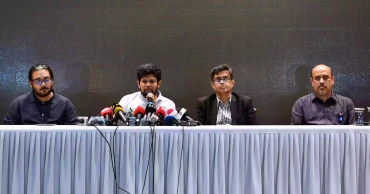
Chief Adviser's Special Assistant Mahfuj Alam on Saturday said the government will form a search committee following the existing law to constitute a new Election Commission for taking forward the relevant activities to hold the next national election.
“The interim government's ‘non-partisan and neutral’ approach will continue in this process without any political influence,” Mahfuj said during a briefing at the Foreign Service Academy in the evening.
CA's Press Secretary Shafiqul Alam and Deputy Press Secretaries Apurba Jahangir and Abul Kalam Azad Majumder were present.
Earlier, Chief Adviser Prof Muhammad Yunus held dialogue with political parties, including Liberal Democrats Party, Gono Forum, Jatiyatabadi Samamana Jote, 12 parties, Jatiya Mukti Council, Labour Party, Bangladesh Jatiya Party (BJP), Bangladesh Jasad (Sharif Nurul Ambia), National Democratic Movement at the state guesthouse Jamuna.
Responding to a question, Mahfuj said the government has a clear position about Awami League and the 14 parties that supported the Awami League.
He also talked about those who participated in the last three elections and went to Parliament illegally and there is a position against them from much earlier that they were illegally elected by betraying with people.
Mahfuj said the position is clear that interim government will certainly create a barrier towards their participation (in polls) politically and there are legal and administrative aspects on how this barrier will be implemented. “You will see soon. When election activities will begin, these issues will become clear.”
Banning Awami League and its allies including 14-party came up for discussion. Mahfuj said the government is reviewing this and the government will not take any decision alone but stressed that they stood against people.
All parties fully backed Interim Govt in dialogue with Chief Adviser: Mahfuj Alam
The political parties in the dialogue raised the issues like election, reforms, AL’s financial crimes, trial of them for killing people and position about the allies who made AL’s hands stronger.
From the political parties it was also said how the last three parliaments can be declared illegal and they gave their opinions.
Mahfuj said a large number of young people could not cast their votes in the last three elections and the Election Commission, once constituted, will see how they could be included in the updated voter list.
Meanwhile, the Chief Adviser assured the political parties about improvement of law-and-order situation, stability in the RMG sector and addressing the issues of prices of essential commodities.
Liberal Democratic Party (LDP) President Dr Col (retd) Oli Ahmad said Bangladesh Awami League should be banned, insisting that they have no right to do politics after its role against 18 crore people of the country in July-August protests.
“Why Awami League should not be banned! We said today again, Awami League should be banned because they waged war against 18 crore people. They have no right to do politics,” he told reporters after holding dialogue with Chief Adviser Prof Muhammad Yunus on Saturday.
1 year ago