Masato Kanda
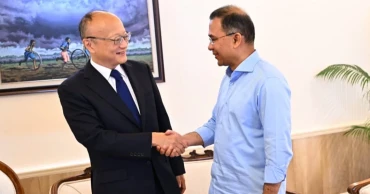
Bangladesh entering critical new phase, says ADB President highlighting $5 billion in funding
Asian Development Bank (ADB) President Masato Kanda has said Bangladesh is entering a 'critical new phase' and ADB will help the country protect hard-won stability, unlock new sources of growth, and build a more resilient economy that delivers better jobs and wider opportunity.
He met Prime Minister Tarique Rahman in Dhaka to discuss Bangladesh’s development priorities during a visit that highlighted funding announcements totaling $5 billion.
During the visit, ADB signed about $1.4 billion in loans as part of the 2026 annual commitment program, said the Manila-based lending agency on Monday.
ADB support was scaled up by $250 million to help address financing gaps linked to the economic impact of the Middle East conflict, which is adding pressure to Bangladesh’s economy, driving up the cost of fuel, liquefied natural gas, fertilizer, and shipping.
These strains come as inflation remains high and the banking sector remains under stress.
ADB said it will work with the government and development partners to track the situation, bring in additional financing and private investment, and help Bangladesh build a more resilient economy through more diverse energy sources and exports, and stronger institutions.
ADB also intends to provide $5 billion over five years for the Integrated Growth Network Development Initiative.
The Initiative, presented by Kanda during the visit, is designed to expand investment, create jobs, improve connectivity, and promote more balanced regional growth.
The five-year package is expected to amount to about $1 billion a year and will be strategically integrated into ADB’s enhanced annual sovereign commitment envelope for Bangladesh.
ADB plans to increase its annual sovereign commitments for Bangladesh by 20%, from about $2.0 billion to about $2.4 billion over the medium term.
The higher annual envelope will support Bangladesh’s development priorities, including investment-led growth, job creation, economic diversification, stronger governance, and a smooth transition from least developed country status.
ADB will also provide $2 million in technical assistance to support the preparation and implementation of Bangladesh’s medium-term development framework and align ADB’s forthcoming country partnership strategy with government priorities.
Kanda also met Finance and Planning Minister Amir Khosru Mahmud Chowdhury, with discussions focused on Bangladesh’s reform agenda, macroeconomic pressures, external financing needs, and ADB’s support for the government’s growth and resilience priorities.
He met with key private sector leaders to discuss the opportunities and constraints shaping investment.
ADB is also working with the government to mobilize additional private capital by deepening capital markets, preparing bankable projects, and attracting cofinancing and private investment.
On Monday morning, the ADB delegation, led by its President Masato Kanda met Prime Minister Tarique Rahman at the Prime Minister’s Office in Tejgaon.
ADB is a leading multilateral development bank supporting sustainable, inclusive, and resilient growth across Asia and the Pacific.
3 months ago

Masato Kanda elected ADB President, succeeds Masatsugu Asakawa
The Asian Development Bank (ADB) Board of Governors has unanimously elected Masato Kanda as ADB’s 11th President, the Manila-based lender said on Thursday.
Kanda, 59, currently serves as Special Advisor to Japan’s Prime Minister and Minister of Finance.
He will assume office on 24 February 2025, succeeding Masatsugu Asakawa, who will leave office on 23 February 2025, according to a press release.
Kanda will complete the unexpired term of President Asakawa, which ends on 23 November 2026.
“Kanda’s extensive experience in international finance and proven leadership in multilateral settings will serve ADB well in navigating complex global economic challenges and fostering international cooperation,” said Chair of the ADB Board of Governors and Governor of the Bank of Italy Fabio Panetta.
“The ADB Board of Governors looks forward to working with Kanda.”
With nearly 4 decades of experience, Kanda has held key leadership roles at the Ministry of Finance of Japan, including Vice-Minister of Finance for International Affairs.
He has extensive experience in financial sector policy and macro-fiscal policy, having served as Deputy Commissioner at the Financial Services Agency, Deputy Director-General of the Budget Bureau, and Deputy Vice-Minister for Policy Planning and Coordination.
He is also a leading expert in education and science policy as well as university reform.
Kanda has been actively engaged in the G7, G20, and other international forums, addressing key policy challenges such as multilateral development bank (MDB) evolution, pandemic prevention, preparedness and response, and debt sustainability and transparency.
During his tenure as Vice-Minister of Finance for International Affairs, Japan made a record contribution of more than $1 billion to the Asian Development Fund 13th replenishment.
Since 2016, Kanda has served as Chair of the OECD Corporate Governance Committee, overseeing the review of the G20/OECD Principles of Corporate Governance in 2023.
ILO to launch new report highlighting wage trends, inequality today
He also has substantial experience in strategic discussions and decision-making at MDBs, having served as Alternate Executive Director for Japan at the World Bank.
Kanda obtained his Bachelor of Laws from the University of Tokyo in 1987 and M.Phil in Economics from Oxford University in 1991.
1 year ago