independent police commission
Political parties agree on forming independent police commission: Ali Riaz
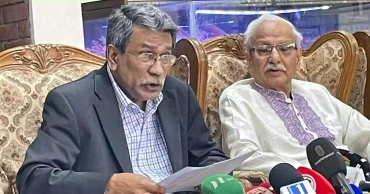
Political parties have reached a consensus on the formation of an independent police commission, Vice Chair of National Consensus Commission Prof Ali Riaz said on Sunday.
"So far, there has been a consensus on 12 major issues as part of the ongoing political dialogue and reform discussions," he said.
Speaking at the 19th session of the second round of reform talks, held at the Foreign Service Academy in Dhaka, Prof Riaz also mentioned that progress has been made on seven additional issues, though final agreement on those has yet to be achieved.
Outlining the proposed structure of the Bangladesh Police Commission, he said it will comprise nine members.
The commission will be chaired by a retired judge of the Appellate Division who is not older than 75 years and a retired police officer, under the age of 62 and below the rank of Additional Inspector General, will serve as the member secretary, he added.
Other members will include representatives of the Leader of the House, the Leader of the Opposition, the Speaker and the Deputy Speaker.
The commission will also include a retired government official of at least Secretary rank with experience as a District Magistrate, a judicial officer not below the rank of District Judge or a High Court lawyer with at least 15 years of experience, and a human rights activist with a minimum of 10 years’ practical experience in a registered human rights organisation.
Try to reach decisions over unsettled reform issues soon: Ali Riaz
At least two of the commission members will be women.
Meanwhile, political parties reached a consensus over two reform proposals – one for not allowing anyone to serve as the Prime Minister for more than 10 years in life and another is for forming an independent police commission to ensure professionalism and accountability in the police force.
“We had reached a consensus on one matter but didn’t announce it before. It’s that the Prime Minister will not be allowed to serve more than 10 years in total,” said Prof Ali Riaz.
The NCC Vice Chair expressed the hope that discussions with political parties will be concluded by July 31 and the draft of the national charter will be sent to the parties by the commission on Monday.
Some 30 political parties, including Bangladesh Nationalist Party (BNP), Bangladesh Jamaat-e-Islami and the National Citizen Party (NCP), participated in the second-round dialogue.
1 year ago

Political parties in Bangladesh agree on PM’s term limit, independent police commission
Political parties on Sunday reached a consensus over two reform proposals – one for not allowing anyone to serve as the Prime Minister for more than 10 years in life and another is for forming an independent police commission to ensure professionalism and accountability in the police force.
“We had reached a consensus on one matter but didn’t announce it before. It’s that the Prime Minister will not be allowed to serve more than 10 years in total,” said Prof Ali Riaz, Vice Chair of the National Consensus Commission (NCC), during the 19th session of the second-round reform dialogue with the political parties at the Foreign Service Academy in the capital.
He said the Commission will include this – maximum tenure of a Prime Minister is 10 years – in the National Charter.
Prof Riaz then asked, “Are we all agreed on this? Earlier, Mr Salahuddin Ahmed had placed a condition on this—does that still remain?”
In response, BNP Standing Committee Member Salahuddin Ahmed clarified his party’s position, saying, “We earlier proposed that no one shall remain in the post of Prime Minister for more than 10 years. I had mentioned that if there is no provision for appointments to the constitutional and statutory bodies through a committee, we won’t agree to this.”
Unresolved reform issues must be decided within 10 days: Ali Riaz
"The forum has now agreed to include such a provision in the Constitution for the Election Commission. If similar committees are discussed for appointing other bodies, the same conditions will apply,” he said, adding, “We hope you can consider it. You may announce the 10-year limit. In fact, this was our proposal.”
Earlier in the day, the NCC proposed the formation of an independent police commission aimed at ensuring professionalism and accountability in the Bangladesh Police.
Following discussion, the participating political parties agreed in principle to the formation of such a commission, though they will continue to deliberate on its structure.
Speaking about the matter, Prof Ali Riaz said, “We are in consensus on the formation of a police commission. We’ll continue discussions on its formation process. Bangladesh’s political parties have agreed in talks to establish an independent police commission that will ensure accountability, responsibility, and a people-friendly police service.”
During the placement of the proposal, Prof Riaz said the issue of forming a police commission was not among the original 166 reform proposals sent to political parties for opinion.
“We are not including this issue to waste time,” he said, adding that both political parties and citizens have consistently questioned why the formation of a police commission is not being discussed during the dialogues.
In light of the police’s role during the 2024 July–August uprising and over the past 16 years, this demand for a police commission is legitimate. That’s why, following both formal and informal consultations, the proposal has been brought to the table, he said.
Referendum needed for future changes to caretaker system in constitution: Ali Riaz
This commission will be mandated to address complaints raised by both police personnel and citizens.
A retired police official who served at least as additional IGP will be its member secretary.
The seven other members will be one representative each of the Leader of the House, the Leader of Opposition, the Speaker and the Deputy Speaker, a listed lawyer of the High Court, a human rights activist and a retired police official who served at least as additional IGP.
Of them, only the chairman and the member secretary will be permanent members, while the rest seven members will not receive any salary.
Some 30 political parties, including Bangladesh Nationalist Party (BNP), Bangladesh Jamaat-e-Islami and the National Citizen Party (NCP), are participating in the second-round dialogue.
The NCC aims to finalise a unified position on approximately 20 core reform proposals by July 31 through consensus-building with political parties.
The second round of talks began on June 2, inaugurated by Chief Adviser and Commission Chairman Prof Muhammad Yunus.
The Commission, formed on February 15, 2025 under Prof Yunus’ leadership, was entrusted with building national consensus on key state reforms. It previously held first-round talks with political parties and alliances between March 20 and May 19.
1 year ago