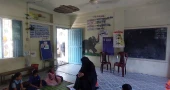
government primary school
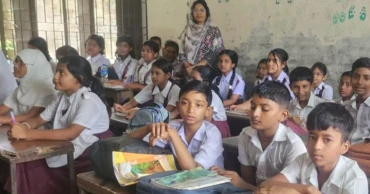
Over half of Narail’s primary schools run by acting head teachers, affecting teaching
Over half of the government primary schools in Narail district are currently operating without permanent head teachers, forcing assistant teachers to shoulder additional administrative responsibilities and affecting classroom teaching.
According to the District Primary Education Office, 280 of the district’s 495 government primary schools – nearly 57 percent – are being run by acting headmasters.
DSB Government Primary School in Sheikhhati union of Sadar upazila is such a school. Established in 1954 and nationalised in 1974, the school currently has 132 students but has remained without a permanent head teacher for the past two years.
Assistant teacher Mahmuda Parvin, who is serving as the acting head teacher, said the dual responsibilities often interfere with classroom activities.
“As I am performing the duties of a head teacher, I frequently have to remain occupied with official work. As a result, classroom teaching is disrupted,” she said.
Another assistant teacher at the same school, Sonia Khanam, said administrative and official duties often require acting head teachers to stay outside the school premises.
“Teacher numbers are already limited. Managing both administrative responsibilities and regular teaching activities has become increasingly difficult,” she added.
The shortage is not limited to head teachers. Assistant teacher positions also remain vacant in many schools across the district, forcing them to conduct academic activities with insufficient staff.
Kripa Sikder, who has been serving as acting head teacher at Tularampur Government Primary School in Narail Sadar since 2018, expressed frustration over the situation.
“Although I am performing the responsibilities of a head teacher, I continue to receive the salary of an assistant teacher. We are also deprived of the second-class status and other benefits designated for head teachers,” she said.
Kripa Sikder noted that prolonged additional responsibilities without corresponding benefits have led to growing dissatisfaction among teachers.
Teachers said acting head teachers must simultaneously manage classroom instruction and a wide range of administrative tasks, including maintaining records, submitting government reports online, coordinating meetings and overseeing office management.
They said these responsibilities often leave insufficient time for teaching, particularly in schools already facing teacher shortages.
Guardians also voiced concern, saying the head teacher serves as the academic and administrative leader of a school. Prolonged vacancies in such positions weaken overall school management and place additional pressure on teachers, ultimately affecting the quality of education.
District Primary Education Officer Md Jahangir Alam acknowledged the challenges caused by teacher shortages.
“We are trying to address the situation through acting head teachers. The issue of vacant posts has been communicated to the Directorate of Primary Education,” he said.
Jahangir Alam attributed the prolonged vacancies largely to legal complications and expressed hope that the issue will be resolved soon.
3 months ago
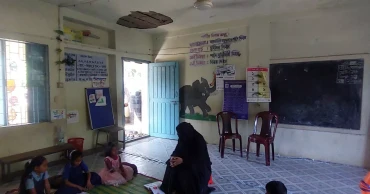
Life under threat: Feni schools continue classes in unsafe buildings
Every school day, teachers and students in Feni step into classrooms of many schools that could collapse under their feet.
More than 200 government primary schools in the district are operating despite damaged infrastructure, with over fifty buildings officially declared unsafe. For those inside, each day is a constant struggle against fear.
In Feni, a district of 559 government primary schools, the aftermath of the 2024 floods is still painfully visible.
Of the 284 schools damaged by the floods, many remain unrepaired, leaving teachers, students and guardians anxious about their safety, both locals and officials said.
Read more: Infrastructure, education projects worth over Tk 190cr get govt nod
In Feni Sadar Upazila, 110 out of 151 schools continue to function despite structural damage. Daganbhuiyan Upazila has 16 affected schools out of 102. Sonagazi Upazila has 77 schools damaged, Chhagalnaiya 65, Parashuram seven and Fulgazi nine.
Many of these schools struggle with broken furniture, cracked walls, exposed rods, and leaking roofs.
At Paschim Sonapur Government Primary School in Kazirbagh Union of Feni Sadar Upazila, UNB found classes continuing in a building that seems ready to crumble. Plaster falls from the ceiling, iron rods stick out dangerously, and cracks snake across walls and pillars. Rainwater seeps into classrooms, leaving students soaked and frightened.
“We are always afraid because the school building is unsafe. It has not been repaired for a long time. We want the government to build a new school so we can study safely,” said students Abrar Mahmud Iran, Bibi Mariam Maria, Jannatul Fateya, and Jannatul Maula Radia.
Parents share the fear. Mohammad Faruk and Md Saiful Islam said, “We fear sending our children to school. The building is unsafe and we do not know what might happen. Who will take responsibility if an accident occurs? The school is supposed to serve as a shelter during floods, but now even that is risky. We strongly urge the government to take immediate action.”
Read more: ADB pledges $2.57 bln to boost Bangladesh’s infrastructure, finance
For teachers, daily lessons are delivered under a shadow of danger.
Arup Dutta, a local resident, described how plaster frequently falls during classes, rods jut out from walls, and ceilings leak when it rains. “We are teaching in fear. The government must build a new building to safeguard students’ education and future.”
Headmaster Sangram Lodh added that the building’s poor condition, worsened by last year’s floods, leaves him with no choice but to continue classes there.
“Many parents are now sending their children to kindergartens or madrasas instead of government schools. Despite repeated requests, authorities have taken no action to build a new facility,” he said.
Mohi Uddin Khandaker, Secretary General of the Central Committee of the Teachers’ Association, emphasised that education must happen in safe and supportive environments. “Urgent steps are needed to develop these dilapidated schools so that students can study with interest,” he said.
Feni District Primary Education Officer Firoz Ahmed confirmed the scale of the problem. “The district has 559 government primary schools across six upazilas. Several were damaged in the 2024 floods, and more than fifty are in risky condition. Some buildings have already been repaired.”
Cooking inside operation theatre at Feni General Hospital; probe body formed
He said details of unsafe schools have been sent to the relevant authorities. “We hope that when the Primary Education Development Programme (PEDP-5) begins in July 2026, all schools will see improvements.”
Until then, however, the children of Feni continue their studies in fear, navigating classrooms where every crack and leak is a reminder of the risks they face, and the urgent need for action, according to locals.
7 months ago