US-Israeli strikes on Iran
Global tensions rise as US-Israeli strikes on Iran fuel fears of 'wider war'
Coordinated military strikes by the United States and Israel on Iranian targets have sharply escalated global tensions, triggering widespread concern over the risk of a broader regional conflict.
World leaders and neighbouring countries have urged restraint as fears grow that the rapidly intensifying situation could spiral into a wider war.
Iranian state media, citing the Red Crescent, on Saturday evening said at least 201 people were killed and more than 700 injured.
U.S. President Donald Trump urged the Iranian public to “seize control of your destiny” by rising up against the Islamic leadership that has ruled the nation since 1979.
In a video announcing the “major combat operations," Trump told Iranians that “when we are finished, take over your government. It will be yours to take. This will be probably your only chance for generations."
Meanwhile, Iran retaliated by firing missiles and drones toward Israel and U.S. military bases in the region, and exchanges of fire continued into the night.
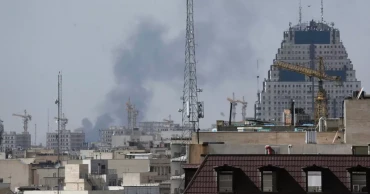
Some of the first strikes on Iran appeared to hit near the offices of 86-year-old Supreme Leader Ayatollah Ali Khamenei. Smoke rose from the capital as part of strikes that Iranian media said occurred nationwide.
Iranian Foreign Minister Abbas Araghchi told NBC News that Khamenei and President Masoud Pezeshkian are alive “as far as I know,” and called the attack “unprovoked, illegal and absolutely illegitimate.”
He also said Iran will continue to exercise its inherent and lawful right of self-defense until the ongoing aggression by the United States and Israel is ceased “fully and unequivocally.”
Araghchi made the remarks in a letter to the UN secretary-general and the president of the UN Security Council on Saturday.
Besides, Foreign Ministry spokesperson Esmaeil Baqaei has denounced the United States and the Israeli regime for killing civilians, including dozens of students in a primary school, in their unprovoked attacks on Iranian cities.
“The US & Israel launched an egregious, unwarranted act of aggression against Iran by indiscriminately targeting Iranian cities. In just one single case, they targeted a primary school in Minab, Hormozgan Province, killing and maiming tens of innocent young girls,” Baqaei wrote in a post on his X account on Saturday afternoon.
Calling the attack on the school “a blatant crime” he said, “The world must stand up to this grave injustice and the UNSC must act now in exercise of its primary responsibility under the Charter.”
How world leaders react
Global leaders have voiced deep concern following military strikes by Israel and the United States on Iran, and Tehran’s subsequent retaliation, warning of the risk of a wider regional conflict across the Middle East.
The United Nations Human Rights Chief, Volker Türk, called for “restraint” and urged all parties to “see reason, to de-escalate, and for a return to the negotiating table.”
“I deplore the military strikes across Iran this morning by Israel and the United States of America, and the subsequent retaliatory strikes by Iran,” he said, stressing that civilians ultimately bear the brunt of armed conflict. He reminded those involved that protecting civilians is “paramount” under international law.
The European Union’s top diplomat, Kaja Kallas, described the latest developments as “perilous.”
A spokesperson for the Government of the United Kingdom said London does not want to see “further escalation into a wider regional conflict.” The statement emphasised that the immediate priority is the safety of UK nationals in the region, adding that Britain stands ready to protect its interests.
Prime Minister Keir Starmer chaired a meeting of the government’s emergency Cobra committee and is expected to hold a series of calls with allies.
The BBC reported that the UK was not involved in the US-Israeli strikes.
Germany said it had been informed of the attack in advance, with Chancellor Friedrich Merz consulting relevant security ministers.
In Rome, the office of Italian Prime Minister Giorgia Meloni said she had held a conference call with ministers and intelligence chiefs and would consult allies and regional leaders to support efforts aimed at easing tensions.
Australian Prime Minister Anthony Albanese said his country supported the US in acting to prevent Iran from obtaining a nuclear weapon and from continuing to threaten international peace and security.
Meanwhile, Russia condemned the US-Israeli strikes, calling them a “reckless move.” The Russian foreign ministry said it was “condemnable” that the attacks were being carried out under what it described as the guise of renewed negotiations, referring to recent US-Iran nuclear talks.
Moscow also urged the international community to assess what it termed “irresponsible actions aimed at undermining peace, stability, and security” in the region.
As diplomatic activity intensifies, world leaders continue to call for restraint, warning that any further escalation could destabilise an already volatile Middle East.
Oil prices poised for volatility amid fears of wider conflict
Oil markets, currently closed for the weekend, are expected to see sharp price swings next week as uncertainty lingers over the impact of U.S. and Israeli strikes on Middle East oil supplies.
Earlier projections suggested any price spike would be short-lived if oil shipping routes and infrastructure—such as Iranian pipelines and the Kharg Island terminal—remain unaffected. However, disruption to infrastructure or tanker traffic through the Strait of Hormuz could trigger a sharper and more prolonged surge.
Brent crude has already climbed to a seven-month high of $72.87. Iran exports about 1.6 million barrels per day, mostly to China, and any disruption could push Chinese buyers to seek alternative supplies, driving global prices higher.
Around 20% of global oil passes daily through the Strait of Hormuz, used heavily by Saudi Arabia, Iraq and the UAE. Analysts say Iran is unlikely to close the strait as it would harm its own exports and key customer China.
Pre-conflict forecasts suggested limited strikes could raise prices by $5–$10 on market fears alone, while a broader war disrupting tanker traffic could push crude above $90 per barrel and send U.S. gas prices well above $3 per gallon, from last week’s average of $2.98.
# With input from agencies
5 months ago