PMO spokesperson
Govt’s first 180 days focused on democracy, good governance: PMO spokesperson
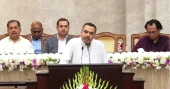
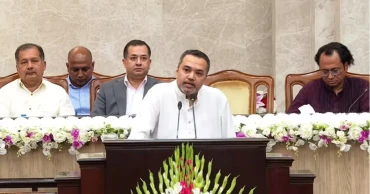
The BNP government has been on a “relentless journey” to consolidate democratic values, ensure good governance and fulfil its election pledges during its first 180 days in office, Prime Minister’s Office spokesperson Mahdi Amin said Monday.
Speaking at an exchange of views with journalists marking 180 days of the government, he highlighted a series of welfare, economic, administrative and institutional initiatives taken during this period.
Mahdi said the government’s journey, guided by the principle of “Bangladesh First,” has focused on accountability, transparency and people’s welfare, with Allah’s blessings, as it works to build a prosperous, self-reliant and welfare-oriented Bangladesh.
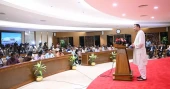
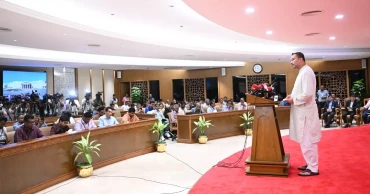
The exchange of views was held to mark 180 days of the government at the International Conference Centre “Shapla” at the Prime Minister’s Office in Tejgaon.
The Prime Minister’s Office spokesperson elaborately presented statistics on the government’s activities and achievements over the past 180 days as well as future plans.
He said the people’s power was ensured through the free, fair and neutral 13th parliamentary election held on February 12 after a long wait, and the representative government took the oath on February 17.
“The government’s 180-day journey is a direct reflection of accountability, transparency and responsibility to the people,” Mahdi said.
He said the government, formed through the continuation of the anti-discrimination movement and a 15-year-long struggle against fascism, received unprecedented public support.
Outlining various initiatives taken to implement the government’s election manifesto and welfare programmes, Mahdi said implementation began immediately after the election in line with the manifesto, the 19-point programme of Shaheed President Ziaur Rahman, Khaleda Zia’s Vision 2030, the BNP’s 27-point programme and the joint movement’s 31-point programme.
At its first cabinet meeting, the government waived loans including interest of up to Tk10,000 for 1.3 million farming families, he said.
The adviser said the government has also introduced the “Krishak Card” for farmers and “Family Card” for women, while initiatives for a “Probashi Card”, honorariums for imams, muezzins and religious leaders of other faiths, as well as nationwide canal excavation and tree plantation programmes, had been revived.
Referring to measures taken during Ramadan and Eid, Mahdi said the government has worked to prevent artificial syndicates and keep commodity prices under control while ensuring workers’ salaries and bonuses.
He also said Tk2,000 crore has recently been released to clear outstanding dues of retired MPO-listed teachers.
In the education sector, the adviser said a record number of ordinances have been converted into laws in parliament and a revised anti-terrorism ordinance has been used to ban a “fascist political organisation”.
The government also introduced new subjects into the education curriculum, provided free education for girls up to graduation, launched mid-day meals in primary schools and taken initiatives to provide free Wi-Fi facilities and opportunities for students to attend parliament, besides organising sports and innovation competitions, he said.
Mahdi said initiatives have also been taken to introduce 200 electric buses in Dhaka and an AI-based traffic management system.
Highlighting the government’s tough stance on law and order, the PMO spokesperson said steps have been taken to establish a police and administration free from political harassment.
He also said the United States has raised its travel advisory for Bangladesh to Level 2 and that visible progress has been made in several widely discussed cases, while legal procedures concerning the repatriation of former prime minister Sheikh Hasina are continuing.
3 hours ago
PM’s 60 steps in 60 days hailed as ‘remarkable achievements’ by PMO spokesperson
Prime Minister’s Office (PMO) spokesperson Mahdi Amin on Saturday described the 60 steps taken by Prime Minister Tarique Rahman in the first two months of his government as “remarkable achievements”.
“Under the leadership of the Prime Minister, the government has taken up an unprecedented range of activities at a fast pace. The 180-day action plan covering all sectors and aimed at improving people’s lives is itself a remarkable achievement,” he said.
Mahdi, also an adviser to the Prime Minister, made the remarks while presenting a summary of the government’s activities at a press conference at the PMO to mark the completion of the first two months of the BNP government.
He said last Friday marked two months of the current government and within this short time, work has begun to implement the promises made in the election manifesto.
“Reflecting the aspirations of the people, the Prime Minister has taken a number of effective steps over the past two months to ensure the progress of the state and every citizen, of which 60 are particularly notable,” Mahdi said.
He said people had lost trust in the government and the state system, but Prime Minister Tarique Rahman has now restored that confidence, re-established transparency and accountability, and begun implementing the promises made in the election manifesto, which he described as a unique achievement.
The PMO spokesperson expressed hope that with collective efforts, the government will be able to take further positive initiatives and build the desired Bangladesh.
Following a landslide victory for the BNP in the February 12 national election, party chairman Tarique Rahman was sworn in as Prime Minister on February 17.
The spokesperson highlighted a wide range of initiatives taken by the government, covering social protection, economy, healthcare, education, infrastructure and governance.
He said the Prime Minister’s 60 steps include introducing family cards and a pilot farmers’ card scheme, waiving loans of up to Tk 10,000 for 1.2 million small and marginal farmers, and disposing of 133 ordinances in Parliament, with 16 of them — including those related to the Human Rights Commission and prevention of enforced disappearance — being reviewed for reintroduction as bills.
Mahdi also mentioned commitments to implement the July charter, excavate canals, keep prices of essentials under control and continue imports of daily necessities, alongside providing monthly allowances to imams, muezzins and other religious leaders, and appointing special assistants for minority communities.
Other measures include distributing relief materials and gifts during Eid-ul-Fitr, modernising the zakat system, plans to introduce a probashi card, reducing Hajj costs by Tk 12,000 per ticket, and providing Nusuk Hajj cards to pilgrims within the country before their departure.
The PM’s adviser said the government has also adopted plans to fill 468,220 vacant posts in phases, reopen closed state-owned industries to create jobs, and identify underutilised economic zones and develop them, economic zones, BSCIC areas and high-tech parks by linking them with universities.
He said steps have been taken to strengthen the economy through inclusive policies, with short-, medium- and long-term plans to transform Bangladesh into a trillion-dollar economy by 2034, alongside a five-year strategy for stable, investment-led growth.
To ease foreign investment, Mahdi said the requirement for prior central bank approval for repatriation of up to Tk 100 crore has been withdrawn, while workers in industrial sectors have been ensured timely payment of wages and bonuses before Eid.
He also highlighted reopening of the Malaysian labour market, efforts to explore new labour markets in Europe, and initiatives to export skilled and semi-skilled manpower.
Other initiatives include developing an agro-processing hub in northern Bangladesh, introducing PayPal and other payment gateways, recruiting 100,000 healthcare workers, launching e-health cards and strengthening hospital security.
In the education sector, Mahdi said steps include scrapping annual re-admission fees, introducing merit-based admission systems, increasing benefits for teachers, doubling stipends, and providing financial support for higher studies abroad.
He said plans have also been taken to recruit teachers, modernise madrasa education, expand technical training, introduce sports programmes, and improve school facilities, including free distribution of uniforms and learning materials.
Mahdi also said measures have been taken to expand digital services in land management, launch the Padma Barrage project, promote use of jute products, and strengthen efforts to prevent dengue and restart measles vaccination.
He said the government has also taken steps to improve law and order, build a people-friendly police force, introduce electric buses and women-friendly transport services, and expand free internet services at airports and on trains.
In addition, the PM’s adviser said initiatives have been taken to promote renewable energy, strengthen economic diplomacy, improve foreign relations, recover laundered money, and address climate challenges, including river erosion in coastal areas.
Besides, he said the government has increased subsidies to keep fuel prices stable amid the global energy crisis and is exploring alternative sources of energy.
Mahdi said a rooftop solar programme and net metering have already added 35MW of electricity to the national grid, with a target of producing 10,000MW from renewable sources by 2030.
Mahdi Amin also described several personal decisions of the Prime Minister as “landmark steps”, including not using the state residence Jamuna, living in his own house, using personal vehicles and reducing state expenditure.
He also mentioned limiting official formalities during foreign visits and avoiding VIP protocols.
Addressing the press conference, Prime Minister’s Press Secretary Abu Abdullah M Saleh (Saleh Shibly) said public confidence in the government has returned in the past two months.
“People had started losing trust in governments and political leaders. But in the last two months, confidence has come back — especially in Prime Minister Tarique Rahman,” he said.
Shibly said the Prime Minister is trying to fulfil all promises made to the people. “In my view, the biggest achievement of these 60 days is that people have trusted Tarique Rahman, and he has trusted the people."
Additional Press Secretary Atikur Rahman Rumon said the Prime Minister has taken office with a clear intention to serve the country.
“You have seen his simple lifestyle. He has taken responsibility to serve the country and to deliver results,” he said.
Rumon also said despite global challenges, including the energy crisis, the government has been able to reduce irregularities and improve administrative performance.
PM’s Speech Writer Mahfuzur Rahman, Deputy Press Secretaries Jahidul Islam Rony, Mostafa Zulfikar Hasan (Hasan Shiplu), Md Sujauddoula and Shahadat Hossain Swadhin, and Assistant Press Secretaries Nazmul Haque Khan and Abdullah Al Mahmud Shahriar were present at the press conference.
3 months ago