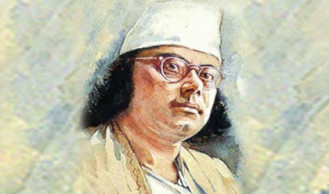
national poet Kazi Nazrul Islam
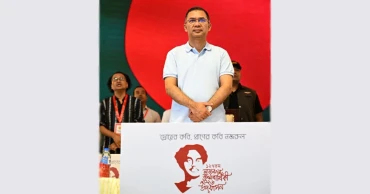
PM laments Nazrul not given due respect in last two decades
Prime Minister Tarique Rahman on Saturday said Kazi Nazrul Islam is an inseparable part of Bangladesh’s identity and deplored that the national poet was not given due respect at the national level during the past two decades.
“Bangladesh and Kazi Nazrul Islam are an inseparable entity. He is a true representative of our national identity, a symbol of our national consciousness, and a pioneer of our nationalism,” he said.
The Prime Minister made the remarks while inaugurating the three-day programme marking the 127th birth anniversary of National Poet Kazi Nazrul Islam in Trishal, Mymensingh.
On the occasion of the poet's birth anniversary, he urged all to take inspiration to remove injustice, inequality, hunger, poverty and division, and to embrace Bangladesh first principle.
Tarique Rahman also greeted the people on the birth anniversary, which will be observed on May 25, and expressed deep respect to his memory.
He said the government feels proud to resume state-level celebration of Nazrul’s birth anniversary in Trishal after nearly two decades.
The Prime Minister bemoaned that after 2006, such national observance had not been held in Trishal.
“Since 2006, Nazrul Jayanti had not been celebrated at the national level in Trishal, which is closely associated with the immortal memory of the National Poet. After nearly two decades, the government feels proud to once again organise the National Poet’s birth anniversary at the state level,” he said.
In his speech, Tarique Rahman also recalled police officer Rafiz Ullah, saying he had brought young Nazrul to Trishal’s Kazir Shimla village and given him shelter in 1914.
Referring to the respect shown to the national poet by former President Ziaur Rahman and former Prime Minister Begum Khaleda Zia, he said ignoring national figures reflects national weakness.
The Prime Minister ecalled that Ziaur Rahman took part in Nazrul-related programmes, including the poet’s funeral procession in 1976 and a rally in 1979 marking his birth anniversary.
He also mentioned that Begum Khaleda Zia founded the National Poet Kazi Nazrul Islam University in Trishal.
“This reflects the highest level of respect and honour shown to the National Poet. It proves that showing respect to others does not diminish one’s own dignity; rather, modesty elevates a person,” Tarique Rahman said.
He also said distancing from such timeless ideals is now reflected in the visible erosion of moral values in society.
Describing Nazrul as a source of inspiration, the Prime Minister said the poet’s arrival in the national history was like a “light of hope” for a subjugated nation.
He also said Nazrul’s writings reflect the nation’s dreams, struggles, literature, culture and heritage.
Tarique Rahman said Nazrul’s work covers revolution, resistance, religious harmony, human values, patriotism, and love for humanity, making him a unique figure in Bengali literature.
“His appearance marked a new dawn in Bengali literature and a revolution in literary taste,” he said, adding that Nazrul gave voice to freedom and resistance.
The Prime Minister said the poet was a unique champion of women’s rights, the welfare of working people, and universal human values free from communalism. “The great poet remains and will continue to remain alive in the nation’s hearts as a symbol of the eternal spirit of Bangladesh’s age-old culture.”
Tarique Rahman suggested that Trishal, which is closely associated with the poet’s childhood memories, could be developed as a “Nazrul City” after a feasibility study.
Earlier, he formally inaugurated the three-day event at the Nazrul Mancha on the grounds of Darirampur Nazrul Academy in Trishal. The programme also includes a Nazrul book fair and rural fair.
Cultural Affairs Minister Nitai Roy Chowdhury chaired the programme.
State Minister for Cultural Affairs Ali Newaz Mahmood Khyom, State Minister for Jute and Textiles Shariful Alam, Cultural Affairs Secretary Kaniz Moula, Mymensingh Zila Parishad Administrator Syed Emran Saleh Prince, Executive Director of Kabi Nazrul Institute Latiful Islam Shibli, chairperson of the institute’s trustee board and the poet’s granddaughter Khilkhil Kazi, Dhaka University Bangla Department teacher Prof Tariq Manzoor, Mymensingh-7 lawmaker Mahbubur Rahman Liton and Deputy Commissioner Saifur Rahman, among others, spoke at the programme.
On the occasion, the Prime Minister handed over the Nazrul Award and honours to two recipients for their contribution to Nazrul research and literature.
He later launched a commemorative publication and attended a cultural programme in honour of the poet.
4 months ago

Remembering rebel poet Kazi Nazrul Islam
Saturday marks the 46th death anniversary of national poet Kazi Nazrul Islam, widely revered for his limitless contribution to Bengali literature.
To observe the day commemorating the life and works of the rebel poet, different organisations have lined up multiple programmes throughout the day.
The Ministry of Cultural Affairs paid its tributes to the poet by placing floral wreaths on his grave beside the Dhaka University Central Mosque at 7am.
Top officials of the Ministry of Cultural Affairs honoured the poet by laying floral wreaths at his grave. The programme was organised in collaboration with the Kabi Nazrul Institute and other departments and organizations under the ministry.
Dhaka University authorities also placed floral wreaths at the grave of the great poet, with a rally led by DU Vice Chancellor Dr Md Akhtaruzzaman.
Bangladesh Awami League arranged a special prayer session at the graveyard of Kazi Nazrul at 9am.
Kabi Nazrul Institute will organise a special seminar and cultural programme at Rabindra Sorobor in Dhanmondi at 5pm, which will be joined by the Ministry of Cultural Affairs Secretary Md Abul Mansur as the chief guest.
Cultural institution Chhayanaut will organise a special cultural tribute programme at its auditorium in Dhanmondi at 7pm. The event will be simultaneously broadcast on its Facebook group and YouTube channel, and the institution is dedicating this event to the late Nazrul exponent Sohrab Hossain.
Also read; Why not directive to issue gazette declaring Nazrul as national poet: HC
Marking the 46th death anniversary of the rebel poet, Bangabandhu Sheikh Mujib Medical University and Hospital (BSMMU) will lift the curtain of the Nazrul Memorial Cabin at its B Block’s 117 number cabin, the room where the poet spent his last days, in the capital’s Shahbagh.
Envisioned by BSMMU Vice-Chancellor Professor Dr Md Sharfuddin Ahmed and established in association with late Professor and Nazrul researcher Dr Rafiqul Islam and State Minister for Cultural Affairs KM Khalid, the room will be open for visitors on Saturday by State Minister for Disaster Management and Relief Md Enamur Rahman, along with cultural personality Ramendu Majumdar.
Several television channels including Bangladesh Television (BTV), radio stations, including Bangladesh Betar, and online platforms will broadcast special programmes commemorating the life and works of the national poet.
Known for his iconoclastic and majestic literary creations, Kazi Nazrul was born in Churulia village of Burdwan in the Indian state of West Bengal in 1899.
Through his fiery poems, the poet had inspired people to fight against the injustice and repression of colonial rule.
According to the Nazrul Institute, Kazi Nazrul wrote 2,600 songs, 600 poetry, three novels, and 43 articles in a career spanning 21 years before losing his speech.
After the death of his father, Kazi Nazrul obtained a job as a caregiver and also worked as a muezzin at a mosque to support his family. At the age of nine, he had to drop out of school to join a Churulia-based professional ‘leto' company.
He was introduced to Bangali and Sanskrit literature while working for the group. He returned to school a year later and enrolled at Matharun English School, but dropped out again in Class VI due to poverty.
After a while, police officer Kazi Rafizullah took him in at his home in Trishal, Mymensingh, and enrolled him in Class VII at Darirampur School.
Serving the British Army in 1917 as a soldier, Kazi Nazrul started his literary career within a few years. His cult-classic poem ‘Bidrohi’ (The Rebel) was published in 1921. A year later, he started a fortnightly magazine named ‘Dhumketu’ (The Comet).
His nationalist participation in the Indian Independence Movement landed him in the hands of colonial British authorities on several occasions.
While in prison, Kazi Nazrul authored the 'Rajbandir Jabanbandi' (Deposition of a Political Prisoner), and his creations later encouraged Bangladesh Liberation War.
Freedom, humanity, love and revolution are the constant themes in Kazi Nazrul's majestic literary creations. He was against all sorts of religious, caste-based, and gender-based discrimination and extremism.
He wrote short stories, novels and essays, but his songs and poems are his most critically acclaimed literary creations. He popularised Bengali ghazal melodies, and is noted for his liberal usage of Arabic and Persian terms in his writings.
Kazi Nazrul created a new genre in music called ‘Nazrul Geeti’, a collection of 4,000 songs that he wrote and created the music for, many of which were recorded on HMV.
In 1942, Kazi Nazrul began to lose his voice and memory due to an unexplained ailment. Later, a medical team in Vienna identified his illness as Pick's disease, a rare and incurable neurodegenerative disease.
His family travelled to Bangladesh at the invitation of then Bangladeshi government and settled down in Dhaka in 1972. For his iconic contribution to Bangla literature and culture, Dhaka University awarded him an honorary post-doctoral degree in 1974. He was awarded Ekushey Padak in 1976.
Kazi Nazrul breathed his last in Dhaka on August 29, 1976, and was buried next to a mosque on the Dhaka University campus, fulfilling a wish he had made in one of his poems.
4 years ago

Nazrul’s 44th death anniversary today
The 44th death anniversary of national poet Kazi Nazrul Islam is being observed on Thursday.
6 years ago
.jpg)
Nazrul’s 121st birth anniversary celebrated
The 121st birth anniversary of National Poet Kazi Nazrul Islam was observed in the country on Monday.
6 years ago
.jpg)
Google Doodle celebrates Nazrul’s 121st birthday
Search engine giant Google is celebrating the 121st birthday of Bangladesh’s National Poet Kazi Nazrul Islam with a doodle.
6 years ago
.jpg)
Nazrul’s 121st birth anniversary Monday
The 121st birth anniversary of National Poet Kazi Nazrul Islam will be observed in the country on Monday.
But unlike previous years, there will be no public function this year because of the coronavirus outbreak. The day also coincides with Eid-ul-Fitr, the biggest festival of the Muslims.
6 years ago
.jpg)
Mosud Mannan made new Bangladesh ambassador to Turkey
The government has appointed Mosud Mannan, currently serving as the Ambassador to Uzbekistan, as the next Ambassador of Bangladesh to Turkey.
6 years ago

Alliance Française de Dhaka pays tribute to Tagore-Nazrul
Dhaka, Oct 4 (UNB) – French cultural organization Alliance Française de Dhaka paid tribute to Nobel laureate Rabindranath Tagore and National poet Kazi Nazrul Islam through a musical programme at its Dhanmondi center on Friday evening.
7 years ago
Nazrul’s 43rd death anniversary observed
Dhaka, Aug 27 (UNB) - The 43rd death anniversary of national poet Kazi Nazrul Islam was observed in a befitting manner on Tuesday.
7 years ago
Nazrul’s 43rd death anniversary being observed
Dhaka, Aug 27 (UNB) - The 43rd death anniversary of national poet Kazi Nazrul Islam is being observed today (Tuesday).
7 years ago