Cockroach Janta Party
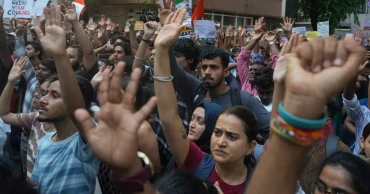
Thousands gather in New Delhi as 'Cockroach' movement seeks march to Parliament
Thousands of supporters of India's youth-led "Cockroach" movement gathered in New Delhi on Monday in an attempt to march to Parliament, demanding the resignation of the country's education minister despite police refusing permission for the protest.
Heavy police deployment surrounded the barricaded protest site at Jantar Mantar, close to Parliament, raising fears of clashes if demonstrators tried to move forward. Television footage showed police using batons to disperse some protesters after they attempted to cross security barricades.
The crowd included students, professionals and families, many carrying food, water and backpacks in preparation for a day-long demonstration. Protesters waved Indian flags and chanted slogans against Education Minister Dharmendra Pradhan and Prime Minister Narendra Modi, while police repeatedly urged them to leave the area through loudspeakers.
The "Cockroach" movement began in May after India's chief justice referred to some unemployed young people as "cockroaches" during an unrelated Supreme Court hearing. Supporters later adopted the term as a symbol of protest, turning it into a satirical campaign that has gained millions of followers on social media.
The movement has grown rapidly amid public anger over repeated leaks of entrance examination papers for medical colleges and government jobs. It gained further attention after police forcibly moved activist Sonam Wangchuk, who had been on a hunger strike, to a hospital on Saturday.
For the past month, protesters calling themselves "cockroaches" have been camping at Jantar Mantar. Student organisations from across the country have joined Wangchuk's hunger strike, while similar demonstrations have taken place at universities and in several other cities.
The protesters are demanding the resignation of the education minister, reforms to the country's examination system and compensation for families of students who died by suicide after examination paper leaks.
Before Monday's planned march, Wangchuk said he would end his nearly three-week hunger strike only if the government accepted responsibility for failures in the education system and the exam leaks, or if protesters were allowed to march to Parliament and lawmakers agreed to raise the issues in both houses.
Delhi Police said permission for the march had not been granted because security restrictions were in place around Parliament during the monsoon session, which began on Monday.
The protests have emerged as one of the most significant public challenges to Prime Minister Modi's government since it began its third term. The movement has received support from opposition parties, rights groups and some Bollywood personalities.
Protesters argue that freedom of dissent has declined under Modi's government, which has faced criticism from rights organisations over its handling of demonstrations, including arrests of activists and police crackdowns.
Senior government leaders have rejected the movement's demands. Education Minister Dharmendra Pradhan accused the protesters of acting against national interests, while other ministers acknowledged students' concerns but said there was no need for formal talks with the movement.
Among the demonstrators was yoga teacher Jyoti Rajput, who said she joined the protest because the authorities had failed to address students' concerns.
"This broken system refuses to take action. It does not understand the suffering of students, and that is why so many people have joined this movement," she said.
1 month ago
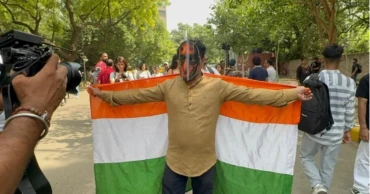
‘Cockroach Janta Party’ gets nod for Jantar Mantar protest demanding Education Minister’s resignation
The Delhi Police on Saturday morning granted permission for a protest at Jantar Mantar organised by the social media platform “Cockroach Janta Party,” which is demanding the resignation of Education Minister Dharmendra Pradhan over the NEET examination paper leak controversy.
The demonstration was called by the online group to seek accountability in the alleged leak case. Its founder, Abhijeet Dipke, arrived in Delhi from the United States on Friday to lead the protest.
Police officials reportedly met Dipke at the airport and allowed him to proceed directly to the protest site. Earlier, he had asked supporters to gather at the Parliament Street Police Station to obtain permission, but later redirected them to Jantar Mantar after clearance was granted.
Dipke was seen arriving at the airport carrying a copy of BR Ambedkar’s autobiography.
Authorities have deployed tight security arrangements in central Delhi, with around 2,000 police personnel stationed at and around the protest venue.
A pamphlet distributed by the group at the site said the protest aims to demand accountability, justice, and the resignation of the education minister. It also claimed that an online petition supporting the demand had gathered more than 8 lakh signatures.
The “Cockroach Janta Party,” a satirical digital movement launched by Dipke on May 16 following controversy linked to remarks attributed to Chief Justice of India Surya Kant, quickly gained widespread attention and amassed a large following on social media platforms.
Source:NDTV
3 months ago

From India to Pakistan: Cockroach Janta Party movement crosses borders
The satirical “Cockroach Janta Party” movement, which first gained traction in India, has now crossed into Pakistan’s online political space. Inspired by India’s viral Cockroach Janta Party (CJP), several Pakistani social media accounts have emerged using similar themes and branding after the Indian movement exploded online following its launch on May 16.
The Indian collective, symbolized by the cockroach — an insect viewed as resilient, difficult to eliminate, and fast-growing — has reportedly gained millions of followers within days.
In Pakistan, multiple versions of the movement have appeared, including Cockroach Awami Party, Cockroach Awami League, and Muttahida Cockroach Movement. One account describes itself as, "A political front of the youth, by the youth, for Pakistan". Another bio states, "Jinhein system ne cockroach samjha, hum unhi awaam ki awaaz hain" (We are the voice of those people whom the system considered cockroaches.)
These Pakistani pages use logos similar to the Indian version but feature a green-and-white palette, presenting themselves as alternatives to major political parties such as PTI, PML-N, and PPP.
Origin of the Cockroach Janta Party
India’s Cockroach Janta Party was founded by Abhijeet Dipke, a 30-year-old Boston University student and former political communications strategist for the Aam Aadmi Party. The Indian movement also has its own manifesto and official website, reports NDTV.
Unlike the Indian version, the Pakistani adaptations appear to be loosely organized, with several independent creators launching their own interpretations of the concept.
The movement began after Chief Justice of India Surya Kant compared certain unemployed youth and activists to “cockroaches” and “parasites” during a Supreme Court hearing.
"There are youngsters like cockroaches, they don't get any employment, they don't have any place in profession," Kant said. He later clarified that the comment referred to people entering professions using fake degrees.
Although it is not officially registered as a political party, the Cockroach Janta Party has reportedly attracted more than 20 million Instagram followers in under a week.
3 months ago
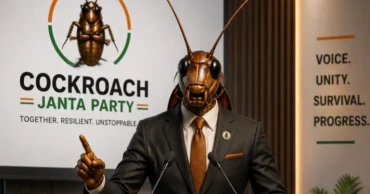
Why is India’s Gen Z rallying behind the ‘Cockroach Janta Party’?
A satirical online political movement dubbed the “Cockroach Janta Party” has gained massive traction across India after controversial remarks by the country’s chief justice comparing some unemployed young people and activists to cockroaches.
The controversy erupted on Friday when Chief Justice Surya Kant, during a Supreme Court hearing, referred to “parasites” attacking the system and remarked that some unemployed youths become activists or social media commentators and begin criticizing institutions.
“There are youngsters like cockroaches, who don’t get any employment or have any place in the profession. Some of them become media, some of them become social media, RTI activists and other activists, and they start attacking everyone,” he said.
The comments triggered widespread criticism, particularly among India’s Gen Z population, many of whom face rising unemployment, inflation and growing social tensions.
Although Justice Kant later clarified that his remarks were aimed at individuals obtaining fraudulent degrees rather than the country’s youth, the explanation did little to quell the backlash online.
Capitalising on the outrage, Abhijeet Dipke, a 30-year-old public relations graduate, posted a tongue-in-cheek message on social media asking what would happen if all “cockroaches” united.
The joke quickly evolved into the “Cockroach Janta Party” — a parody of Prime Minister Narendra Modi’s ruling Bharatiya Janata Party (BJP).
Within days, the movement attracted millions of followers on social media and hundreds of thousands of membership applications.
The party describes itself as “a political front of the youth, by the youth, for the youth” and uses humour and satire to highlight issues such as unemployment, political accountability, media independence and concerns over democratic institutions.
Supporters say the movement reflects growing frustration among young Indians struggling with limited job opportunities despite the country’s economic growth. Official data show graduate unemployment remains significantly higher than the national average, reports Al Jazeera.
Former civil servant Ashish Joshi, who joined the movement, said many Indians feel increasingly hesitant to express dissent and view the satirical campaign as a rare outlet for public frustration.
Prominent lawyer and activist Prashant Bhushan also criticised the chief justice’s remarks, arguing they reflected broader prejudice against young people and activists. He said the popularity of the movement demonstrates a growing demand for accountability and public debate.
Dipke said the party’s branding and manifesto were created within 24 hours using artificial intelligence tools, turning what began as an online joke into a nationwide conversation about youth discontent and political expression.
3 months ago