Naogaon Mango
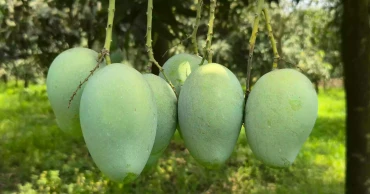
Mangoes worth Tk 300-400 crore go to waste in Naogaon every season; growers call for urgent action
Rows of mango trees laden with fruit stretch across the horizon in Naogaon, Bangladesh’s one of the largest mango-producing districts.
In orchards across Sapahar, Porsha and other upazilas, farmers are now busy with the final stages of care, hoping for a profitable harvest after overcoming weather-related challenges.
The district’s signature Amrapali mango, which accounts for the largest share of local production, is expected to hit markets by mid or late June.
But despite producing a substantial portion of the country’s mangoes, Naogaon still lacks large-scale processing industries or preservation facilities that could protect farmers from market volatility and post-harvest losses, said farmers.
Growers said rising production costs and labour wages continue to squeeze profit margins, while traders often dictate prices during peak harvest periods.
When supply surges, they allege, groups of traders work together to push down prices, leaving farmers with little bargaining power.
The absence of mango-based industries has compounded the problem.
According to local traders, mangoes worth an estimated Tk 300-400 crore spoil every season due to inadequate storage and processing facilities.
According to the Department of Agricultural Extension (DAE), mango cultivation has expanded to 30,310 hectares in Naogaon this season, with a production target of 450,000 tonnes.
Last year, mangoes were grown on 30,300 hectares, yielding around 375,000 tonnes.
“We have only 25 to 30 days to sell Amrapali mangoes after they start ripening,” said Redwanur Rahman Mun, a grower from Kuchkurilia village in Sapahar upazila.
“Farmers cannot keep the fruit on the trees beyond that period. When the market is flooded with mangoes, traders lower prices, forcing us to sell at reduced rates. A large cold storage facility or mango-based industry could save farmers from such losses,” he said.
Motour Rahman, a farmer from Amoir village in Porsha upazila, said weather conditions had been less favourable for mango cultivation this year compared to previous seasons.
“Almost all orchards have fewer fruits this season. Last year, I sold Amrapali mangoes at Tk 1,500 to Tk 4,000 per maund depending on quality. This year, if prices fall below Tk 3,000 per maund, it will be difficult even to recover production costs,” he said.
He added that a mango processing zone could help stabilise prices and ensure fair returns for growers.
Sapahar, home to what traders describe as the country’s largest mango market, attracts thousands of buyers from across Bangladesh every season.
Imam Hossain Rifat, general secretary of the Sapahar Mango Traders Association, said the seasonal market handles mango transactions worth Tk 6,000-7,000 crore annually.
“Nearly 20 percent of our mango production goes to waste every year, representing losses of around Tk 300-400 crore,” he said.
“Establishing large-scale processing industries would benefit not only farmers but also traders. It would create a sustainable market for surplus production and reduce wastage significantly.”
Agriculture officials acknowledge the need for infrastructure to support the sector.
Humayra Mondal, deputy director of DAE in Naogaon, said the issue has been raised at various coordination meetings involving government agencies.
“We have proposed the establishment of cooling houses and packing houses in Sapahar region under a project focused on producing export-quality mangoes,” she said.
“These facilities would help preserve fruit quality, reduce post-harvest losses and increase farmers’ profitability.”
For now, however, Naogaon’s mango growers continue to rely on a short marketing window and uncertain market prices.
As production continues to rise, stakeholders said investment in processing industries, cold-chain infrastructure and export-oriented facilities is no longer a luxury but a necessity.
3 months ago