Draft Development Project Proposal
Bangladesh needs $300m investment to diversify exports before LDC graduation: Study
Bangladesh must urgently diversify its export base beyond garments and mobilise around $300 million in targeted public investments across six non-RMG sectors to cushion the economic blow of graduating from the Least Developed Country (LDC) status, according to a new competitiveness study.
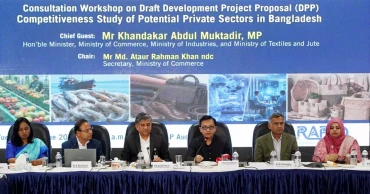
The findings of the study were presented by MA Razzaque, chairman of Research and Policy Integration for Development (RAPID), at a consultation workshop titled “Draft Development Project Proposal (DPP): Competitiveness Study of Potential Private Sectors in Bangladesh” held in the CIRDAP auditorium on Tuesday.
Commerce Minister Khandakar Abdul Muktadir was the chief guest at the event with Commerce Secretary Ataur Rahman Khan in the chair.
The study, prepared under the World Bank-supported Export Competitiveness for Jobs (EC4J) Project Phase II, maps out sector-specific constraints and a portfolio of nine infrastructure interventions targeting leather goods and footwear, agro-processed food, frozen fish and shrimp, handicrafts, IT-enabled services, semiconductors, and pharmaceuticals.
LDC Graduation
Bangladesh is on course to graduate from LDC status, which will strip the country of duty-free, quota-free access to major export markets and subject its goods to MFN tariff rates. The combined effect, the study warns, will raise the cost of exporting and erode Bangladesh's price competitiveness at a time when it can least afford it.
Under the EU's standard GSP regime, Bangladeshi apparel exports could face tariffs of up to 12 percent compared to zero under the current Everything But Arms arrangement. Footwear will face a 6 percent duty, fish a 7.16 percent tariff, and leather goods between 0 and 2 percent. Canada's GPT regime could subject apparel to average tariffs of 16 percent, and Japan's exclusion of leather from its concluded EPA would leave that sector exposed to MFN tariffs of around 11 percent.
A SMART partial-equilibrium simulation presented at the workshop projects Bangladesh's total export fall across key markets: a loss of $486.4 million, equivalent to 26.4 percent of market exports, to India; $5.8 billion, or 22.1 percent, to the EU under standard GSP; and $175.1 million, representing 10.4 percent of market exports, to China.
Recent UNCTAD estimates place total exports at risk at $17.7 billion, or 32.2 percent of Bangladesh's export base, with the EU accounting for 77.2 percent of projected losses and apparel and footwear making up 97 percent of exposure.
The study underscores just how structurally exposed Bangladesh is. Its export concentration, measured by the Herfindahl-Hirschman Index, is four times the developing country average and higher even than the LDC average, a reflection of the country's near-total dependence on RMG, which dominates shipments to every major market.
Of Bangladesh's 1,393 non-RMG products, only 346 export more than $1 million annually. Only 2 to 5 percent of domestically grown crops are ever processed for export. The country holds less than 1 percent of the world leather goods market despite a $101.7 billion global market size, and less than 0.05 percent of global fish and shrimp trade despite possessing natural aquaculture advantages.
Using the ITC Export Potential Map, RAPID estimates Bangladesh's overall untapped export potential at $32 billion, of which $5 billion relates to non-RMG products. Leather goods and footwear alone account for $2.6 billion of that unrealised potential. Home textiles, agro products, and sea animal products follow.
Six Priority Sectors
The study identifies six priority non-RMG sectors for Phase II intervention: agro-processed products, frozen fish and shrimp, leather goods and footwear, handicrafts, IT and IT-enabled services, and semiconductors. A seventh sector, pharmaceuticals, was subsequently added to the intervention portfolio.
Each sector faces acute structural bottlenecks that suppress export competitiveness. Bangladesh has only five mango hot water treatment units against Thailand's fifty or more, making it legally ineligible to export mangoes to the United States, Japan, or Australia. The government's sole irradiation facility in Savar has been closed for two years, cutting off access to the North American spice market. Cold chain gaps cause an estimated 26 percent post-harvest loss for fruits alone.
In shrimp farming, the sector requires 5 billion larvae annually but receives only 100 to 150 million from safe domestic sources, leaving farms reliant on disease-prone wild-caught broodstock. Bangladesh's fish and shrimp exports remain stuck in low-value raw forms, whole frozen shrimp while competitors like Vietnam command premium prices through value-added processed products.
The leather sector cannot prove the provenance of its raw material to European buyers, who increasingly require full supply chain traceability. In handicrafts, artisans capture less than 20 percent of the final export price, with middlemen absorbing most of the value.
The IT sector lacks GDPR-aligned data protection legislation, deterring European clients. And Bangladesh currently has only around 550 semiconductor designers against a minimum threshold of 5,000 needed to compete credibly.
The nine proposed interventions carry a combined project-level cost of $140.43 million, with projected economic benefits of $216.06 million, implying an overall positive return. Individual benefit-cost ratios range from 2.05 for the two Common Facility Centres for leather and footwear, to 4.59 for the National Drug Testing Laboratory.
The National Drug Testing Laboratory, at $5.13 million, will be housed at the Faculty of Pharmacy at the University of Dhaka and upgraded to achieve WHO prequalification and ISO/IEC 17025 accreditation. Its estimated annual economic benefit of $4.50 million reflects avoided overseas testing costs, faster export certification, and expanded pharmaceutical market access.
The IT/ITES advanced training programme across 22 centres, with a $3.82 million cost, carries the second-highest BCR of 4.11, driven primarily by wage premiums for trained workers placed in export-oriented firms.
Three Hot Water Treatment and quarantine centres for agro-processed exports, at $7.85 million, carry a BCR of 3.33, directly addressing phytosanitary compliance gaps that block mango exports to Japan and Europe. Two Brood Multiplication Centre hatcheries for the shrimp sector, at $5.41 million, carry a BCR of 2.13, with economic benefits concentrated in disease-loss reduction and improved post-larval survival rates.
The study also proposes establishment of two large General Engineering and Technology Centres, one at BSCIC Sirajdikhan in Munshiganj at $33.73 million and another at the Mirsarai Economic Zone in Chattogram at $33.79 million, to supply skilled workers and shared technical services to industrial clusters.
Across all components, including a $34 million LDC graduation preparedness component covering policy studies and private sector export readiness support, $81.85 million in construction and infrastructure, $134.65 million in machinery and equipment, $11 million in public sector capacity building, $12.5 million in private sector and business association support, and $20 million for project management, the total EC4J Phase II programme is estimated at $300 million with a 2 percent contingency.
Drawing on Phase I implementation experience, the study recommends against government-only management models, noting that the 50:50 public-private ownership structure for technology centres proved effective in ensuring financial sustainability.
For Phase II, the study recommends early private sector engagement in technology centre operations, shift to behaviour-change communication emphasising financial incentives, and resolution of procurement bottlenecks before facilities are commissioned.
Over a five-year horizon, the projected export growth from Phase II interventions could generate between 57,000 and 86,000 new jobs in agro-processing, 124,000 to 249,000 in frozen fish and shrimp, the largest employment-generating sector with 1.24 million current workers, 13,000 to 16,000 in IT-enabled services, and 20,000 to 24,000 in leather goods and footwear.
The study cautions that these estimates assume constant labour productivity and that actual outcomes may vary where growth is driven by automation or higher value-addition per unit rather than proportional volume expansion.
2 months ago