US strikes on Iran
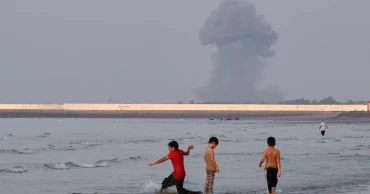
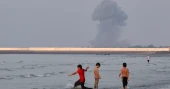
US launches fresh strikes on Iran as Tehran retaliates in Strait of Hormuz, Bahrain
The United States launched a new wave of military strikes on Iran early Tuesday, targeting coastal military infrastructure, while Tehran retaliated by attacking Bahrain and two United Arab Emirates-linked tankers in the Strait of Hormuz, further escalating tensions in the Gulf.
The US Central Command (CENTCOM) said American forces struck military targets in Bushehr, Chabahar, Jask, Konarak, Abu Musa and Bandar Abbas, targeting Iran's coastal defense systems, missile and drone sites, and maritime capabilities.
CENTCOM said the strikes were intended to reduce Iran's ability to threaten commercial shipping and regional security.
US President Donald Trump confirmed the operation, saying the attacks would continue and asserting that Washington had "reinstated" a blockade in the Strait of Hormuz.
Speaking at the White House, Trump said the United States was regaining control of the strategic waterway and indicated that his administration planned to seek compensation from commercial vessels for providing maritime security, marking a major departure from longstanding US policy supporting unrestricted freedom of navigation.
Iran responded by launching attacks on Bahrain and targeting two UAE-associated oil tankers transiting the Strait of Hormuz.
According to the UAE Defense Ministry, two cruise missiles struck the tankers Mombasa and Al Bahiyah, killing one Indian crew member and injuring eight others, including six Indians and two Ukrainians. Fires broke out aboard both vessels but were later extinguished.
Iran's Islamic Revolutionary Guard Corps claimed responsibility for the tanker attack, alleging the ships had ignored repeated warnings and entered a restricted area.
Bahrain also came under renewed missile attack, prompting authorities to activate air raid sirens and advise residents to seek shelter. No casualties or damage were immediately reported.
The UAE condemned the attacks and said it reserved the right to take all necessary measures to protect its territory, citizens and residents.
The latest escalation comes amid an ongoing dispute between Washington and Tehran over control of the Strait of Hormuz, a critical maritime route for global energy supplies. Oil prices rose following the renewed hostilities, with Brent crude climbing above $84 per barrel in early trading.
The US Embassy in Abu Dhabi and the US Consulate in Dubai canceled consular appointments through Wednesday, citing the deteriorating regional security situation.
2 months ago
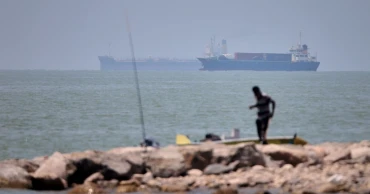
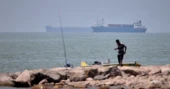
Iranian drones target Bahrain, ship attacked in Strait of Hormuz after US strikes on Iran
Iran launched a drone attack targeting Bahrain on Saturday while a commercial vessel in the Strait of Hormuz also came under attack, in what appeared to be Tehran's response to overnight U.S. airstrikes on Iranian targets.
The latest incidents have heightened fears of a renewed escalation in the Gulf despite an interim agreement between Washington and Tehran aimed at ending the conflict and paving the way for a final accord.
The U.S. strikes came after an Iranian drone attack on a vessel attempting to leave the Strait of Hormuz on Thursday, extending a series of confrontations that have undermined the fragile ceasefire.
Bahrain, home to the U.S. Navy's Fifth Fleet and one of Iran's strongest regional critics, condemned the drone attack.
In a statement, Bahrain's Foreign Ministry said a number of Iranian drones targeted the kingdom, describing the attack as "a flagrant threat to the security of citizens and residents."
Earlier on Saturday, Iran's paramilitary Revolutionary Guard said it had targeted several locations linked to the "U.S. terrorist army in the region," but did not specify the sites.
Separately, the British military's United Kingdom Maritime Trade Operations (UKMTO) said a tanker was attacked in the Strait of Hormuz. The crew was reported safe and no environmental damage was recorded. No group immediately claimed responsibility for the attack, though suspicion quickly fell on Iran.
Following the incident, the U.S. Navy-supervised Joint Maritime Information Center announced an expansion of a maritime route near Oman's coast to facilitate both inbound and outbound shipping traffic.
Iran has insisted that vessels transiting the strait comply with its directives and has warned that it could begin charging transit fees in the strategic waterway, through which around one-fifth of the world's oil and natural gas supplies traditionally pass.
The United States and Gulf Arab states have rejected Tehran's demands, maintaining that the Strait of Hormuz is an international waterway despite lying within the territorial waters of Iran and Oman.
The Joint Maritime Information Center warned that the threat to commercial shipping in the region remains "substantial" and advised mariners to exercise caution due to the presence of mines and ongoing naval clearance operations.
2 months ago