global cricket market
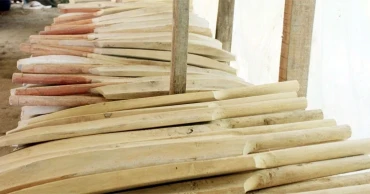
Bangladesh's bat-making hub eyes global cricket market
Long known for its rich tradition of woodworking, Nesarabad upazila in Bangladesh's southern Pirojpur district has quietly emerged as the country's largest producer of cricket bats, supplying equipment to players from school grounds to competitive tournaments nationwide.
Every bat shaped in the workshops of Nesarabad reflects not only the craftsmanship of local artisans but also the ambitions of an industry determined to take Bangladesh's cricket manufacturing expertise onto the international stage
Currently, the upazila produces an estimated 75 percent of all locally manufactured cricket bats in Bangladesh, making it the undisputed centre of the country's bat-making industry.
Spread across more than 65 workshops in over 15 villages, the industry produces around 3,00,000 cricket bats annually.
Bridge without approach roads leaves thousands suffering in Patuakhali for years
It has also become a major source of employment, supporting the livelihoods of more than 12,000 people directly and indirectly, according to local industry stakeholders.
Unlike internationally manufactured bats that rely on imported English willow or Kashmir willow, Nesarabad's manufacturers craft their products from locally available timber, including kadam, gaua, neem shishu, cotton tree, fig and chatim wood.
The abundance of these materials helps keep production costs low while maintaining quality that has earned the bats growing acceptance across Bangladesh.
What began three to four decades ago as a small-scale venture by a handful of local woodworkers has gradually developed into a thriving cottage industry.
Foreign mango variety 'Red Ivory' creates buzz among farmers in Chapainawabganj
Their handmade bats, once sold mainly in local markets, are now distributed to nearly every part of the country, including Dhaka, Chattogram, Rajshahi, Khulna and Sylhet.
The industry's growing reputation has also encouraged several entrepreneurs to explore export opportunities.
A limited number of locally produced bats have already been shipped to neighboring India and Nepal, offering a glimpse of the sector's international potential.
Manufacturers believe Nesarabad has the essential ingredients to compete in the global cricket equipment market. They say the region already possesses skilled craftsmen, an experienced workforce and a strong base of domestic raw materials.
However, industry insiders argue that greater institutional support is needed to unlock that potential.
Easier access to imported willow wood, advanced technical training for craftsmen and stronger export facilitation could enable local manufacturers to produce internationally competitive cricket bats for global markets.
If those challenges are addressed, they believe Pirojpur's bat-making industry could evolve from a domestic success story into an export-oriented sector, generating significant foreign exchange earnings while creating even more employment opportunities.
Floating guava market breathes new life into Pirojpur's rural economy
Contacted, Nesarabad Upazila Nirbahi Officer (UNO) Amit Datta said if local cricket bat manufacturers want to export their products abroad, the upazila administration, along with the government, will provide support through training and access to loans.
Once the industry becomes established, the government will extend full cooperation to help it grow and expand, he said.
2 hours ago