Ceuta enclave
Thousands of migrants return to Morocco after mass crossing into Spain's Ceuta enclave
Tens of thousands of migrants who entered Spain's North African enclave of Ceuta from Morocco voluntarily returned home on Friday, a day after the unprecedented influx created chaos, triggered a humanitarian emergency, and reignited debate over immigration across Europe. At least 57 people lost their lives during the mass crossing.
Ceuta President Juan Jesús Vivas estimated that around 60,000 migrants entered the territory, a figure equal to roughly 70% of the enclave's population. Spanish authorities later estimated the total at about 50,000, adding that more than 48,000 had already returned to Morocco by Friday evening, with more leaving throughout the day.
Many migrants swam several kilometers to reach Ceuta, while others attempted to cross through border barriers. Some encountered security forces using water cannons, tear gas, and warning shots to stop them. Officials said many of the fatalities resulted from drowning, while others were killed in a stampede near the Tarajal border crossing.
Spain deployed additional police officers and military personnel to restore order in Ceuta, located on the Strait of Gibraltar. On the Moroccan side, security forces clashed with migrants trying to reach Spanish territory. The incident also prompted Italy and France to announce tighter border controls for arrivals from Spain.
Describing the situation as unsustainable, Vivas said Ceuta was facing an unprecedented crisis. At the same time, groups of migrants also attempted to enter Melilla, Spain's other North African enclave, where confrontations with police were reported.
Spanish prime minister condemns border crossing
Prime Minister Pedro Sánchez visited Ceuta on Friday, calling the mass crossing a violation of Spain's territorial integrity. He blamed human trafficking networks for encouraging migrants to make the dangerous journey, saying smugglers had misled many young people and exposed them to deadly risks.
According to Spain's Interior Ministry, approximately 50,000 migrants crossed into Ceuta from Morocco beginning Thursday. By Friday evening, more than 48,000 had voluntarily returned.
Rachid Sbihi, head of an association representing Civil Guard officers, described the situation as a severe humanitarian crisis. Thousands of migrants, including many unaccompanied minors, spent the night in parks and on sidewalks, while others wandered the streets without shelter or assistance.
Moroccan authorities did not immediately comment on Spain's figures.
European Commission President Ursula von der Leyen described the scenes in Ceuta as unacceptable, stressing that migration into the European Union must follow established legal procedures. She called for an end to dangerous crossings, stronger action against smuggling networks, and faster returns under existing laws.
Dozens killed during dangerous crossing
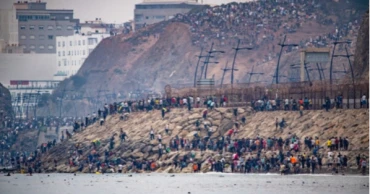
Officials said several of the 57 victims drowned while attempting to swim into Ceuta, while others died during a crush of people trying to cross the breakwater near Tarajal Beach. The shoreline was left scattered with abandoned belongings, including shoes and flotation devices.
Many migrants said they had hoped to find better economic opportunities in Spain but chose to return after witnessing the disorder.
Twenty-one-year-old Abdulah Buji from Tetouan said poor wages and limited job opportunities in Morocco had prompted him to make the journey. However, after failing to find work in Ceuta and seeing the chaotic conditions, he decided to return home.
Human rights organizations reported that Moroccan security forces used water cannons and fired warning shots into the air to prevent additional migrants from crossing into Ceuta.
Morocco's ambassador to Spain, Karima Benyaich, said her government supports legal, orderly, and safe migration but did not explain what had triggered the sudden surge.
Most migrants reached Ceuta by swimming from the Moroccan town of Fnideq, roughly five kilometers away, while others crossed from nearby Belyounech, where the distance is shorter.
Spanish authorities linked the mass crossing to a recent Supreme Court ruling that prevents the immediate deportation of migrants arriving by sea. Sánchez argued that human smuggling networks had misrepresented the court's decision, encouraging thousands to attempt the dangerous crossing.
Migration policy comes under renewed scrutiny
The crisis has intensified criticism of Sánchez's immigration policies. Earlier this year, his government approved residency and work permits for hundreds of thousands of undocumented migrants already living in Spain, arguing the measure would help address labor shortages and the country's aging population. The policy excluded migrants who entered the country after Jan. 1.
Opposition figures claimed the government's approach encouraged irregular migration. Madrid regional leader Isabel Díaz Ayuso accused Sánchez of allowing Spain to be overwhelmed through Ceuta.
The United States also expressed support for Spain, condemning the border breach and describing it as a violation of sovereignty and human rights. The U.S. State Department blamed the incident on Spain's migration policies, a claim rejected by the Spanish government.
Sánchez defended his administration's approach, insisting that the events in Ceuta were unrelated to the legalization program.
The crisis also prompted Italy to temporarily reinstate border controls for travelers arriving from Spain under the Schengen system, while France announced stricter checks along its border with Spain.
Pressure spreads to Melilla
The unrest extended to Melilla, Spain's second North African enclave, where migrants also attempted to cross from Morocco.
Violence erupted in the Moroccan border town of Bni Nsar, where migrants clashed with police, throwing stones and setting police vehicles on fire. Local media and rights groups reported injuries among security personnel and dozens of arrests.
Like Ceuta, Melilla is a self-governing Spanish territory on the North African coast, although Morocco continues to claim sovereignty over both enclaves.
1 month ago