Rajbari’s hilsa glory
Rajbari’s hilsa glory fades as Padma loses depth, current
The boats are still there, the nets are still there. But the hilsa that once filled the fishing boats on the Padma River in Rajbari has largely disappeared.
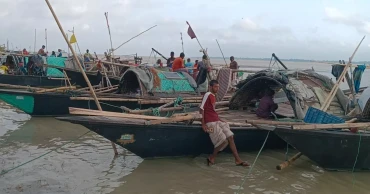
Along the riverbank at Bahir Char Daulatdia in Goalanda, rows of fishing boats remain moored. Some fishermen return from the river with their meagre catch, while others sit in their boats repairing torn nets or applying tar to fishing gear under the sun.
For fisherman Shukur Ali Haldar, 75, the scene is a painful reminder of a very different Padma.
“I have been fishing in the Padma for nearly 50 years. We used to get five to seven maunds of hilsa in a single haul. Sometimes the nets were so heavy with fish that we could hardly pull them up. We would return to the ghat with boats full of hilsa,” he said.
“Now the Padma has neither the depth nor the current it once had. Because of the loss of depth, hilsa are no longer found here like before,” he said.
In the past, the river would come alive after dusk with the flickering lights of fishing boats and fishermen would cast their nets throughout the night and return at dawn with boats loaded with fish, he added.
Goalanda’s importance as a hilsa landing and trading centre was closely linked to its location at the confluence of the Padma and Jamuna rivers.
During the British period and for years after partition, large quantities of hilsa caught in the area were transported by rail to Kolkata.
Local traders said hilsa from Goalanda was once shipped in railway wagons to different parts of the region.
But the river has changed over the decades.
Submerged chars have emerged in many places, reducing navigability and altering the river’s flow.
Fishermen said the decline in depth and current, combined with changes in fishing practices and other environmental pressures, has contributed to the disappearance of hilsa from the Rajbari stretch of the Padma.
‘Now the Padma is almost hilsa-free’
Haldar said he had also witnessed the decline over the years.
“I have caught hilsa with fishermen such as Zafar Haldar, Sonai Haldar, Niranjan Haldar and Madan Haldar of Jafarganj in Manikganj. We used to catch two- to three-seer hilsa regularly,” he said.
He recalled selling a roughly one-kilogram hilsa for Tk 3,600 during the peak season in one year.
But the situation changed after major floods, he said.
“Hilsa started declining after the 1988 flood. After the 1998 flood, hilsa almost disappeared from the Padma,” he said.
Osel Bepari, former general secretary of the Daulatdia-Debagram Fishermen’s Cooperative Society, said fishermen from Rajbari as well as Manikganj, Sirajganj and Pabna used to come to this stretch of the river.
He said around 40 local boats, 12 boats from Manikganj and 16 from Sirajganj and Pabna were once engaged in fishing in the area. This year, only around 27 local boats are operating, he said.
He said fishermen now have to travel far downstream to find suitable fishing grounds. A boat may get only one opportunity to cast and retrieve its net every 16 to 17 hours.
“With hilsa becoming scarce, fishermen are increasingly using different types of nets to catch whatever fish they can find,” he said.
Anwar Bepari, 65, who has spent about four decades fishing in the river, recalled a time when a boat could catch 50 to 60 maunds of hilsa a day.“Now you can hardly say there is fish in the Padma.”
He blamed the use of illegal current nets and China-duari nets for destroying fish and their eggs, while also pointing to changes in the river caused by upstream structures and the formation of chars.
“The river no longer has enough water or current,” he said.
Traders also losing their old business
Fish traders and wholesalers around Daulatdia Ghat said their once-thriving businesses have also shrunk.
Chandu Mollah, who has been involved in the fish trade at Daulatdia ferry ghat for around 20 years, recalled seeing hundreds of kilograms of fish brought to the market every day when he started working there.
Now, he said, only a fraction of the boats return with hilsa.
“At the end of the day, only 10 to 12 hilsa may come from 10 to 20 boats. The fish trade has changed completely,” he said.
Badal Biswas, a wholesale hilsa trader at Goalanda Bazar, has been in the business for around 35 years, following in the footsteps of his late father, Sadeq Ali Biswas.
“Business was very lively during my father’s time. Hilsa from Goalanda used to be sent to different parts of the country. It was even transported to Kolkata in railway wagons,” he said.
“Now there is no Padma hilsa. Those days are a golden past,” Biswas said.
He has kept the family business going by bringing hilsa from Barishal and Chattogram.
Mohan Mondal, president of the Daulatdia Ghat Bazar Business Association, said the decline has been dramatic even in recent years.
“Even six or seven years ago, fishermen used to bring 20 to 30 maunds of hilsa to my wholesale shop every day,” he said.
There are now 11 wholesale shops at the ghat, he said, but on a recent day only two shops received hilsa, totalling just 2-3 kilograms.
During the peak season, the entire ghat may receive only 10-12 kilograms in a day, Mondal said.
A decline seen beyond Rajbari
The decline in Rajbari is part of a broader concern over hilsa production in Bangladesh.
1 hour ago