Red Sea
A week after Houthis seize Red Sea city, rebels eye Yemen’s oil-rich east
A week after Iran-backed Houthi rebels swept along Yemen’s Red Sea coast, expanding their control toward a key maritime chokepoint and threatening Saudi Arabia’s oil exports, the group appears to be turning its attention to the country’s oil-rich east.
The Houthis’ biggest territorial expansion in years has reignited Yemen’s 12-year civil war and pushed global fuel prices higher. It has also provided Iran with another potential source of leverage as the United States has begun easing Tehran’s control over the Strait of Hormuz, located on the other side of the Arabian Peninsula.
The Houthis have also launched attacks on Saudi oil facilities and tankers. An attack on Saudi Arabia’s East-West Pipeline, blamed on Iran-backed militias in Iraq, has added to the kingdom’s security concerns and unsettled global markets.
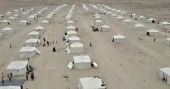
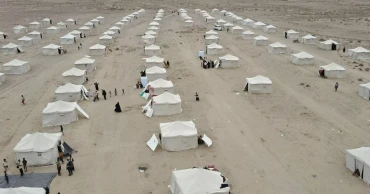
The rebel offensive has forced about 125,000 Yemenis to flee their homes. More than 150,000 people have been killed in the civil war, which has at times pushed Yemen close to famine.
The rebels now appear to be targeting Yemen’s oil-rich eastern regions. Standing in their way are the Saudi-backed government and various armed groups that were still fighting each other as recently as January. Saudi Arabia’s most important ally, the United States, appears to be staying out of the conflict for now.
Houthis fighting on several frontsThe Houthis captured the important Red Sea port city of Mokha before seizing several islands near the narrow Bab el-Mandeb Strait, through which about 12% of global trade passes during peacetime.
The rebels are also only 32 kilometres (20 miles) from Djibouti, a small African country that hosts US and other foreign military bases.
The Houthis launched their first major advance from their northern stronghold in 2014, capturing the capital Sanaa and large parts of northern Yemen. Saudi Arabia intervened the following year, and fighting continued until a ceasefire in 2022.
Heavy fighting has been reported in recent days in and around Marib, a central city in an oil-rich province of the same name. Previous Houthi offensives failed to capture the city, which is also a major military base for Saudi-backed forces.
The Houthis are also threatening Taiz, a western city that has remained a major front line throughout much of the conflict.
Pressure grows on the world’s largest oil exporterThe Houthis want Saudi Arabia to end a long-running blockade on areas under their control.
“It is Saudi Arabia that closed the Bab el-Mandeb strait to shipping traffic to and from Yemen and imposed an unjust blockade on the country,” Mohammed al-Bukhaiti, a member of the Houthi political bureau, told The Associated Press.
Saudi Arabia and its allies have struggled for years to contain or deter the Houthis and could consider a diplomatic solution to stop the attacks. Such a move could eventually require concessions from the United States to Iran, the only country considered to have significant influence over the Houthis.
The United States bombed Houthi targets under both the Biden and Trump administrations but has shown little interest in intervening this time. The Houthis also appear keen to avoid drawing the US into the conflict, saying they are targeting only Saudi-linked shipping.
Red Sea shipping traffic recovers for nowShipping company Windward reported that daily traffic through the Bab el-Mandeb Strait fell from 35 crossings before the Houthi advance to 25 afterward. However, traffic has since recovered, reaching 45 crossings on Sunday.
The Houthis could still broaden their targets beyond Saudi ships and tankers. During their self-declared blockade of Israel at the height of the Gaza war, the rebels attacked ships in the Red Sea that had no known connection to the conflict.
“At the moment, their focus is on Saudi-linked shipping,” said Valentin d’Hauthuille, a Middle East analyst at conflict monitor ACLED.
However, he said the Houthis could “extend the criteria according to which vessels are assessed to be ‘Saudi-linked’ to increase pressure on both Saudi and the global economy.”
Diplomatic efforts underway, but challenges remainRegional mediators have begun efforts to ease tensions, but a diplomatic agreement appears unlikely without progress in the wider conflict involving Iran.
Iran wants the United States to lift a blockade and sanctions that have severely damaged its economy. Washington, meanwhile, wants the Strait of Hormuz fully reopened and seeks an agreement to limit Iran’s nuclear programme.
Neither side has shown signs of changing its position since a preliminary agreement collapsed over the summer.
Oman hosted a meeting between US and Houthi representatives last weekend, according to a Houthi official and another person familiar with the talks who spoke to AP this week. They requested anonymity because they were not authorised to speak publicly about the meeting.
The United States says it has remained in “constant contact” with Saudi Arabia, a close ally that receives billions of dollars in American military assistance.
Saudi Crown Prince Mohammed bin Salman recently visited Egypt, which has played a role in regional mediation. A Turkish government official said this week that Ankara was also holding talks with Iran and the United Arab Emirates to try to reduce tensions.
The Houthi attacks are the first major test of a new defence pact involving Saudi Arabia, NATO member Turkey and nuclear-armed Pakistan. However, officials from Turkey and Pakistan said they have not received a request from Saudi Arabia for military assistance.
Humanitarian crisis deepensThe latest fighting has killed eight civilians and wounded 32 others, according to the UN humanitarian office, which estimates that about 125,000 people have been displaced.
The Health Ministry of the Saudi-backed government says the Houthis have killed about 150 civilians since Sept 3.
Saudi Arabia said Thursday that debris from a Houthi drone intercepted over the kingdom killed one person and injured two others.
Yemen was already the poorest Arab country before the civil war. The conflict and Saudi-led blockade have contributed to widespread hunger in recent years.
The Houthis’ detention of UN and aid workers has also disrupted international assistance in areas under their control. Experts say the rebels have struggled to pay government employees, contributing to unrest, while much of the tax revenue they collect has been directed toward their military operations.
The UN humanitarian office, known as OCHA, said only 20% of its humanitarian appeal for Yemen has been funded. It warned that “millions risk losing access to food, healthcare, nutrition, water and protection services.”
“The needs are extremely high right now,” said Sara Ahmed, a supervisor with Doctors Without Borders in Mokha.
She said medical workers are operating in difficult conditions to keep essential services running while hearing airstrikes nearby.
Mahida Ahmed fled the fighting in Mokha and is now staying at a displacement camp in Aden, where the Saudi-backed government is based.
She said she fled quickly with her children and left all her belongings behind, while her husband remains stranded in Mokha.
“This war has been completely devastating for us,” she said.
1 day ago
Ship attacked with gunfire, RPGs off Yemen coast: UK
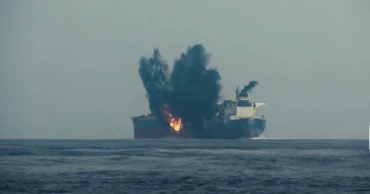
A ship came under attack Sunday in the Red Sea off the coast of Yemen by armed men firing guns and launching rocket-propelled grenades, according to the United Kingdom Maritime Trade Operations center, a group overseen by the British military.
No group has yet claimed responsibility for the attack, which occurred amid heightened tensions in the Middle East due to the Israel-Hamas war and recent conflicts involving Iran and the United States.
The attack took place approximately 100 kilometers (60 miles) southwest of Hodeida, Yemen, a city controlled by Houthi rebels.
The UK Maritime Trade Operations center stated that an armed security team aboard the ship returned fire and described the situation as ongoing. “Authorities are investigating,” the center added.
Maritime security firm Ambrey issued a warning saying that a merchant ship was “attacked by eight skiffs while transiting northbound in the Red Sea” and believed the attack was still in progress.
Ukraine pursues joint weapons production with allies as US pauses some arms shipments
The U.S. Navy’s 5th Fleet referred questions to the U.S. Central Command, which had not immediately responded to requests for comment.
The Houthi rebels have previously launched missile and drone attacks against commercial and military vessels in the region, describing their actions as efforts to end Israel’s offensive against Hamas in Gaza. Their al-Masirah satellite news channel confirmed the attack but offered no further comments, instead airing a speech by their leader, Abdul Malik al-Houthi.
Between November 2023 and January 2025, the Houthis targeted more than 100 merchant vessels with missiles and drones, sinking two ships and killing four sailors.
These attacks significantly disrupted the flow of trade through the Red Sea corridor, which typically sees goods worth $1 trillion annually.
The Houthis had paused their attacks under a self-imposed ceasefire until mid-March, when the U.S. launched a broad assault against them. The ceasefire ended weeks later, and while the Houthis have not attacked any vessels since, they have continued missile attacks targeting Israel.
On Sunday, the group claimed to have launched a missile at Israel, which the Israeli military said was intercepted.
Meanwhile, the decade-long war in Yemen between the Houthis and the exiled government, supported by a Saudi-led coalition, remains at a stalemate. The Yemeni Coast Guard, loyal to the exiled government, has also engaged in firefights with vessels in the Red Sea.
In addition, Somali pirates have operated in the region, typically targeting vessels for robbery or ransom.
1 year ago
.jpg)
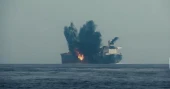
Iran ship said to be Red Sea troop base off Yemen attacked
An Iranian ship believed to be a base for the paramilitary Revolutionary Guard and anchored for years in the Red Sea off Yemen has been attacked, Tehran acknowledged Wednesday.
Iran’s Foreign Ministry confirmed the attack on the MV Saviz, suspected to have been carried out by Israel — though Tehran did not immediately blamed its regional archenemy. The assault came as Iran and world powers sat down in Vienna for the first talks about the U.S. potentially rejoining the tattered deal aimed at curbing Iran’s nuclear program, showing events outside the negotiations could derail those efforts.
The ship’s long presence in the region, repeatedly criticized by Saudi Arabia, has come as the West and United Nations experts say Iran has provided arms and support to Yemen’s Houthi rebels in that country’s yearslong war. Iran denies arming the Houthis, though components found in the rebels’ weaponry link back to Tehran.
Iran previously described the Saviz as aiding in “anti-piracy” efforts in the Red Sea and the Bab el-Mandeb strait, a crucial chokepoint in international shipping. A statement attributed to Foreign Ministry spokesman Saeed Khatibzadeh described the ship as a commercial vessel.
“Fortunately, no casualties were reported ... and technical investigations are underway,” Khatibzadeh said. “Our country will take all necessary measures through international authorities.”
In an earlier state TV statement, an anchor cited a New York Times story, which quoted an anonymous U.S. official telling the newspaper that Israel informed America it carried out an attack Tuesday morning on the vessel. Israeli officials declined to comment about the assault when reached by The Associated Press, as did the Saviz’s owner.
Read: Biden to end US support for Saudi-led offensive in Yemen
Israeli Defense Minister Benny Gantz, while refusing to say if his country launched the attack, described Iran and its regional allies as a major threat.
“Israel must continue to defend itself,” Gantz told journalists. “Any place we find an operational challenge and necessity, we will continue to act.”
Iran’s semiofficial Tasnim news agency, believed to be close to the Guard, reported that a limpet mine planted on Saviz’s hull caused the blast. A limpet mine is a type of naval mine that is attached to the side of a ship, usually by a diver. It later explodes, and can significantly damage a vessel. Iran did not blame anyone for the attack and said Iranian officials likely would offer more information in the coming days.
In a statement, the U.S. military’s Central Command only said it was aware of media reports of an incident involving the Saviz and that U.S. forces were not involved.
On Wednesday, Iranian President Hassan Rouhani called the Vienna talks a “success” while speaking to his Cabinet.
Read: Pompeo to designate Yemen’s Houthi rebels as terrorist group
“Today, one united statement is being heard that all sides of the nuclear deal have concluded that there is no better solution than the deal,” he said.
A European diplomat with knowledge of the talks, speaking on condition of anonymity to frankly discuss the closed-door meeting in Vienna, acknowledged outside events could affect the negotiations.
“We hope that every action, whether it comes from (nuclear deal) parties or external parties, won’t undermine the dynamic,” he said.
The Saviz, owned by the state-linked Islamic Republic of Iran Shipping Lines, came to the Red Sea in late 2016, according to ship-tracking data. In the years since, it has drifted off the Dahlak archipelago, a chain of islands off the coast of the African nation of Eritrea. It likely received supply replenishments and switched crew via passing Iranian vessels using the waterway.
Briefing materials from the Saudi military earlier obtained by the AP showed men on the vessel dressed in military-style fatigues, as well as small boats capable of ferrying cargo to the Yemeni coast. Those materials also included pictures showing a variety of antennas on the vessel that the Saudi government described as unusual for a commercial cargo ship, suggesting it conducted electronic surveillance. Other images showed the ship had mounts for .50-caliber machine guns.
The Washington Institute for Near-East Policy has called the Saviz an “Iranian mothership” in the region, similarly describing it as an intelligence-gathering base and an armory for the Guard. Policy papers from the institute don’t explain how they came to that conclusion, though its analysts routinely have access to Gulf and Israeli military sources.
Read: 5 seamen held by Houthi rebels in Yemen return home
The Saviz had been under international sanctions until Iran’s 2015 nuclear deal with world powers, which saw Tehran receive relief from sanctions in exchange for limiting its enrichment of uranium. The Trump administration later renewed American sanctions on the Saviz as part of its decision to unilaterally withdraw from the accord.
In June 2019, Saudi Arabia flew a critically ill Iranian off the Saviz after Tehran made a request through the United Nations for assistance.
Amid the wider tensions between the U.S. and Iran, a series of mysterious blasts have targeted ships in the region, including some the U.S. Navy blamed on Iran. Among the ships damaged recently was an Israeli-owned car carrier in an attack Netanyahu blamed on Iran. Another was an Iranian cargo ship in the Mediterranean Sea.
Iran also has blamed Israel for a recent series of attacks, including a mysterious explosion in July that destroyed an advanced centrifuge assembly plant at its Natanz nuclear facility. Another is the November killing of Mohsen Fakhrizadeh, a top Iranian scientist who founded the Islamic Republic’s military nuclear program two decades ago.
5 years ago
Saudi-led coalition says foils Houthi attack in Red Sea
Saudi-led coalition involved in a war in Yemen announced on Sunday the foiling of a "terrorist attack" in the Red Sea.
6 years ago