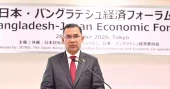
Japanese investment
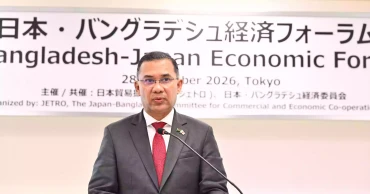
Tarique invites Japanese investment in key sectors, including energy, rail and technology
Prime Minister Tarique Rahman on Wednesday invited Japanese companies to invest in Bangladesh's priority sectors, including automotive manufacturing, energy, technology and space, and high-speed rail and logistics, promising government support and reforms to improve the business environment.
Addressing the Bangladesh-Japan Economic Forum Dialogue at JETRO headquarters in Tokyo, he said the two countries should take their long-standing relationship to a new level through trade and investment following the signing of the Economic Partnership Agreement (EPA), Bangladesh’s first such agreement with any country.
The dialogue was organised by the Japan External Trade Organization (JETRO) in cooperation with the Japan-Bangladesh Committee for Commercial and Economic Co-operation (JBCCEC), with support from the Bangladesh Embassy in Japan.
JETRO President Susumu Kataoka delivered the opening remarks, while Japan's Parliamentary Vice-Minister of Economy, Trade and Industry Shinji Wakayama addressed the event as a guest speaker.
The programme also featured a memorandum of understanding (MoU) exchange and announcements of investment and cooperation projects.
The Prime Minister said Bangladesh has a market of more than 180 million people, a young workforce with a median age of 27 and a growing middle class. “The country is expected to become one of the world’s top 10 consumer economies by 2030,” he added.
He said Bangladesh is expected to become the world’s ninth-largest consumer economy by 2030, while its annual GDP is projected to cross US$1 trillion by 2034, driven by a rising affluent middle class.
Under the EPA signed between Bangladesh and Japan in February this year, Tarique said 7,379 Bangladeshi products will enjoy duty-free access to Japan, while Japanese goods, including steel, automotive parts and electronic components, will receive preferential access to Bangladesh. “Investors on both sides will benefit from recently simplified and progressive rules on investment, services and customs procedures.”
He said Japanese automotive manufacturers, large retailers, agro machinery developers and many others are already taking steps to set up factories in the Japanese Economic Zone in Araihazar, pledging that the government will provide all the support in this regard.
The Prime Minister said Japanese companies have raised three key concerns — reliable energy, efficient infrastructure, and predictable customs clearance and taxation — and that his government has already resolved some of them and is working to address the remaining issues.
“I fully understand that businesses need certainty. Investors need confidence. Our job is creating the right environment to deliver both,” he said, adding that the government will provide every possible support for the initiative.
Tarique said Bangladesh’s ambition is to transform the country into a global manufacturing hub.
“By setting up factories in Bangladesh, you not only enjoy direct access to a large and growing domestic market but also benefit from efficient factors of production to export to the rest of the world,” he said.
In the energy sector, the Prime Minister invited Japanese companies to explore Bangladesh’s future energy needs and participate in energy infrastructure, efficient power generation and renewable energy projects.
He said Bangladesh is planning to establish a Bangladesh-Japan Technology Park focused on artificial intelligence, cloud computing, robotics and electronics manufacturing, involving Japanese companies, universities and investors.
Tarique also called for cooperation with Japanese institutions in space science, satellite engineering and related technologies to strengthen Bangladesh’s space capabilities.
On rail and logistics, he said Bangladesh plans to develop a nationwide elevated high-speed rail network connecting six major divisional cities.
The Prime Minister said the government plans to prepare a national master plan, assess passenger and freight demand, prioritise routes and conduct feasibility studies, inviting Japanese institutions to invest in the initiative.
6 days ago

Bangladesh seeks more Japanese investment in energy, other key sectors
State Minister for Foreign Affairs Shama Obaed Islam has called for enhanced Japanese investment in key sectors including renewable energy, ICT, infrastructure, pharmaceuticals, agro-processing and manufacturing.
The State Minister held a bilateral meeting with Japanese Vice Minister of Foreign Affairs Onishi Yohei on the sidelines of the ‘Dakar International Forum on Peace and Security in Africa’ held in Dakar, Senegal on April 20, said the Ministry of Foreign Affairs on Tuesday.
They discussed expanding cooperation in trade, investment, connectivity, technology, skills development and people-to-people exchanges.
The State Minister expressed appreciation for Japan’s continued support in addressing the Rohingya crisis and sought further assistance to facilitate their early and sustainable repatriation to Myanmar.
6 months ago

Biman’s Dhaka-Narita direct flights will boost Bangladesh-Japan trade, relations: BCCIJ president
The launch of Biman's Dhaka-Narita (Tokyo) direct flight will enhance trade and relations between the two countries, Badal Chaklader, president of Bangladesh Chamber of Commerce and Industry in Japan (BCCIJ), has said.
He said this while speaking at a reception programme organised by BCCIJ in Japan's Tokyo on Sunday (September 03, 2023) night.
He also thanked the Bangladesh government and Biman Bangladesh Airlines for launching the direct flight.
Read: After Narita (Tokyo), Biman eyeing flights to New York, Chennai, Los Angeles, Rome
"We expect that the direct flights would not be discontinued like in the past. We want more Japanese investment in Bangladesh," the BCCIJ president said.
“For boosting trade with Japan, initiatives should be taken to operate daily flights in phases. The quality of services offered by the airline should also be enhanced so that domestic and foreign passengers show more interest,” the BCCIJ president added.
Business leaders said that Japanese investors were often not interested in going to Bangladesh due to lack of direct flights. It also took a long time for Bangladeshis to travel to and from Japan.
Relations and trade between the two countries will reach a new height due to the direct Biman flights, they hoped.
They also urged Biman authorities to transport dead bodies of Bangladeshi expatriates to the country free of cost.
Business leaders also demanded harassment-free services at Dhaka airport.
Read: Dhaka-Narita Tokyo direct flights launched
State Minister for Civil Aviation and Tourism, Md Mahbub Ali, said, “We have 50 years of relationship with Japan. This relationship will grow even more due to the direct flights to Japan. Biman resumed flights to Tokyo, Japan after 17 years and it will facilitate passengers as well as cargo transportation.”
“Besides, more Japanese businessmen will now come to Bangladesh and invest here as our country has great potential,” he added.
3 years ago

Bangladesh urges Japanese businessmen to invest more in various sectors
Bangladesh Ambassador to Japan Shahabuddin Ahmed has urged the Japanese businessmen and investors to invest in various sectors in Bangladesh including information technology, garment industry, and leather.
He also highlighted Japan's involvement in various mega projects in Bangladesh and thanked the Japanese government for their continuous support.
In the context of the decreasing population in Japan, the Ambassador urged Japan's manpower recruiting agencies to recruit skilled workers from Bangladesh.
Read Japan honours businessman Matiur Rahman with Order of the Rising Sun award
He was addressing a seminar on ‘Trade, Investment and Skilled Human Resources’ held in Saitama, Japan on Wednesday.
Nearly 200 participants from Japanese companies and manpower recruiting organisations were present at the event, said the Bangladesh Embassy in Tokyo.
The seminar was organised as part of celebrating 50 years of Bangladesh-Japan diplomatic relations supported by the City of Saitama, Japan International Cooperation Agency (JICA), Japan External Trade Organization (JETRO), Saitama, UNIDO-ITPO Tokyo, and JITCO.
Read: Japan to provide US$ 5 million to promote Bangladesh primary education
From the city of Saitama, Hitoshi Shibuya, director, Department of Commerce, Industry, and Tourism, Bureau of Economic Affairs spoke.
Dr Ariful Haque, Minister (Commerce) of the Embassy delivered a presentation on trade and investment opportunities in Bangladesh, and Md Zoynal Abedin, first secretary (Labour), of the Embassy, presented on the ‘Prospects and Potentials of Skilled Human Resources in Bangladesh: Collaboration with Japan for Greater Mutual Benefit.’
Noriyoshi Fukuoka, director (South Asia), Trade Policy Bureau, Ministry of Economy, Trade, and Industry (METI) praised Bangladesh’s economic progress and prospects.
Read Japan: Lasting Rohingya solutions to help a free Indo-Pacific
Yuji Ando, country representative, JETRO Bangladesh discussed the business environment in Bangladesh through a video message.
Toshihiro Shimizu, from JICA, presented on JICA’s business supporting survey in Bangladesh and Kiminobu Hiraishi, CEO of Maruhisha Group shared business experiences of Japanese textile companies in Bangladesh.
Ambassador Shigeo Matsutomi, senior vice president, Japan International Trainee & Skilled Worker Cooperation Organisation (JITCO) discussed on sending or acceptance structure of Bangladeshi trainees & workers, and Keisuke Irako, chief director, Machida Hospital shared experiences of recruiting Bangladeshi caregivers in his hospital.
Read Japan pulls out of Matarbari-2 plant after consulting Bangladesh: Nasrul
Embassy officials, officials, and representatives from METI, JICA, JETRO, Japan Chamber, and UNIDO ITPO Tokyo, among others, attended the seminar.
4 years ago
Japanese company to invest $25m in Ishwardi EPZ
Roulin (BD) Limited, a Japanese apparel manufacturing company, is going to expand its business in Ishwardi EPZ and create employment for 3,500 Bangladeshis.
The enterprise signed an agreement to this effect with BEPZA on Wednesday.
Recently, the major share of the company was taken over by Matsuoka Corporation, a major player in the wholesale sector of Japan. Now the new shareholder will expand the existing operation of Roulin (BD) by investing $25 million where 3,500 Bangladeshis will be employed.
Read: BEPZA gives highest priority to workers’ safety, welfare: Law Minister
Roulin (BD) has been operating their business in IEPZ since 2011 and invested $4.53 million.
In presence of the Executive Chairman of Bangladesh Export Processing Zones Authority Major General Md Nazrul Islam, Member (Investment Promotion) Md Mahmudul Hossain Khan for BEPZA and Representative of Matsuoka Corporation Osamu Sasaki on behalf of Roulin (BD) signed the agreement at BEPZA Complex, Dhaka.
BEPZA is trying its best to attract foreign and local investment in the EPZ even during the Covid-19 pandemic. Investment-friendly policies of the government and favourable investment atmosphere of EPZs are encouraging Japanese investors including others to invest in EPZs.
Read Dekko ISHO Group joins hands with Markopolo.ai to contribute to IT industry growth
Presently, 31 Japanese enterprises have invested $525 million in the EPZs and created employment opportunity for 13,500 Bangladeshis.
Among others, Member (Engineering) Mohammad Faruque Alam, Member (Finance) Nafisa Banu, Secretary Md Zakir Hossain Chowdhury, General Manager (Public Relations) Nazma Binte Alamgir and General Manager (Investment Promotion) Md Tanvir Hossain of BEPZA including Managing Director of Roulin (BD) Md Mahbubar Rahman were present at the signing ceremony.
Read: Korean envoy discusses investment issues with BEPZA Executive Chairman
5 years ago

PM seeks more Japanese investment in power, energy sector
Prime Minister Sheikh Hasina on Monday sought more Japanese investment in power and energy sector of the country to meet the growing demand of electricity.
6 years ago