IFAD
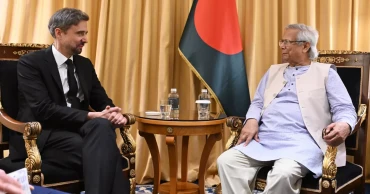
Prof Yunus urges IFAD to create Social Business Fund for young agri-entrepreneurs in Bangladesh
Chief Adviser, Prof Muhammad Yunus has urged the International Fund for Agricultural Development (IFAD) to establish a social business fund aimed at supporting young agricultural entrepreneurs, women, farmers and food processors in Bangladesh.
Prof Yunus made the proposal during a meeting with IFAD President Alvaro Lario on the sidelines of the World Food Forum on Sunday.
"I encourage you to create a social business fund,” said Prof Yunus, adding, “Such a fund would address social issues including healthcare for poor and promote entrepreneurship among youth, farmers, women, and those involved in the fishing industry.”
During their meeting, the two leaders discussed a range of strategic issues, including support for launching Bangladesh’s deep-sea fishing industry, expanding exports of mangoes and jackfruit, promoting climate-resilient agricultural entrepreneurship and assisting buffalo farmers in producing dairy products such as mozzarella cheese.
Prof Yunus invited the IFAD President to visit Bangladesh and send a team to explore potential opportunities for collaboration in agriculture, social business, and technology, said Deputy Press Secretary Abul Kalam Azad Majumder.
In response, President Lario expressed IFAD’s keen interest in supporting social business initiatives and expanding collaboration with the private sector in Bangladesh.
Social business now a global movement: Prof Yunus
He noted that IFAD is currently funding more than half a dozen agricultural projects in the country.
The Chief Adviser also emphasised Bangladesh’s need for technological support and investment in fruit processing, cold storage, warehousing, and large-scale exports of tropical fruits like mangoes and jackfruit.
“We’ve begun exporting mangoes, but the volume is still small. China has expressed interest in importing big quantities of both mangoes and jackfruit from Bangladesh,” he added.
Farida Akhter, Adviser on Fisheries and Livestock, also attended the meeting and highlighted how Bangladeshi women dairy farmers are producing mozzarella cheese from buffalo milk.
She requested IFAD’s support to scale up cheese and other dairy production in the country.
Dr Yunus urges Sweden to invest in social businesses instead of providing grants
11 months ago
IFAD approves US$70 mln for new climate-resilient agri project in Bangladesh
The International Fund for Agricultural Development (IFAD) has approved a new US$70 million project to support rural communities in flood-prone and drought-prone regions adapt to environmental shocks and improve their livelihoods.
The Climate Resilient Agriculture and Livelihood Enhancement Project (CRALEP) received formal approval at IFAD’s 144th Executive Board session in Rome recently, IFAD said on Tuesday.
It will be implemented by the Local Government Engineering Department (LGED), under the Ministry of Local Government, Rural Development and Cooperatives, with oversight from the Economic Relations Division (ERD) of the Ministry of Finance.
IFAD urges more rural investment in developing countries
With a target of reaching 1.34 million people across 33 upazilas in the Haor and High Barind regions, which are frequently affected by floods, flash floods, and droughts, CRALEP aims to improve climate-resilient infrastructure, expand income-generating opportunities, and strengthen the capacity of institutions to manage climate risks more effectively.
The project will channel investments into building 334 kilometres of climate-resilient village roads and 58 rural markets, significantly improving connectivity and access to essential services for remote communities.
In 240 villages, it will also install key infrastructure such as walkways, tubewells, and sanitation facilities to enhance daily living conditions and improve public health.
Report: IFAD expands its climate finance for more resilient rural populations
To help rural populations better withstand climate-related shocks, CRALEP will develop 72 elevated platforms known as killas to provide shelter for livestock during floods.
It will also introduce nature-based protection systems in 280 villages to reduce environmental risks.
In addition, the project will strengthen early warning systems for flash floods and droughts through the Climate Resilient Local Infrastructure Centre (CReLIC) to support timely and community-based disaster response.
Youth empowerment is central to CRALEP’s approach.
The project will provide vocational skills training to 34,000 young people and offer entrepreneurship support to another 10,000, helping them build sustainable livelihoods and contribute to the rural economy.
“This project builds on the strong and longstanding collaboration between IFAD and the government of Bangladesh. CRALEP takes that partnership further by strengthening community resilience and well-being through climate resilient infrastructure and diversified livelihoods that integrate nature-based solutions and climate information services, focusing on rural women, men, and youth in some of the country’s most climate-vulnerable and underserved areas," said Valantine Achancho, IFAD Country Director for Bangladesh.
"Meeting their needs requires coordinated and sustained efforts. Through this initiative, will contribute to building a more secure and dignified future for the rural population in Bangladesh,” said Valantine Achancho.
Bangladesh holds “incredible potential” in agriculture, transforming rural communities: IFAD
In a letter to the Adviser, Ministry of Finance and IFAD Governor, IFAD President Alvaro Lario reaffirmed IFAD’s strong partnership with Bangladesh, commending the country’s excellent performance in implementing development projects.
1 year ago

FAO, IsDB, and IFAD collaborate to strengthen food security technologies for smallholder sarmers
The Food and Agriculture Organization of the United Nations (FAO), the Islamic Development Bank (IsDB), and the International Fund for Agricultural Development (IFAD) have joined hands in a significant partnership agreement aimed at enhancing global food security and nutrition.
This trilateral cooperation agreement focuses on empowering rural smallholder farmers by providing them with accessible, affordable and adaptable technologies crucial for ensuring food security, according to an official press release.
IsDB’s Vice President of Operations Dr. Mansur Muhtar emphasized the significance of this collaboration in addressing the pressing challenges of food insecurity and malnutrition that confront numerous IsDB Member Countries, particularly among small-scale farmers and pastoralist communities.
Global food prices down 2.1 pct in August: FAO
He stated, "Our partnership with FAO and IFAD will play a pivotal role in identifying technologies suitable for integration into IsDB's Food Security Response Program (FSRP) and other agricultural initiatives." This alliance is poised to usher in transformative change in agricultural sustainability and food security across diverse regions.
“A majority of countries in the Near East and North Africa region projects increasing rates of food insecurity and malnutrition. These challenges are particularly more prevalent amongst small-scale farmers and pastoralist communities. The new tripartite cooperation between FAO, IsDB and IFAD will facilitate identification of technologies that have the potential for mainstreaming throughout the crop value chain to improve livelihoods of smallholder farmers and food security among the entire populations,” said AbdulHakim Elwaer, FAO assistant director-general and regional representative for the Near East and North Africa (NENA).
“This cooperation is important to FAO, as it is a first building block in the partnership between FAO and IsDB since the signing of an MoU in 2020.” Elwaer added.
“Technology has enabled small-scale producers to effectively contribute to sustainable agricultural development and food security. Despite the huge efforts to introduce new technologies to support farmers across the value chain, there is still an urgent need to increase capacities and accelerate innovation through partnerships. The cooperation agreement is a major milestone in our joining forces with other partners to help reach the United Nations Sustainable Development Goals and Saudi Vision 2030," said IFAD’s Director of Sustainable Production, Markets, and Institutions Division Thouraya Triki.
FAO-ERD sign technical assistance project agreement
She added: "We aim through this agreement to share our knowledge and technical expertise with FAO and IsDB and benefit from this joint initiative to promote the scale of these technologies and strengthen the capacities of rural farmers to help them to reduce costs and increase production, income and food security.”
These transferable, adoptable, smart agricultural technologies and digital solutions will support the development of low carbon agriculture, improve resilience, contribute to poverty alleviation, create employment and reduce vulnerability to climate-related risks.
Aligned with the digital era, this collective initiative aspires to harness innovative tools and approaches with the objective of empowering rural households and smallholder family farmers to thrive despite multifaceted challenges.
These technologies and solutions are anticipated not only to improve agricultural productivity but also to pave the way for sustainable, low-carbon practices. By enhancing resilience, reducing poverty, creating employment opportunities, and mitigating vulnerabilities linked to climate-induced risks, this partnership emerges as a source of optimism.
Global food prices rise after collapse of Black Sea deal: FAO
This tripartite agreement represents a synergistic collaboration, harnessing the expertise and resources of FAO, IsDB, and IFAD to empower rural households, uplift smallholder family farmers, and contribute to elevated global food security. Through the integration of cutting-edge technologies into agricultural practices, this partnership seeks to cultivate a sustainable and resilient food supply, fostering prosperity for communities worldwide.
3 years ago

Bangladesh seeks IFAD support to boost wheat and edible oil production
Prime Minister Sheikh Hasina has sought assistance from the International Fund of Agricultural Development (IFAD) to boost the production of wheat and edible oil in Bangladesh to reduce its export dependency for the two items.
The assistance was sought when IFAD President Alvaro Lario met her at the FAO headquarters, Foreign Minister AK Abdul Momen told reporters after the meeting on Monday (July 24, 2023).
Read: Bangladesh signs agreement with WFP to expand school feeding programme
Hasina also asked the IFAD to help Bangladeshi small agro-enterprises in marketing their goods and help the country build an efficient food storage system.
Also on Monday the prime minister asked the World Food Programme (WFP) to raise funds for Bangladesh particularly displaced Rohingyas who took shelter in Bangladesh as per capita fund for Rohingya declined to US$ 8 from US$ 12.
She made the call when WFP Executive Director Cindy Hensley McCain met her at the FAO Headquarters on Monday.
Hasina said Bangladesh has successfully raised food production thanks to her government's taking various steps in this field.
Read: PM Hasina offers Nepal use of Payra port during meeting with Nepalese counterpart in Rome
Bangladesh is in a good position in producing not only crops but also fish and other foods, she said.
Cindy Hensley McCain is the wife of former US presidential candidate John McCain who adopted a three-month Bangladeshi girl in the early 1990s.
Meanwhile, the prime minister along with other heads of government and states attended a reception hosted by Director General of Food and Agriculture Organization Qu Dongyu at the FAO headquarters.
3 years ago

Sugar-sweetened beverage consumption is on the rise in developing countries: IFAD
Sugar-sweetened beverage consumption is on the rise in developing countries, according to a literature review released by the International Fund for Agricultural Development (IFAD) as part of its IFAD Research Series.
The global sales of total per capita volumes of packaged food – which are usually processed which in most cases increases the content of added or free sugars, saturated and trans-fat, salt and diet energy density, while decreasing protein, dietary fibre, and micronutrients – rose from 67.7kg per capita in 2005 to 76.9kg in 2017.
Steep price gaps between healthy and unhealthy foods, coupled with the unavailability of a variety of healthy foods, are driving rising obesity rates in both urban and rural areas of developing countries, IFAD said on Wednesday.
IFAD president urges new Global Financing Pact to prioritize small-scale farmers in poverty
“While price gaps between healthy and unhealthy foods exist in nations across the globe, that price gap is much wider in poorer countries. Also, high-income inequality within a country is associated with a higher prevalence of obesity,” said Joyce Njoro, IFAD lead technical specialist, nutrition.
“If we want to curb rising obesity rates in developing countries, we need big solutions that address how food systems work. It is alarming to note that three billion people globally cannot afford a healthy diet,” said Njoro.
Poorest countries show strong support for IFAD in global efforts to combat hunger and poverty
“Preventing obesity in developing countries requires a comprehensive approach that addresses cultural norms, raises awareness of associated health risks, and promotes the production, availability and affordability of healthy foods.”
The research conducted by IFAD, in collaboration with Wageningen Centre for Development Innovation (WCDI), reviewed hundreds of peer-reviewed studies and examined data from five representative countries—Indonesia, Zambia, Egypt, Nigeria, and Bolivia—to better understand the drivers of rising obesity rates in developing countries and what types of interventions work to address this global public health challenge from a food system perspective.
Obesity rates across developing countries are now approaching levels found in high-income countries. The analysis found a number of drivers of obesity in developing countries, including:
IFAD President lauds Bangladesh's remarkable achievements in food production, climate-smart agriculture
Food Prices: The price gap between healthy foods (expensive) and unhealthy foods (inexpensive) is greater in developing countries than in rich developed countries. As a result, three billion people cannot afford a healthy diet. According to one of the studies reviewed (Headey 2019), it is 11.66 times more expensive to obtain a calorie from eggs in poor countries than it is to obtain a calorie from starchy staples, while in those same countries it is only 2.92 times more expensive to obtain a calorie from sugary snacks than from starchy staples. In rich countries, there is a much smaller gap: it is 2.6 times more expensive to obtain a calorie from eggs than it is to obtain a calorie from starchy staples and 1.43 times more expensive to obtain a calorie from sugary snacks than from starchy staples.
Culture: In some developing countries, fatness of a child is desirable as it is considered as a sign of health and wealth, and consumption of unhealthy foods may also carry a certain prestige. Culture also plays a role at the energy expenditure side of the equation in cultures where physical inactivity is associated with high social status.
Gender: Women are more likely to be overweight or obese than men in nearly all developing countries. In a review that focused on lower middle-income countries (Nicole D. Ford et al. 2017) proposed multiple reasons for this sex disparity in overweight and obesity prevalence. Reasons included: different physiological responses to early-life nutrition, different hormonal responses to energy expenditure, weight gain associated with pregnancies, lower physical activity levels, depression, economic circumstances over the lifespan, and differences in sociocultural factors – like ideal body size and acceptability of physical activity.
The paper also examines interventions that have been deployed in developing countries to curb obesity rates, including food packaging, labelling and advertisements, taxation and import duties on certain foods, and evaluates their respective effectiveness.
3 years ago

Tulips of Tetulia: Prospects as bright as the blooms
Tulips — the brightly coloured flowers usually associated with the Netherlands — are now growing in Tetulia upazila of Panchagarh district, boosting tourism prospects and local economy.
Seeing the success of a pilot scheme, this year, tulips are being grown on a large tract of land in Darjipara of Tetulia.
Tulips grown in the Panchagarh district are now being sold in Dhaka due to high demands.
Last year, eight women earned Tk 65,000 each by growing tulips on their land — on a pilot basis — and this year, 20 women are growing the beautiful flowers on two acres of land considering the prospects.
Also read: Danish ambassador, IFAD country director visit tulip gardens in Panchagarh
This year, they are expecting to sell tulips worth Tk one crore.
Financed by International Fund for Agricultural Development (IFAD) and Palli Karma-Sahayak Foundation (PKSF), Echo Social Development Organisation (ESDO) and Rural Microenterprise Transformation Project (MRTP) undertook the pilot project with the help of rural women.
They have created a new prospect for livelihood.
3 years ago

"We need to invest in transformation of food systems, adaptation to climate change"
Development finance expert Alvaro Lario takes the helm of the UN’s International Fund for Agricultural Development on Saturday with an urgent mission to battle poverty and hunger among the world’s rural poor as they face existential threats of climate change and food insecurity.
Lario, a Spanish national who has served as IFAD’s chief financial officer since 2018, has led efforts to harness private sector investment to boost the resilience of millions of small-scale farmers and rural communities who are among those most affected by global shocks.
“Our mission has never been more urgent as food insecurity, climate change and conflict threaten the lives and livelihoods of the world’s rural poor,” he said.
“But our power to shape the future has never been greater, if we muster the commitment and resources to make lasting change.”
Lario remains committed to IFAD’s goal to double its impact on poor rural communities by 2030.
This will be done in part by driving forward climate change adaptation as a priority for the Fund, according to a message received here from Rome on Friday.
Poor small-scale farmers produce one-third of the world’s food, but receive less than two percent of climate finance and are the least able to adapt to changing circumstances like drought, extreme weather and crop failure.
“We keep moving from crisis to crisis, focusing on immediate relief. But if we want to avoid winding up in the same place again five years from now, we need to invest in the medium term -- and this means nothing less than the transformation of food systems, and adaptation to climate change,” he said.
Read: Bangladesh, Japan, IFAD partner to bring smallholder farmers closer to international markets
“This won’t be done by governments and the UN alone. This is a shared, global challenge for public and private sectors alike since we can all share the benefits of food security and global stability, just as we will all suffer together should we fail to act.”
IFAD, a UN specialized agency which is also an international finance institution, is the only global development agency exclusively dedicated to transforming agriculture, rural economies and food systems by making them more inclusive, productive, resilient and sustainable.
Since 1978, the Fund has invested more than US$23 billion in low-interest loans and grants, reaching more than a half-billion people through projects that increase food security and food production, improve nutrition and build resilience in the world’s poorest and most marginalized rural communities.
In 2020, as both CFO and Associate Vice-President for financial operations, Lario set out to mobilize greater resources for the Fund by enlisting private sector investment.
Under his stewardship, IFAD became the first UN fund to receive a public credit rating.
That A++ rating, through Fitch agency, has enabled IFAD to secure private sector investment, with two initial private-placement bonds in 2022 totalling US$150 million, and more to come.
Lario will serve a four-year term from 1st October, taking over from Gilbert F. Houngbo, a former Togolese prime minister who has become the head of the UN’s International Labor Organization.
Lario has a PhD in financial economics from Complutense University in his native Spain, and a master’s degree in finance from Princeton University. Previous to the Fund, he worked for more than six years in the International Finance Corporation of the World Bank group, and also in various roles in the private sector asset management industry and academia.
3 years ago
.jpg)
UN agency IFAD reaches record level of support for world’s rural poor
The UN’s International Fund for Agricultural Development (IFAD) doubled down on its commitment to the world’s poorest rural communities in 2021, increasing support to reach 128 million small-scale farmers and vulnerable people, according to its annual report released from Rome on Thursday.
The record level of support for world’s rural poor came amid rising challenges posed by climate change, the COVID-19 pandemic and global economic shocks.
In the IFAD Annual Report 2021, IFAD detailed how its efforts successfully targeted those who needed it most: data released during 2021 revealed that 49 per cent of direct beneficiaries were women, while 22 per cent were youth.
“We know that economic empowerment of women is the key to greater empowerment for all, while more than 600 million youth in rural areas globally need our help,” said Gilbert F. Houngbo, President of IFAD.
“These investments will ultimately help deliver greater food security, poverty reduction and economic resilience to their broader communities – that is, the people who produce a third of the world’s food but are too often left behind,” he said.
Also read: Alvaro Lario to lead response to global food crisis as new IFAD President
The annual report recaps the activities of the UN specialized agency and international finance institution, which mobilizes funds, technical expertise and other resources to combat poverty and hunger among the 3.4 billion people who live in rural areas of the developing world.
With global hunger on the rise and climate change impacting agricultural output, IFAD’s role in ensuring global food security has never been more crucial.
IFAD’s 177 Member States have recognised this by committing a record US$1.55 billion to the agency’s 2022-2024 core resources with the aim of doubling its impact by 2030.
Some of those funds went last year to expanding IFAD’s COVID-19 response initiative – called the Rural Poor Stimulus Facility (RPSF) – to help people survive pandemic-caused financial losses while also protecting the global food supply.
As traditional markets were upended due to COVID-19-related supply chain and transportation disruption, the RPSF stepped in to provide small-scale farmers with seeds, fertilizer, access to liquidity and information.
Support for digital services like e-marketing and e-money were also increased. Twenty million people have received support in 59 hard-hit countries through the RPSF so far in the past two years.
The Annual Report 2021 also highlights IFAD’s efforts to expand its resource mobilisation by enlisting the participation of private sector partners.
Also read: IFAD Member States to appoint next President July 7
This builds on IFAD’s A++ credit rating, attained in 2020, which has allowed the agency to pursue co-financing through partnerships and thereby complement its core three-year “replenishment” resources.
In June 2021, IFAD also launched a Sustainable Development Finance Framework to guide engagement with institutional impact investors who focus on sustainable finance.
Other milestones in 2021 for IFAD included continuing advocacy for rural people and for a transformation of food systems at major international events including the UN Climate Change Conference (COP26) and the UN Food Systems Summit.
The initiatives laid out in 2021 are now serving as building blocks for IFAD’s stepped-up response to the crisis in 2022 prompted by war in Ukraine and the ensuing hike in food, fertilizer, energy and transport costs.
IFAD’s dedicated response to the impacts of the war, called the Crisis Response Initiative, focuses on 22 priority countries in urgent need, and work is now under way in the six in the most critical state – Afghanistan, Ethiopia, Haiti, Mozambique, Somalia and Yemen.
“Our mission is unwavering in the face of conflict, COVID-19 and climate shock: to transform rural economies and food systems, and to drive more sustainable and inclusive development for the most vulnerable small-scale farmers and their communities,” Houngbo said.
4 years ago
.jpg)
Alvaro Lario to lead response to global food crisis as new IFAD President
The International Fund for Agricultural Development (IFAD) has appointed its top finance executive, Alvaro Lario, to be its next president.
Through the appointment, IFAD has chosen a champion of private sector investments to lead the UN agency into battle against a global food security crisis triggered by war in Ukraine, climate change and the economic shock of COVID-19.
Lario will take office on 1 October and serve a four-year term.
Read: IFAD Member States to appoint next President July 7
He succeeds Gilbert Houngbo who has led the organisation since 2017.
Lario, IFAD’s Chief Financial Officer (CFO) and an Associate Vice-President for financial operations since 2018, pledged to double IFAD’s impact on rural poor communities by 2030.
“We have the institutions to tackle poverty, we have the know-how to reduce inequality, what we need is to mobilise resources and join forces,” he told delegates from 177 member states attending the election held at IFAD’s Rome-based headquarters on Thursday.
“We know that ODA (Official Development Assistance) and ODA of agriculture will not be enough. Due to the war in Ukraine small-scale producers globally are suffering the current disruptions of food systems. This is one additional shock on top of the climate disasters and unequal recovery from COVID-19, and poor communities are disproportionally affected,” he added.
Lario committed to scale-up investments in climate resilience and climate-smart agriculture.
“Climate-smart agriculture and climate adaptation will become increasingly important to break the cycle of poverty, inequality, conflict and forced migration. IFAD needs to act urgently and partner with climate liked-minded institutions to support small scale producers and poor rural communities adapt to climate shocks,” said Lario.
Lario also stressed that “it will not be possible to reach the SDGs without harnessing the power of women and the energy of the youth.”
He promised to prioritize programmes that put women at the centre.
As IFAD CFO, Lario has led IFAD’s charge to mobilize private sector engagement in its battle against hunger and poverty, and on behalf of the world’s poorest rural communities.
“As IFAD President, I will ensure that IFAD connects the huge amount of global savings from impact investors and pension funds to tackle poverty in rural poor communities. We need to make sure that we use our AA+ credit rating to mobilize more funds. This is a unique competitive advantage in the UN system,” said Lario.
Read: IFAD: Integration of nutrition in all dev interventions sought
Under his stewardship, IFAD became the first United Nations Fund and the only UN body and specialized agency other than the World Bank Group to enter the capital markets and obtain a credit rating, enabling the Fund to expand resources mobilization efforts to the private sector. Lario has 20 years of experience in the private sector, academia and international financial institutions, including developing local capital markets and investments in emerging markets at the International Financial Corporation of the World Bank group.
Lario will take up the IFAD helm amid mounting challenges in agriculture and notably for smallholders who are both key to global food security and extremely vulnerable to shocks.
Rising global food, energy and fertilizer prices linked to the war in Ukraine now threaten to trigger a global food crisis and push millions more rural people into hunger and poverty.
IFAD’s role in building resilience among small-scale farmers who produce a third of the world’s food have made it a leader in the drive for global food security.
Recently the Fund launched its Crisis Response Initiative to ensure that small-scale farmers can meet their immediate needs for fertilisers, seeds and technology and ensure the next harvests in 22 priority countries affected by commodity price hikes.
New figures published yesterday by five UN agencies including IFAD showed the world falling further behind in efforts to end hunger and poverty in line with the 2030 Sustainable Development Goals.
The State of Food Security and Nutrition report showed that hunger globally rose to as many as 828 million in 2021, an increase of about 150 million since the outbreak of the COVID-19 pandemic.
4 years ago

IFAD: Integration of nutrition in all dev interventions sought
Nutrition interventions play a crucial role to empower women, ensure dietary diversity, build a climate-resilient food system, and boost the overall economy, said experts at a seminar in the city.
Jointly organized by the International Fund for Agricultural Development (IFAD) and BRAC James P Grant School of Public Health on Thursday, the seminar aimed to provide a platform to share lessons on nutrition-sensitive agriculture and food systems, identify good practices and potential areas of collaboration with different government agencies, development partners, and private sectors.
Bringing together experiences from IFAD and BRAC University speakers shared learnings on using gastronomy as a development tool and empowering women to achieve sustainable nutrition impacts that contribute to overall food systems, said a media release on Friday.
Read: Bangladesh a star of growth, says IFAD urging continued focus on rural areas
“When we consider a food system to be healthy, we tend to investigate and invest in maximizing profit and quantifiable indicators. Instead, we have to start considering an integrated system where you include diversity, health, and social factors. The same applies to nutrition interventions which can be used as a tool to transform agriculture and our food systems,” said Arnoud Hameleers, IFAD Country Director for Bangladesh.
Drawing further on how IFAD’s investment and work in nutrition across nations, Joyce Njoro, IFAD Technical Specialist, Nutrition and Social Inclusion said, “Nutrition and food security are at the heart of IFAD’s work through its nutrition-sensitive projects, which address underlying causes of malnutrition related to inadequate household food security, maternal and childcare, and environmental health.”
“IFAD works in food – horticultural, crops, livestock, fish, wild foods, bio-fortified crops – production along with food processing, preserving, storing, and marketing, supporting nutrition education at the community level, mainstreaming gender equality and empowerment, and policy engagement,” added Njoro while underscoring the importance multi-sectoral coordination to implement nutrition-sensitive projects.
Read: It's a priority for IFAD to invest in Bangladesh, says its regional director
Underscoring the importance of the human and social factors, Barnali Chakraborty, Associate Scientist, BRAC James P Grant School of Public Health said, “Development intervention alone cannot change the nutrition status in the country. It is crucial to improve individual capabilities to bring impact at the community and national level by integrating health, agriculture, women empowerment, and other social factors in the development interventions. Communities’ capabilities need to be enhanced to achieve children’s nutrition."
Participants representing different government agencies, national implementors, and development partners utilized this seminar as a platform to explore new ways of strengthening the impact of nutrition-sensitive development interventions and leverage nutrition as a development tool to transform rural Bangladesh.
4 years ago