Jupiter
NASA’s Juno data shows Jupiter smaller and flatter than earlier estimates
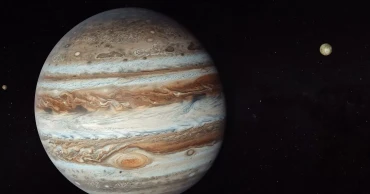
New findings from NASA’s Juno mission suggest that Jupiter, the largest planet in the solar system, is slightly smaller and more flattened than scientists previously believed.
According to NASA, researchers analysed radio occultation data collected during 13 close flybys of the gas giant, while also factoring in the impact of Jupiter’s powerful zonal winds. The study, published in the journal Nature Astronomy, found that Jupiter is around 8 kilometres narrower at the equator and about 24 kilometres flatter at the poles than earlier measurements indicated.
NASA explained that radio occultation allows scientists to peer through Jupiter’s thick and opaque cloud layers to gain insights into its internal structure. During these experiments, Juno sends radio signals to Earth-based receivers in NASA’s Deep Space Network. As the signals travel through Jupiter’s ionosphere, atmospheric gases bend and slow them.
NASA postpones crewed moon mission to March after hydrogen leaks
By analysing subtle changes in the frequency of these signals, scientists can calculate key atmospheric properties, including temperature, pressure and electron density at various depths within the planet’s atmosphere.
The agency said that determining Jupiter’s precise size and shape is crucial because the planet serves as an important reference point for studying giant exoplanets beyond the solar system. A more accurate model of Jupiter will help astronomers better interpret observations of distant planets as they transit their host stars.
7 months ago
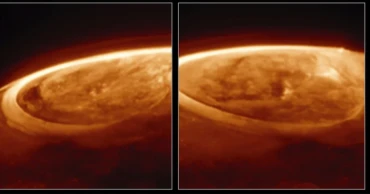
Bright auroras on Jupiter are captured by Webb Space Telescop
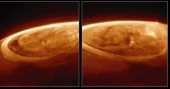
Stunning new images from the James Webb Space Telescope show that Jupiter’s auroras shine hundreds of times more brightly than those on Earth.
These brilliant light displays occur when energetic particles from space crash into gas atoms in Jupiter’s upper atmosphere near its magnetic poles — a phenomenon similar to the auroras, or northern lights, seen on Earth.
But Jupiter’s version has much greater intensity, according to an international team of scientists who analyzed the photos from Webb taken on Christmas in 2023.
Soviet-era spacecraft plunges to Earth after 53 years stuck in orbit
Webb previously captured Neptune’s glowing auroras in the best detail yet, many decades after they were first faintly detected during a flyby of the Voyager 2 spacecraft.
1 year ago

Spacecraft buzzes Jupiter’s mega moon, 1st close-up in years
NASA’s Juno spacecraft has provided the first close-ups of Jupiter’s largest moon in two decades.
Juno zoomed past icy Ganymede on Monday, passing within 645 miles (1,038 kilometers). The last time a spacecraft came that close was in 2000 when NASA’s Galileo spacecraft swept past our solar system’s biggest moon.
Read:NASA picks Venus as hot spot for two new robotic missions
NASA released Juno’s first two pictures Tuesday, highlighting Ganymede’s craters and long, narrow features possibly related to tectonic faults. One shows the moon’s far side, opposite the sun.
“This is the closest any spacecraft has come to this mammoth moon in a generation,” said Juno’s lead scientist, Scott Bolton of the Southwest Research Institute in San Antonio. “We are going to take our time before we draw any scientific conclusions, but until then we can simply marvel at this celestial wonder – the only moon in our solar system bigger than the planet Mercury.”
Read:Chinese cargo spacecraft docks with orbital station
Ganymede is one of 79 known moons around Jupiter, a gas giant. Italian astronomer Galileo Galilei discovered Ganymede in 1610, along with Jupiter’s three next-biggest moons.
Launched a decade ago, Juno has been orbiting Jupiter for five years.
5 years ago
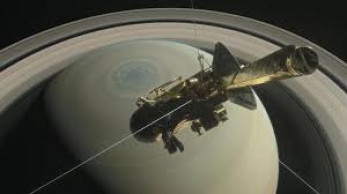
Discovery of 20 new moons puts Saturn ahead of Jupiter
Cape Canaveral, OCT 8. (AP/UNB) — The solar system has a new winner in the moon department.
6 years ago