UN Security Council
China, Russia veto UN Security Council draft on Strait of Hormuz
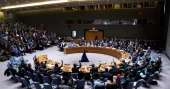
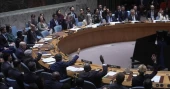
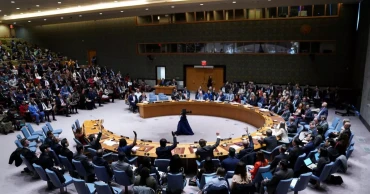
China and Russia vetoed a draft resolution at the UN Security Council that called for coordinated defensive efforts to secure the Strait of Hormuz, diplomats said.
The Gulf-backed draft received 11 votes in favor, while Pakistan and Colombia abstained, according to BBC report.
The resolution underwent weeks of negotiations and was significantly softened. Initially proposed under Chapter VII of the UN Charter, which authorizes the use of force, it was later revised to remove that provision and instead “strongly encourage” defensive measures by states.
Bahrain’s Foreign Minister Abdullatif bin Rashid Al Zayani, who chaired the meeting, said the draft aimed to address what he described as repeated hostile actions by Iran in the strategic waterway. He warned that failure to act could have serious global consequences and risk similar disruptions in other key maritime routes.
The Strait of Hormuz remains a critical global oil transit chokepoint, and tensions in the region have intensified amid ongoing geopolitical disputes.
5 months ago
UN Security Council fails to adopt resolution calling for halt to Middle East crisis
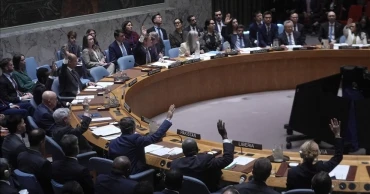
The UN Security Council on Wednesday failed to adopt a draft resolution calling for an immediate halt to military activities and urging all parties to avoid further escalation in the Middle East.
The resolution, proposed by Russia, also sought to condemn attacks on civilians and civilian infrastructure. However, it did not pass after receiving four votes in favour, two against and nine abstentions.
Russia, China, Pakistan and Somalia supported the proposal, while the United States and Latvia voted against it.
Russia’s UN Ambassador Vassily Nebenzia expressed disappointment over the outcome, saying some council members failed to gather the “strength and wisdom” needed to support the resolution.
Earlier the same day, the Security Council adopted another resolution related to the Middle East crisis, which followed the joint US-Israeli military strikes on Iran that began on Feb 28 and Tehran’s subsequent retaliatory attacks across the region.
The resolution, introduced by Bahrain on behalf of the Gulf Cooperation Council (GCC), was approved with 13 votes in favour and two abstentions. It condemns Iran’s attacks on GCC countries and Jordan, calls on Tehran to immediately stop such actions and declares them a breach of international law and a threat to international security.
Reacting to the decision, Iran’s UN Ambassador Amir Saeid Iravani said the resolution was “a manifest injustice” against Iran, describing it as unlawful and inconsistent with the UN Charter and international law.
6 months ago
UN Security Council condemns deadly militant attacks in Pakistan
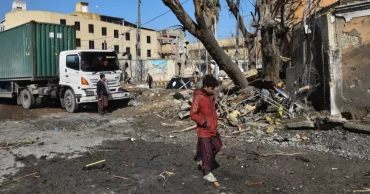
The U.N. Security Council on Wednesday strongly condemned a recent surge of militant attacks in southwestern Pakistan that have killed dozens, mostly civilians, as security forces intensified operations in the insurgency-affected region.
Authorities said Pakistani forces have killed scores of militants in recent days while cracking down on insurgents in Balochistan, where about a dozen coordinated attacks began Saturday, targeting civilians and buildings housing police and security personnel.
Federal and provincial officials reported at least 36 civilians and 17 security personnel killed. Security forces said they have so far killed 197 militants from the outlawed Baloch Liberation Army, which claimed responsibility for recent suicide bombings and gun attacks.
In an overnight statement, U.N. Security Council President James Kariuki said the council condemned in the “strongest terms the heinous and cowardly terrorist attacks across multiple locations” in Balochistan and expressed condolences to the victims’ families and the government and people of Pakistan.
Balochistan has long faced a separatist insurgency by ethnic Baloch groups seeking greater autonomy or independence from Pakistan’s central government. While Islamabad has claimed to have quelled the insurgency, sporadic violence has continued.
7 months ago
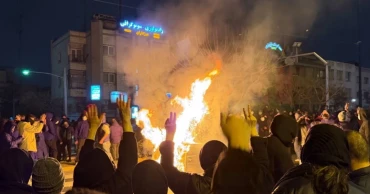
Trump says Iran paused execution plans as protests rage
U.S. President Donald Trump said Wednesday he had been told “on good authority” that Iran has stopped plans to carry out executions, even as Tehran signals fast-track trials and harsh punishments for thousands detained in its nationwide crackdown on protesters.
The U.S. president made the claim without providing details, days after telling protesting Iranians that “help is on the way” and that his administration would “act accordingly” in response to the Iranian government’s actions.
However, Trump did not explain how Washington might respond and it was unclear whether his remarks suggested a delay in any possible U.S. action.
Earlier in the day, Iran’s judiciary chief Gholamhossein Mohseni-Ejei said authorities must move quickly to punish more than 18,000 people detained during the unrest through rapid trials and executions.
Iran’s security forces have killed at least 2,586 people during the crackdown, according to the U.S.-based Human Rights Activists News Agency. The toll is the highest from any wave of unrest in Iran in decades, recalling the turmoil surrounding the country’s 1979 Islamic Revolution.
Tensions between Tehran and Washington remained high as Iran further extended an order closing its airspace to commercial aircraft without explanation early Thursday. A notice to pilots said the closure was expected to last until 7:30am local time.
The United States also requested an emergency meeting of the UN Security Council on Iran, while U.S. embassies in Kuwait and Qatar ordered heightened security measures and advised personnel to limit movements to key military bases.
Britain shut its embassy in Tehran and withdrew diplomats, citing security concerns, while several countries, including India and Italy, urged their nationals to leave Iran.
Iranian Foreign Minister Abbas Araghchi said Tehran is “ready for negotiation” and urged Washington to choose diplomacy over war, while again blaming foreign powers for the unrest.
US labels three Muslim Brotherhood branches as terrorist groups
Meanwhile, mass funerals were held in Tehran for security force members killed in the protests, and demonstrations in support of Iranian protesters continued in cities across Europe.
8 months ago
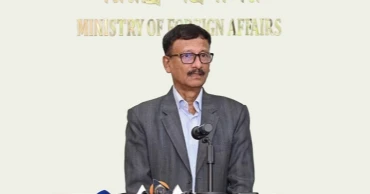
Dhaka yet to decide on sending forces under ISF to Gaza; reiterates conditions
Foreign Affairs Adviser Md Touhid Hossain on Wednesday (January 14, 2026) said Bangladesh has not yet taken any decision regarding sending its forces to Gaza under the International Stabilization Force (ISF), stressing that the country has clearly outlined three conditions.
“No decision has been made. It is still at the discussion level. It has not been determined yet who will be part of this initiative. Most importantly, three conditions have been mentioned clearly,” he told reporters responding to a question at the Ministry of Foreign Affairs.
Under no circumstances Bangladesh would join without the creation of an environment consistent with the three key preconditions, he added.
Read more: BSC should maintain profitable status, expand fleet: Prof Yunus
Asked about discussing such an issue at the fag end of the interim government’s tenure, Adviser Hossain said the tenure is ending with the February 12 election, but the government remains in place.
He said the country’s engagement and interests do not change overnight and the government would not do anything that goes against national interests.
The Foreign Affairs Adviser also said they are very hopeful that the upcoming transition will take place smoothly.
He the ISF is an issue of global concern and does not fully depend on Bangladesh alone.
The interim government said some Muslim countries are interested in participating in the force.
Chief Adviser’s Press Secretary Shafiqul Alam on Monday said they recognise the significance of the UN Security Council decision to establish the International Stabilization Force (ISF) for Gaza and understand that some Muslim countries are interested in participating in the force.
Read more: Election on Feb 12, no matter who says what: Prof Yunus tells former US diplomats
“We are also carefully considering the matter,” he said while responding to a question, noting that as one of the largest contributors to UN peacekeeping forces and an ardent supporter of the Palestinian cause, their interest in participating in the ISF is contingent on the fulfillment of a number of principles.
These include, among others, that the ISF should be temporary and operate under a clear UN Security Council mandate, he said, adding that there must be permanent ceasefire and complete withdrawal of all Israeli forces from Gaza; and the responsibilities for Gaza will be transferred to the Palestinians.
The Press Secretary said they remain steadfast in their support for the right of the Palestinians to self-determination and the establishment of a sovereign Palestinian State based on 1967 borders with Al Quds Al Sharif as its capital.
"As the third largest Muslim nation in the world, Bangladesh has consistently condemned Israeli genocide in Gaza, and called for its immediate end and the complete withdrawal of all Israeli forces from the territory,” Alam said.
Bangladesh noted that the United Nations Security Council, on 17th November 2025, adopted resolution 2803 which provided for, among other things, the establishment of an ISF for Gaza.
Alam said all Muslim countries members of the Security Council voted for the resolution.
He also said a number of other Arab and Muslim countries jointly recommended the adoption of the resolution by the Security Council.
Read more: ISF for Gaza: Dhaka weighs its options carefully
8 months ago

ISF for Gaza: Dhaka weighs its options carefully
Chief Adviser’s Press Secretary Shafiqul Alam on Monday (January 12, 2026) said they recognise the significance of the UN Security Council decision to establish the International Stabilization Force (ISF) for Gaza and understand that some Muslim countries are interested in participating in the force.
“We are also carefully considering the matter,” he said while responding to a question, noting that as one of the largest contributors to UN peacekeeping forces and an ardent supporter of the Palestinian cause, their interest in participating in the ISF is contingent on the fulfillment of a number of principles.
Read more: Gaza reports 14 dead after Israel says it killed two top Hamas figures
These include, among others, that the ISF should be temporary and operate under a clear UN Security Council mandate, he said, adding that there must be permanent ceasefire and complete withdrawal of all Israeli forces from Gaza; and the responsibilities for Gaza will be transferred to the Palestinians.
The Press Secretary said they remain steadfast in their support for the right of the Palestinians to self-determination and the establishment of a sovereign Palestinian State based on 1967 borders with Al Quds Al Sharif as its capital.
"As the third largest Muslim nation in the world, Bangladesh has consistently condemned Israeli genocide in Gaza, and called for its immediate end and the complete withdrawal of all Israeli forces from the territory,” Alam said.
Bangladesh noted that the United Nations Security Council, on 17th November 2025, adopted resolution 2803 which provided for, among other things, the establishment of an ISF for Gaza.
Alam said all Muslim countries members of the Security Council voted for the resolution.
He also said a number of other Arab and Muslim countries jointly recommended the adoption of the resolution by the Security Council.
Read more: Fourth Palestinian baby freezes to death in Gaza amid winter crisis
8 months ago

UN member states urged to pursue accountability for Rohingya genocide
Fortify Rights and 57 other groups in a joint statement on Wednesday said United Nations member states must pursue accountability for genocide and other atrocities committed against ethnic Rohingya civilians in Rakhine State, Myanmar.
“Eight years on from the start of the Myanmar military’s genocidal attacks against Rohingya, not a single person has been held criminally responsible. This is a deep stain on the world’s conscience,” said Senior Advocate at Fortify Rights Patrick Phongsathorn.
“It’s not too late to address this injustice. The UN Security Council (UNSC) should immediately refer the situation in Myanmar to the International Criminal Court, and all UN Member States should explore every possible avenue to pursue justice for the Rohingya,” Phongsathorn said.
August 25 is Rohingya Genocide Remembrance Day and marks the Myanmar military’s initiation of a series of massacres, killings, rapes and other genocidal attacks, which led to the forced deportation of at least 700,000 Rohingya people from northern Rakhine State to neighboring Bangladesh in 2017.
The joint statement noted that a UN Security Council referral of the situation in Myanmar to the International Criminal Court (ICC) would “ensure comprehensive accountability for crimes committed against all communities” in Myanmar.
Apart from a Security Council referral, the statement called on all UN Member States to “exercise universal jurisdiction to initiate or support criminal prosecutions of those responsible for crimes.”
Universal jurisdiction is a legal principle that enables domestic courts in many different countries to pursue justice for international atrocity crimes such as genocide and crimes against humanity.
On September 30, the UN General Assembly will convene a high-level conference on the situation of Rohingya Muslims and other minorities in Myanmar, where participants are expected to discuss responses to the ongoing abuses suffered by the Rohingya.
Diplomatic Missions seek inclusive engagement for Rohingyas in Bangladesh
The joint statement expressed concern “about the lack of Rohingya representation at the conference and the need for a wider spectrum of voices, including Rohingya women, youth, and diverse Rohingya-led civil society from Myanmar, Bangladesh, and the global diaspora.”
“Violence, abuse, and persecution of the Rohingya by multiple actors have been tolerated by the international community for too long,” said Patrick.
“As governments again gather to discuss the Rohingya crisis and the junta’s widespread atrocities throughout Myanmar, concrete steps toward justice and accountability must be devised alongside and in close consultation with Rohingya survivors.”
On August 25, 2017, following coordinated attacks by Rohingya militants on several Myanmar security posts, Myanmar armed forces and groups of local non-Rohingya citizens raped and murdered Rohingya men, women, and children, and burned and looted Rohingya property.
Publicly referred to by the Myanmar authorities as “clearance operations,” the attacks on August 25, 2017, and subsequent atrocities led to the fastest exodus of refugees since the Rwanda genocide.
A Fortify Rights report, released in 2018, found that Myanmar authorities made “extensive and systematic preparations” for attacks against Rohingya civilians in the weeks and months prior to the militant attacks on August 25, 2017, indicating premeditated genocidal intent on the part of the Myanmar authorities.
Similarly, a 2019 report from the Independent International Fact-Finding Mission, established by the UN Human Rights Council, found evidence of genocide and crimes against humanity.
On March 21, 2022, the US government issued a determination that Myanmar’s military committed genocide against the Rohingya.
Since the Myanmar military’s attempted coup on February 1, 2021, the Rohingya continue to suffer grave risks and ongoing persecution.
The junta’s movement restrictions and aid blockages have caused widespread hunger and avoidable civilian deaths.
Prof Yunus places 7-point roadmap for Rohingya repatriation
The Myanmar junta and Rohingya armed groups have unlawfully conscripted Rohingya in Bangladesh and Myanmar to fight in the ongoing conflict against the ethnic Rakhine armed group, the Arakan Army (AA).
Many other ethnic minority communities throughout Myanmar have also faced relentless airstrikes, civilian massacres, and other abuses at the hands of the illicit military junta’s forces.
The AA, which currently controls much of Rakhine State, has committed serious violations of the laws of war against Rohingya civilians, including murder, mutilation, and torture.
In May 2024, following fighting between the AA and the Myanmar junta and its allied Rohingya militias, AA fighters committed widespread arson and destruction of civilian property in downtown Buthidaung – a predominantly Rohingya town in northern Rakhine State.
On August 5 and 6, 2024, AA forces attacked fleeing Rohingya civilians as they attempted to seek safety in neighboring Bangladesh, killing more than one hundred men, women, and children.
More recently, Fortify Rights has documented how the AA have systematically abducted, tortured, killed, and beheaded Rohingya civilians.
All parties to the armed conflict in Myanmar must comply with international humanitarian law and engage with international justice mechanisms, Fortify Rights and 57 other groups said.
1 year ago
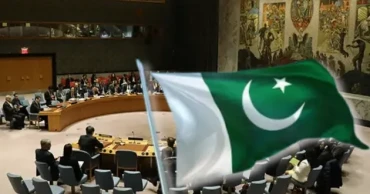
Pakistan to lead UN Security Council in July
Pakistan will take over the presidency of the United Nations Security Council (UNSC) starting Tuesday, overseeing the council’s proceedings throughout July, according to state media reports.
This marks a key moment in Pakistan’s ongoing two-year term as a non-permanent member of the Security Council, which began in January 2025.
Islamabad secured the position with a strong mandate, receiving 182 votes out of 193 during the election.
US vetoes UN security council call for immediate Gaza ceasefire
The presidency of the UNSC rotates every month among its 15 member states, following the alphabetical order of their names.
For July, the responsibility falls to Pakistan, placing it at the helm of one of the UN’s most influential bodies.
Source: With inputs from PTI
1 year ago
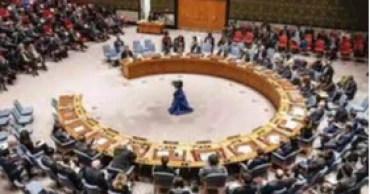
UN Security Council, minus China and Russia, condemns Myanmar military's killing of civilians
Members of the U.N. Security Council – minus China and Russia – condemned the “unrelenting violence” and killing of civilians in Myanmar and again urged its military rulers to stop attacks, release ousted leader Aung San Suu Kyi and respect human rights.
Thirteen of the 15 council members on Wednesday backed a joint statement that said there had been “insufficient progress” on implementing the first-ever Security Council resolution on Myanmar that was adopted last December. In that 12-0 vote, China and Russia, which have ties to the military that seized power from Suu Kyi’s elected civilian government in February 2021, abstained along with India whose two-year term on the council has ended.
Bangladesh urges OIC for efforts to send Rohingya back home in Myanmar
Britain’s deputy U.N. ambassador James Kariuki read the statement, flanked by diplomats from the other countries, after the council was briefed at a closed meeting by U.N. humanitarian chief Martin Griffiths on his recent visit to Myanmar and by Assistant Secretary-General Khaled Khiari on efforts to resolve the crisis.
The statement reiterates demands from the December 2022 council resolution that still require implementation: the immediate release of all “arbitrarily detained” prisoners including ousted leader Suu Kyi and president Win Myint, restoring democratic institutions, respecting human rights and “the democratic will of the people,” and upholding the rule of law.
It also calls for the full implementation of the plan by the 10-member Association of Southeast Asian Nations that Myanmar’s rulers agreed to in April 2021 but have made little progress in fulfilling. It includes an immediate cessation of violence, a dialogue among all parties mediated by an ASEAN envoy who is also to visit Myanmar and meet all parties. Envoys have visited but not been allowed to meet Suu Kyi.
The 13 council members said the military’s actions have left over 18 million people in Myanmar in need of humanitarian assistance – over 15 million of them without regular access to adequate food – and 2 million people displaced.
Investigators say Myanmar's military is committing increasingly brazen war crimes
Members also expressed ongoing concern about the plight of nearly a million Rohingya Muslims who fled Buddhist-majority Myanmar following a military crackdown in northern Rakhine state in August 27 to Bangladesh and other countries. They urged Myanmar “to address the fundamental causes of the crisis and restore the rights of Rohingya.” Almost all Rohingyas are denied citizenship and their movements are restricted.
At the council meeting, diplomats discussed a report this month by U.N. independent investigators who said Myanmar’s military and affiliated militias are committing increasingly frequent and brazen war crimes.
The Independent Investigative Mechanism for Myanmar, established in 2018 by the Geneva-based U.N. Human Rights Council, said it also found strong evidence during the year ending in June of the indiscriminate and disproportionate targeting of civilians with bombs, mass executions of people detained during military operations, and large-scale burning of civilian houses.
Nicholas Koumjian, head of the investigative group, said: “Our evidence points to a dramatic increase in war crimes and crimes against humanity in the country, with widespread and systematic attacks against civilians, and we are building case files that can be used by courts to hold individual perpetrators responsible.”
Myanmar atrocities, impunity must end: UN
U.S. Ambassador Linda Thomas-Greenfield cited the group’s report in a statement saying “the regime’s horrific atrocities must stop.” Given the military’s “intransigence and continued human rights abuses,” she said the Security Council needs to take action beyond last December resolution.
Myanmar’s U.N.-accredited ambassador, Kyaw Moe Tun, who represented the Suu Kyi government, urged the council to adopt a resolution banning the supply of weapons, jet fuel, and financial flows to the military.
“The people of Myanmar demand the removal of the military from politics and the establishment of a civilian, federal, democratic union," he said.
3 years ago
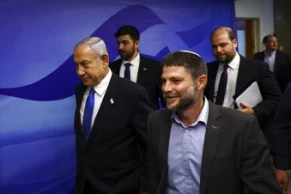
Israel approves over 7,000 settlement homes, groups say
Israel’s far-right government has granted approval for over 7,000 new homes in Jewish settlements in the West Bank, settlement backers and opponents said Thursday. The move defies growing international opposition to construction in the occupied territory.
The announcement came just days after the U.N. Security Council passed a statement strongly criticizing Israeli settlement construction on occupied lands claimed by the Palestinians. The United States, Israel’s closest ally, blocked what would have been an even tougher legally binding resolution, with diplomats saying they had received Israeli assurances of refraining from unilateral acts for six months.
Read More: 10 Palestinians killed, scores hurt in Israel West Bank raid
The new approvals took place during a two-day meeting that ended Thursday and appeared to contradict those claims. The U.S. has repeatedly criticized Israeli settlement construction, saying it undermines hopes for a two-state solution with the Palestinians, but taken no action to stop it.
Peace Now, an anti-settlement watchdog group that attended the meeting, said a planning committee granted approvals for some 7,100 new housing units across the West Bank.
The group said the committee scheduled a meeting next month to discuss plans to develop a strategic area east of Jerusalem known as E1. The U.S. in the past has blocked the project, which would largely bisect the West Bank and which critics say would make it impossible to establish a viable Palestinian state alongside Israel.
Read more: UN approves resolution calling for Russia to leave Ukraine
Lior Amihai, the group's incoming director, said some 5,200 housing units were in the early stages of planning, while the remainder were approved for near-term construction. He also said construction was approved in four unauthorized outposts.
Earlier this week, Prime Minister Benjamin Netanyahu’s office said he had pledged not to legalize any more wildcat outposts. He made the promise after retroactively legalizing 10 existing outposts earlier this month.
The Israeli government is “spitting on the face of the U.S., only a few days after announcing that they committed to them that there would be no advancement of settlements in the near future,” said Peace Now.
The United States criticized the decision. “We view the expansion of settlements as an obstacle to peace that undermines the geographic viability of a two-state solution,” said a National Security Council Statement. But it gave no indication that the U.S. was prepared to act.
Read more: Israel's Netanyahu advances judicial changes despite uproar
Nabil Abu Rudeineh, spokesman for Palestinian President Mahmoud Abbas, appealed to the United States to intervene. “The American side is required to stop this violation, which will not lead to any peace or stability in the region,” he said.
The planned construction is likely to add to the already heightened tensions following an Israeli military raid that killed 10 Palestinians in the West Bank city of Nablus on Wednesday.
The international community, along with the Palestinians, considers settlement construction illegal or illegitimate. Over 700,000 Israelis now live in the occupied West Bank and east Jerusalem — territories captured by Israel in 1967 and sought by the Palestinians for a future independent state.
Netanyahu’s new coalition, which took office in late December, is dominated by religious and ultranationalist politicians with close ties to the settlement movement. Finance Minister Bezalel Smotrich, a firebrand settler leader, on Thursday was officially granted Cabinet-level authority over settlement policies.
Smotrich had promised earlier this month a major settlement push. His office declined to comment Thursday, but settler representatives, who also attended the planning meeting, celebrated what they said were new approvals.
Yossi Dagan, a settler leader in the northern West Bank, welcomed the retroactive approval of 118 homes in “Nofei Nehemia,” an outpost in the northern West Bank, after a 20-year struggle. “Great news for Samaria, for settlement and for the entire nation of Israel,” he said, using the biblical name for the region.
Shlomo Neeman, chairman of the Yesha settler’s council, declared the approvals “a tremendous boost.” Neeman is also mayor of the “Gush Etzion” settlement bloc near Jerusalem, where settlers said hundreds of new homes were approved.
The decision marks one of the largest approvals of settlement construction in years. In comparison, some 8,000 units were approved in the previous two years, according to Peace Now.
“It's very big,” said Amihai.
3 years ago