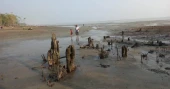
riverbank erosion

PM calls for eco-friendly solutions to tackle riverbank erosion
Prime Minister Tarique Rahman on Thursday stressed the need for adopting innovative and environmentally sustainable solutions to tackle riverbank erosion and asked the authorities to move forward with the use of vetiver grass to protect rivers, canals, embankments and transport infrastructure.
He gave the directive while chairing a meeting at the Cabinet Division in the Secretariat on the use of vetiver grass for protecting riverbanks and canal embankments, said PM’s Deputy Press Secretary Shahadat Shadhin.
At the meeting, Dr Muhammad Shariful Islam, Pro-Vice Chancellor of the Bangladesh University of Engineering and Technology(Buet) and a professor of the university's Civil Engineering Department, made a presentation on the use of vetiver grass as an environmentally friendly and sustainable alternative to concrete blocks and geo-blocks.
He highlighted its potential to prevent erosion of riverbanks and canal embankments, protect coastal dykes, stabilise roads in char and haor areas, and safeguard roadsides and railway embankments.
The presentation said vetiver grass could provide an effective, durable and eco-friendly solution to erosion. It also noted that the grass has already been used experimentally at several locations in the country with encouraging results.
The meeting also discussed implementing the initiative on a larger scale through dedicated projects.
2 months ago
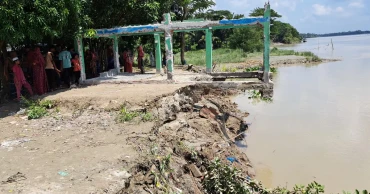
Par Bishnupur residents in Narial fall victims to riverbank erosion
Sudden and severe riverbank erosion has taken a devastating turn in Par Bishnupur village of Kalia upazila of Narail district, swallowing several business establishments overnight and leaving local traders and farming families in crisis.
According to locals, at least 10 shops in Par Bishnupur Bazar, situated on the banks of the Nabaganga River, collapsed into the river in a single night.
Trees along the market’s edge were also swept away.
The abrupt destruction has left business owners disoriented, while agriculture-dependent families are facing acute hardship.
Dhaka’s battery rickshaw anarchy: Crackdown or compromise?
Dilruba, a tea stall owner, shared her distress, “As a woman, I have been running this tea shop for years to support my family. With the shop gone to the river, I no longer have any income. Every day I worry about how to feed my children.”
Abdul Quddus, who owned a grocery, tea and cosmetics shop, said, “I have lost everything at once. The shop was my only source of livelihood. Now that everything has been washed away, I am left on the streets with my family. I don’t know where to go or what to do.”
Local resident Shariful Sheikh said that riverbank erosion is a recurring problem in the area, but this year’s devastation is unprecedented.
“Every year erosion happens here, but I never imagined it would be this severe. The entire market collapsed overnight. Unless a permanent embankment is built, the whole area will disappear into the river,” he said.
Anthrax outbreak spreads in Rangpur, sparks concern in northern districts
Another grocery shop owner, Nazrul Sheikh, expressed despair, “The shop’s earnings were enough to sustain my family. Now, with it gone, we are left destitute. Unless compensation or rehabilitation is arranged, we have no way to survive.”
Tea stall owner Atiar Mina said, “It was a small shop, but it was the lifeline for our family. The river has swallowed it. Now there is no work, and we are spending our days in hunger. If the government does not step in with urgent aid, we will be forced to live on the streets.”
Former chairman of Purulia Union Parishad, Abu Bakar Siddique, warned of the broader impact, “If the market collapses like this, the entire economy of the area will crumble. Not only the market, but roads, mosques, schools and many important structures are at risk. If the government does not immediately construct a permanent embankment, Par Bishnupur Bazar will soon vanish from the map.”
Feni villagers watch helplessly as erosion swallows homes
Responding to the crisis, Abhijit Kumar Saha, Executive Engineer of the Water Development Board, said, “As soon as we heard about the erosion at Par Bishnupur Bazar in Purulia Union, we dispatched representatives from the office. We are monitoring the situation closely. Discussions have already been held with higher authorities, and we will take measures as quickly as possible to prevent further erosion.”
1 year ago
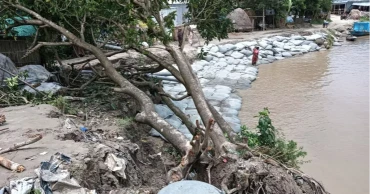
All Daulatdia ferry terminals face erosion threat as Padma swells
Riverbank erosion in the Padma has taken a serious turn with the rising water level since mid-July, putting all ferry terminals at Daulatdia under threat.
According to Bangladesh Inland Water Transport Authority (BIWTA), the three active terminals — No. 3, 4, and 7 — in Rajbari’s Goalanda upazila are now at serious risk of collapse.
Although sandbags are being dumped as part of emergency repairs the measures are insufficient given the scale of the erosion, said locals.
They said some adjoining villages including Bahir Char Sattar Member Para, Mojid Matubber Para, and Shahadat Member Para as well as markets, mosques, schools, and madrasas are also in danger.
BIWTA officials including the executive engineer of the Aricha office visited the site Saturday to assess the damage.
They reported severe erosion in a two-kilometre stretch around the terminals particularly around No. 4 and 7 terminals where ferry pontoons are becoming increasingly unstable due to soil loss.
Riverbanks residents alleged repeated delays in permanent river training.
Dharla erosion steals homes and hopes in Lalmonirhat
“Every monsoon brings the same problem, but no long-term solution,” said tea seller Shahin Sheikh. He also alleged irregularities in sandbag use.
Local residents Altaf Molla, Shahadat Pramanik, and Moyan Sardar said they do not want relief and want only effective river management.
They said they want to save their last refuge. “Many came with promises to prevent erosion but none kept their word,” said Altaf Molla.
Mohammad Salah Uddin, Assistant General Manager of BIWTC’s Daulatdia office, said, “Erosion has made the ferry terminals vulnerable. We’ve requested BIWTA to take immediate measures. Although three terminals are still operational, if erosion worsens, it may disrupt the transportation of passengers and vehicles.”
Panic grips Shariatpur residents as erosion resumes near Padma Bridge
Nepal Chandra Debnath, Executive Engineer of the BIWTA Aricha office, said, “Terminals 4 and 7 are at highest risk, and we’ve informed the authorities. As part of emergency repairs, around 700 sandbags have been dumped recently. However, no bags have been placed in the central part of the terminal yet. We can complete the remaining work if we receive the required allocation.”
1 year ago
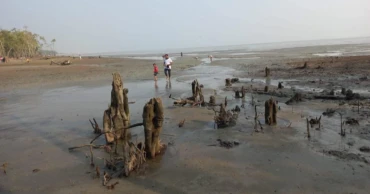
Sundarbans at stake as erosion shrinks forest land
The Sundarbans, the world's largest mangrove forest and a UNESCO World Heritage Site, is facing an alarming threat as relentless riverbank erosion steadily devours its landmass, displacing communities, destroying infrastructure and shrinking vital forest cover.
Spanning the delta region of the Padma, Meghna and Brahmaputra river basins, the Sundarbans is a crucial ecological zone shared between Bangladesh and India.
It is home to rich biodiversity, including the endangered Royal Bengal tiger. But continuous erosion is rapidly reshaping the landscape, with islands and coastal land disappearing into the sea.
Vanishing Land and Lost Infrastructure
Jetties, Forest Department offices and other vital infrastructure are being washed away, forcing officials to abandon their posts.
In September last year, the East Sundarbans Division sought assistance from the Bangladesh Water Development Board (BWDB) to curb erosion at nine vulnerable locations.
Although sand-filled geo bags were placed in front of the Forest Office to mitigate the damage, the measure has largely proven ineffective.
Top 3 Books in English on the Bangladesh Sundarbans
According to sources in the Forest Department, the situation has worsened over the years, swallowing entire forested areas along with their trees.
The jetty at the Dubla Forest Office, several drinking water ponds, cyclone shelters and freshwater reservoirs at Meherali Char have already been lost to the rising tides.
Meanwhile, the old rest house and jetty at Katka have disappeared, and the two-storey Bogi Forest Office building is on the brink of collapse into the river.
“The forest land is continuously being destroyed, and many trees have already vanished. The old rest house at Katka has gone into the sea, and numerous areas deeper into the Sundarbans have been submerged,” said Soyebur Rahman Suman, in charge of the Katka Sanctuary Centre, a popular tourist spot in the Sundarbans.
A Sabur, an officer at Bogi Forest Station, echoed similar concerns. “Our office-cum-barracks are also at risk of being submerged. Staff have been forced to move to alternative shelters to avoid further danger.”
Despite efforts to control the damage, the situation has not improved. “The Water Development Board placed sandbags in September and October last year to prevent erosion, but they have not been effective,” added Sabur.
Nylon net fencing starts in Sundarbans to prevent tigers entering surrounding localities
Nine Critical Zones Under Threat
Forest officials have identified nine key locations that are severely affected by erosion:
· Kachikhali Sanctuary Centre
· Katka Sanctuary Centre
· Chandeshwar Patrol Outpost
· Jelepalli Dubla Patrol Outpost
· Bogi Forest Station
· Jhapsi Patrol Outpost
· Jongra Patrol Outpost
· Karamjal Wildlife Breeding Centre
· Shuarmara Patrol Outpost
Rana Deb, Sharankhola Range Officer of the Eastern Sundarbans Division, noted that while some forest areas are eroding, new chars (sandbanks) are forming in other river regions. But this offers little consolation given the immense destruction already suffered by the Forest Department, particularly after Cyclone Remal.
Funding Shortages Hindering Protection Efforts
Abu Raihan Md. Albunni, Executive Engineer of BWDB in Bagerhat, admitted that financial constraints have hindered further erosion prevention efforts. “Sand-filled geo bags were placed in front of Bogi Forest Station, but due to budget limitations, no action has been taken in other erosion-affected areas,” he said.
Divisional Forest Officer of the East Sundarbans Division, Kazi Muhammad Nurul Karim, expressed grave concern over the worsening crisis, attributing it in part to climate change.
“We sent a letter to the Executive Engineer of BWDB in September last year, requesting urgent intervention at nine locations. Although some geo bags were placed in Bogi, they were ineffective in halting the erosion,” he said.
Sundarbans Day to be observed Friday, still awaits national recognition
Alarming Shrinkage of the Sundarbans
A World Bank report, Coping with Climate Change in the Sundarbans: Lessons from Multidisciplinary Studies (2020), presents alarming evidence of the forest's shrinking footprint. The total area of the Sundarbans (including both Bangladesh and India) measured 11,904 sq km between 1904 and 1924. By 1967, it had reduced to 11,663 sq km, and in 2016, it further declined to 11,506 sq km.
According to various sources, the Sundarbans is crisscrossed by approximately 450 rivers and canals, stretching about 350 km in total length. Natural tidal activity continuously reshapes these waterways, causing both erosion and deposition. However, the extent of land loss in the last century has far outpaced natural recovery, posing an existential threat to the forest and its inhabitants.
Need for Urgent Action
The relentless erosion of the Sundarbans demands immediate intervention from policymakers, conservationists and international stakeholders. Without robust mitigation strategies and sustainable erosion control measures, the continued loss of land will exacerbate climate vulnerability, displace more communities, and push the region’s fragile ecosystem further towards collapse.
Conservation projects paying fruit as Sundarbans witness increase in tiger population
1 year ago

Teesta riverbank erosion in Lalmonirhat: Fear of losing homes grips locals
Residents of areas along the Teesta river in Aditmari upazila of Lalmonirhat district are living in fear of losing their homes and crops as erosion has taken a serious turn.
Several thousand families living on the riverbanks were facing waterlogging issues due to the torrential rainfall last week. Several hundred hectares of cropland were damaged during this period.
But when the floodwater started to recede, panic gripped them as erosion took a serious turn in seven to eight points along the left side of the river.
Over the past few days, 25-30 houses, croplands and several establishments were washed away due to the erosion, forcing many families to live under the open sky.
Rising river waters trigger flooding, erosion concerns in Kurigram
Many have shifted their valuables including furniture on the roadside and near the flood protection dam.
Meanwhile, residents of Gobordhan and Garibullatari villages under Mahishkhocha union of the upazila saw severe erosion at the dead night on Tuesday near the embankment. A number of establishments including a mosque have gone into the river.
The families of Rabiul, Bhuttu and Yeakub Ali are living under the open sky as their homesteads were washed away due to the erosion.
Locals said if the authorities do not take any steps immediately, the embankment would also go into the river.
Villagers spend sleepless nights as Madhumati river banks erosion intensifies in Faridpur
They also demanded constructing a permanent dam along the riverbank.
Sunil Kumar, executive engineer of Lalmonirhat Water Development Board, said erosion occurred in seven-eight points along the riverbanks while erosion at spur dam-2 took a serious turn.
They have informed the matter to the high official concerned, he said.
After visiting the affected areas, GR Sarwar, Upazila Nirbahi Officer of Aditmari upazila, said a list of affected people is being prepared and assistance will be provided as per the list.
Teesta erosion worsens in Kurigram; 50 homes swept away
3 years ago
.jpg)
Ecnec approves Tk 1803-cr project to fight flood, riverbank erosion
The Executive Committee of the National Economic Council (Ecnec) on Tuesday approved 10 projects, including a Tk 1,803-crore one, to minimise damages caused by flood and riverbank erosion in four districts -- Pabna, Sirajganj, Tangail and Manikganj.
The approval came from the Ecnec meeting presided over by Prime Minister and also Ecnec Chair Sheikh Hasina. She joined it virtually from her official residence Ganobhaban.
The ministers and others concerned got connected from the NEC conference room in the city.
Read: City development: Ecnec clears Tk 2,490 cr for Chattogram
“Today the meeting approved a total of 10 projects, including five revised ones, with the overall estimated cost of Tk 4,621.34 crore (only additional costs of five projects were counted here),” said Planning Minister MA Mannan while briefing reporters.
Of the cost, Tk 3,055.21 crore will come from government funds and the remaining Tk 1,566.13 from foreign sources, he said.
Talking about Flood and Riverbank Erosion Risk Management Investment Program (Project-2) involving Tk 1,803.06 crore, he said Bangladesh Water Development Board implemented the project by December 2025.
According to the project factsheet of the Planning Commission, Tk 1329.77 crore will come as loan from the Asian Development Bank (ADB), while Tk 151.56 crore from the Netherlands government as project assistance. And the rest will come from government funds.
The project will be executed in Bera, Shahjadpur, Belkuchi, Chouhali, Tangail Sadar, Nagarpur, Daulatpur, Harirampur and Shibalaya upazilas of the four districts -- Pabna, Sirajganj, Tangail and Manikganj.
The main objectives of the project include improving the livelihood of the people living in the vicinity of the Jamuna and Padma rivers, developing flood and riverbank risk management through structural changes and enhancing institutional capacity and reducing riverbank erosion.
Its major operations include 30-km riverbank protection, 7.9-km dam construction, 40-km adaptation work, 6-km emergency work and 3-km dam management.
The other new projects are Bangladesh Industrial Technical Assistance Centre (BITAC) Office Establishment in Gopalganj, Sunamganj, Barishal, Rangpur, Jamalpur and Jashore with a cost of Tk 1,132.61 crore and Urea Formaldehyde -85 (UF-85) Plant Establishment involving Tk 724.30 crore, Sylhet Region’s Agricultural Development through modern technology with Tk 200.54 crore and Climate Smart Agriculture and Water Management (CSAWM) (DAE Part) with a fund of Tk 106.08 crore.
Read: Turning Bangladesh into digital economy: Ecnec clears Tk 2,542 cr project
The five revised projects are Netrakona-Bishiura-Iswarganj Road Development (1st revised) with additional cost of Tk 220 crore (now cost Tk 481.20 crore), Construction of Bangladesh Telecommunication Regulatory Commission Bhaban (1st revision) with additional cost of Tk 59 crore (now cost Tk 261.86 crore), Construction of 16 Regional Passport Offices (1st revision) with additional cost of Tk 31 crore (now cost of Tk 128.40 crore and construction of 17 regional passport offices and vertical extension of 4 passport offices).
Two other revised projects are Sheikh Hasina Cantonment Barishal Establishment (1st revised) with additional cost of Tk 331 crore (now cost of Tk 2030.10 crore), Widening the Approach Road and development of other necessary infrastructure of Bangabandhu Sheikh Mujib Safari Park, Gazipur (3rd revised) with an additional cost of Tk 43 crore (now its cost is Tk 282.06 crore).
4 years ago
.jpg)
Riverbank erosion leaves Gashial residents on the edge
In the remote Gashial mouja of Magura district, riverbank erosion along the Garai is a frequent affair.
Every monsoon, residents of the mouja see the ground literally disappear into the raging Garai. And over the past couple of years, the erosion has washed away several houses in the area, rendering hundreds homeless.
The residents allege that local authorities have never paid heed to their urgent pleas for measures to prevent erosion of the river bank. As a result, the house of Ajit Sheikh is the last structure standing on the edge.
Read Climate migration in Bangladesh may increase 7-fold by 2050: ActionAid
According to local resident Rustom Biswash, a freedom fighter, a large portion of Gashial mouja has been devoured by the river over the past 50 years. "Erosion is a perennial affair here," he says.
"If the authorities concerned do not act immediately, then the mouja could soon become a barren land," he adds.
In fact, the residents say that some 1,500 acres of land have disappeared in the mouja in the past few years and nearly 35-40 families in Char-Chougachi village are living with the fear of their houses being swept away.
Read Prof. Ainun Nishat joins Bangladeshi teenager’s climate campaign.
Owing to poverty and occupational reasons, many people in the village live near the river, which makes them a victim of erosion.
The local administration though says that it has dumped more than 15,000 sandbags on the riverbank to prevent erosion in the area. "The sandbags will prevent erosion to a large extent," says Anwar Hossain, a sub-contractor of the Water Development Board.
Read Dhaleshwari erosion takes serious turn in Keraniganj
The local residents, however, have demanded that the authorities build a river embankment in the area to put an end to the problem of riverbank erosion once and for all.
Solaiman Molla, president of River Erosion Protection Committee, says that this is the first time in 50 years that the authorities concerned have placed sandbags, "which is good news for the residents living here"
Mohammad Zakir Hossain, chairman of Dariapur Union, said already the dredging and sand-lifting work have been done.
Also read: Riverbank erosion displacees await rehabilitation.
Engineer Golam Sarwar of Water Development Board, says, "Sandbags have been placed in the 500-metre area along the riverbank and a committee will soon be formed to protect the river. More sandbags will be dumped in phases.”
5 years ago
.jpg)
Living in fear of the mighty Padma
Originally a resident of the Isaeel Shibrampur area in Goalundo upazila's Daulatdia union, Jalil Sikder now lives with his family in a hutment on a Good Samaritan's land in Nasir Sardar Para.
"We were rendered homeless after our house was washed away by the mighty Padma river in front of our eyes last year. Thanks to a benevolent person in Isaeel Shibrampur, we have a roof over our heads," he says.
Riverbank erosion is a common problem along the Padma during the rainy season.
And Jalil is also not the lone sufferer. Over the years, several families in the riverine areas of the upazila's Daulatdia and Debgram unions have been rendered homeless by such engulfing calamity.
READ: Padma boat capsize: Bodies of missing AIUB student, cousin found after 8 days
Some 2,000 families still living in the riverine areas of the two unions are now spending sleepless nights. Their fears are tangible, with monsoon rains barely a week away.
"Every day, the river is washing away some three to four bighas of land. The erosion aggravates during the monsoon when the Padma overflows its banks. It's high time that the authorities took safety measures without any delay," says Hazrat Sheikh, a resident of Devgram's Munshibazar area.
"In the past three years, some 300 families have been forced to abandon their houses in Devgram. What we get from the local authorities after every monsoon is only assurances of better preparedness for next year," says Ruby Khatun, a resident of Aziz Sardar Para.
Read Riverbank erosion destroys homes and hopes
Upazila Chairman Mostafa Munshi admits the problem the riverine areas face during the monsoon. "I have sought Rajbari-1 MP Kazi Keramat Ali's help in this regard," he says.
According to the Rajbari-1 MP, all preparations are underway for starting the construction of an embankment from Ferry Ghat to Debgram Antarmor to prevent erosion.
"The Executive Committee of the National Economic Council will soon begin work on Daulatdia and Paturia Ghat modernisation projects worth around Tk 650 crore," he says.
Upazila Nirbahi Officer (UNO) Azizul Haque Khan recently visited the affected areas. "For the time being, the Water Development Board is placing sand bags along the ferry ghat," he says.
READ: Padma devours SESDP Model High School in Madaripur
5 years ago
.jpg)
Riverbank erosion destroys homes and hopes
It's an ordeal people living on the banks of the Teesta and Dharla rivers in Lalmonirhat district go through almost every monsoon -- severe erosion of riverbanks. But this year, pre-monsoon showers have caused widespread damage.
Since last week, several buildings -- residential and educational -- in many areas of the district have been swallowed up by the mighty rivers, rendering hundreds homeless. Water levels in the Teesta and Dharla have gone up because of incessant showers over the past four-five days.
Read Dhaleshwari erosion takes serious turn in Keraniganj
While buildings in Mogolhat Folimari in Sadar upazila have been swallowed up by the Dharla, at least 20 houses in Kutirpar, Balapara, Badiartari and Chouraha of Aditmari upazila's Mohishkhocha union have been flattened by the Teesta.
5 years ago
.jpg)
Climate migration in Bangladesh may increase 7-fold by 2050: ActionAid
Bangladesh could see a seven-fold increase of climate migration, forcing 3 million people to migrate from their homes due to climate disasters by 2050.
5 years ago