Dhaka-Beijing
Time for Dhaka-Beijing to jointly create prosperity: PM's Adviser
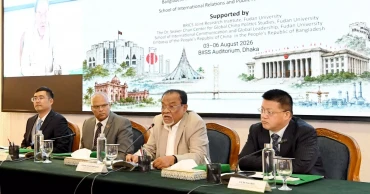
Prime Minister's Adviser on Public Administration Md Ismail Zabihullah on Thursday said Bangladesh has entered "a new chapter with renewed momentum and optimism" and now is the time for Bangladesh and China to jointly create prosperity for the benefit of the people.
"We must seize this historical opportunity to build a future of shared growth and mutual prosperity," he said while speaking as the chief guest at a programme in Dhaka.
Drawing lessons from China's rapid development over the past four decades, Zabiullah said sustained progress depends on long-term planning, institutional continuity, technological innovation and investment in human capital.
"History teaches us that countries progress not simply because they possess natural resources, but because they continue to learn from one another," he said.
He also stressed that Bangladesh has valuable experiences to share in areas such as microfinance, disaster management, climate resilience and pharmaceutical manufacturing.
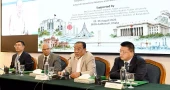
The four-day "Comparative Governance Forum 2026", jointly organised by the Bangladesh Institute of International and Strategic Studies (BIISS) and the School of International Relations and Public Affairs (SIRPA), Fudan University, concluded at the BIISS Auditorium.
1 month ago
Dhaka-Beijing ties poised for greater opportunities in next 50 years, scholars from both countries say
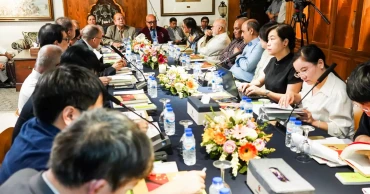
Noting that the story of Bangladesh-China relations extends far beyond the fifty years of formal diplomatic ties, scholars from both countries at a book launching-cum-seminar have said the next fifty years promise even greater opportunities for both nations and for the wider region with vision, patience, and continued cooperation.
Ahead of Prime Minister Tarique Rahman’s scheduled visit to China later this month, the experts highlighted that understanding history is essential for shaping the future and that the friendship between Bangladesh and China, nurtured over generations, remains a bridge connecting civilizations, economies, and people.
China supports Bangladesh’s development: Mirza Fakhrul
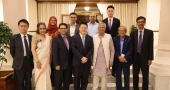
The event marking the formal launching of a book titled “50 Years of Bangladesh-China Relations: Achievements, Challenges & Prospects” was held in city’s Baridhara on Friday evening as part of the Cosmos Dialogue hosted by Cosmos Foundation, the philanthropic arm of the Cosmos Group.
The seminar was chaired by renowned scholar and Cosmos Foundation President Dr Iftekhar Ahmed Chowdhury while Catherine Grace Gardner Khan made the formal announcement of the event with her brief remarks.
The book is co-edited by Cosmos Foundation Chairman Enayetullah Khan and Professor Imtiaz Ahmed.
3 months ago
Beijing seeks to fast-track investment treaty with Dhaka, no matter who leads!
Chinese Ambassador to Bangladesh Yao Wen on Wednesday said no matter who leads Bangladesh, China will continue to increase trade and investment in the country, supporting its sustainable development and the improvement of people's livelihoods.
Speaking at a seminar in the capital, he said a sound investment environment requires institutional safeguards and hoped that Bangladesh will work with China towards the same direction to expedite the launch of negotiations on upgrading the Bangladesh-China bilateral investment treaty and Free Trade Agreement (FTI) between the two countries.
He said these efforts will help further bolster the confidence and determination of Chinese enterprises to invest in Bangladesh.
“We sincerely hope that our Bangladeshi friends will take it seriously and act promptly,” said Ambassador Yao while speaking at the seminar.
Executive Chairman of Bangladesh Investment Development Authority (BIDA) Chowdhury Ashik Mahmud Bin Harun, who spoke at the seminar, said they have a tendency of promising things nut not delivering.
“But in the government, we are trying to change that attitude and culture. Hopefully, you will see significant improvement,” he said.
Beijing working with Dhaka, Islamabad to follow up “concrete cooperation”: Ambassador Yao
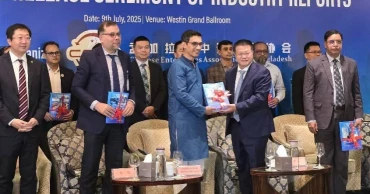
The Chinese Enterprises Association in Bangladesh (CEAB) hosted the seminar titled ‘China-Bangladesh Industrial and Supply Chain Cooperation’ where ‘Industry Reports’ by the CEAB was released.
Executive Chairman of Bangladesh Investment Development Authority (BIDA) Chowdhury Ashik Mahmud Bin Harun, along with representatives from the concerned agencies and departments of the Bangladesh government and business leaders from both countries were present.
He said China stands ready to work with Bangladesh to follow the strategic guidance of the two leaders’ important consensus, take the Golden Jubilee as a new starting point, advance high-quality Belt and Road cooperation, promote the integration of industrial and supply chains as well as investment and trade.
“Together, we can elevate our economic and trade relations to new heights, and further contribute to the China-Bangladesh Comprehensive Strategic Cooperative Partnership,” he said.
The conference featured in-depth research reports from specialised branches of CEAB, covering power and energy, roads and bridges, harbor, textile and garments, trade and services, railway and civil aviation, information and communication technology and water and environment.
These reports aim to identify market trends, investment opportunities and challenges, facilitating collaboration between Bangladeshi and Chinese enterprises under the Belt and Road Initiative (BRI).
Ambassador Yao said with the joint efforts of both countries, Chinese enterprises will continue to thrive in Bangladesh and contribute to its economic and social development as well as the improvement of people's livelihoods.
At Bangladesh’s current stage of development, he said, improving the business environment is crucial for fostering an open economy and achieving steady and sustainable development.
“Now, Bangladesh is also at a critical juncture of transformation and industrial upgrading. Under the able leadership of Chief Adviser Prof Muhammad Yunus, the economy keeps stabilising and improving, and the business environment is steadily enhancing, making the country emerge as a new investment hotspot in South Asia,” Ambassador Yao said.
Since Chinese enterprises constitute the largest group of foreign investors in Bangladesh, he said, it would be invaluable for the Bangladeshi friends to hear from their experiences and suggestions, which originate from their long-term operations here and are reflected in these ten reports.
“They crystallise the collective wisdom of Chinese enterprises in Bangladesh. I believe that they will serve as an important reference for the ongoing economic reforms in Bangladesh,” the Ambassador said.
In the first quarter of this year, Chinese investment in Bangladesh surged by 3.7 times. Since last August, nearly 20 Chinese companies have signed investment agreements with Bangladeshi partners, with a total intended investment exceeding US$400 million.
China has become the largest source of foreign direct investment in Bangladesh since the interim government took office.
The Chattogram Chinese Economic and Industrial Zone is about to start construction.
The cooperation documents for the Chinese Agrivoltaics Economic Zone at Baherchar Island have been signed, and the China-Bangladesh Mongla Port Economic Zone is progressing steadily, the Ambassador said.
He said China not only supports the current interim government but also has full confidence in Bangladesh’s future elected government.
1 year ago
Dhaka, Beijing need to unite to defend WTO rules: Ambassador Yao
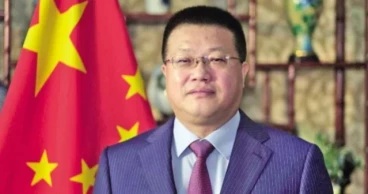
Referring to the US-imposed tariffs, Chinese Ambassador to Bangladesh Yao Wen on Wednesday said Bangladesh and China need to work to safeguard the WTO (World Trade Organization) rules and multilateral trade regime.
“That (WTO rules) is the centre to protect our common interest,” he said, adding that they support all the measures taken by Bangladesh to safeguard their legitimate interests.
The Ambassador made the remarks while responding to a question after attending a seminar in the capital.
WTO is the only international organisation dealing with the rules of trade between nations. At its heart are the WTO agreements, negotiated and signed by the bulk of the world’s trading nations and ratified in their parliaments.
The fundamental goal of the WTO, as set out in its founding agreement, is to use trade as a means to improve people's living standards, create better jobs and promote sustainable development.
Beijing working with Dhaka, Islamabad to follow up “concrete cooperation”: Ambassador Yao
The Chinese Enterprises Association in Bangladesh (CEAB) hosted a seminar titled ‘China-Bangladesh Industrial and Supply Chain Cooperation’, during which it released its ‘Industry Reports’.
Executive Chairman of Bangladesh Investment Development Authority (BIDA) Chowdhury Ashik Mahmud Bin Harun, along with representatives from the agencies concerned and departments of the Bangladesh government and business leaders from both countries were present.
Chief Adviser’s Press Secretary Shafiqul Alam on Wednesday said Bangladesh hopes to build on the progress made during the first round of fruitful negotiations with the United States, as the second round of talks on the tariff issue is set to begin in Washington DC today (Wednesday).
The Office of the U.S. Trade Representative (USTR) is responsible for developing and coordinating US international trade, commodity and direct investment policy and overseeing negotiations with other countries.
Starting on August 1, 2025, US President Donald Trump said they will charge Bangladesh a tariff of only 35% on any and all Bangladeshi products sent into the United States, separate from all sectoral tariffs.
1 year ago
Beijing for working together to maintain multilateral trading system, stability
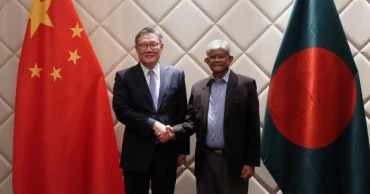
Chinese Commerce Minister Wang Wentao on Sunday stressed the need for countries, including Bangladesh, to work together in preserving the multilateral trading system and ensuring the stability and smooth functioning of global industrial and supply chains amid the current international climate.
While co-chairing the 15th Bangladesh-China Joint Economic and Trade Committee meeting in Dhaka with Finance Adviser Dr Salehuddin Ahmed, the Chinese Minister laid emphasis on unity advocating an equal and orderly multipolar world and inclusive economic globalisation, and promoting the construction of an open world economic system.
Adviser Salahuddin said Bangladesh firmly supports multilateralism and free trade, and attaches great importance to economic and trade cooperation with China.
He hopes to further expand the export of Bangladeshi products to China, according to the Chinese Ministry of Commerce.
The Adviser said Bangladesh is willing to create a good business environment for Chinese companies to invest in Bangladesh, and promote more pragmatic cooperation results between the two countries' enterprises in agriculture, education, medical care and health and other fields.
The two sides had an in-depth exchange of views on issues such as implementing the important consensus reached by the leaders of the two countries, deepening trade, investment and production and supply chain cooperation, and maintaining multilateralism.
Prof Yunus to return to his previous role by June 30: Shafiqul Alam
Wang said this year marks the 50th anniversary of the establishment of diplomatic relations between China and Bangladesh.
The relationship between the two countries has been continuously consolidated and deepened and bilateral economic, and trade cooperation has maintained healthy and stable development.
The Minister said China is willing to work with Bangladesh to earnestly implement the important consensus reached by the leaders of the two countries, promote high-quality joint construction of the ‘Belt and Road’, promote unimpeded trade, strengthen the integration of production and supply chains.
CA Prof Yunus invites Chinese firms to invest in Bangladesh
He laid emphasis on promoting the integrated development of investment and trade, exploring cooperation in emerging fields such as e-commerce and clean energy, and promoting the quality and upgrading of China-Bangladesh economic and trade cooperation.
After the meeting, the two sides jointly signed the Memorandum of Understanding on 'Strengthening Economic Cooperation in Industrial Chain and Supply Chain, between the Ministry of Commerce of China and the Ministry of Finance of Bangladesh.
1 year ago

Wang's visit to elevate Dhaka-Beijing comprehensive ties to new heights: Ambassador Yao
Chinese Ambassador to Bangladesh Yao Wen on Wednesday said Chinese Commerce Minister Wang Wentao’s upcoming visit would elevate the “Comprehensive Strategic Cooperative Partnership” between the two countries to new heights.
“It will serve as a platform for business communities of both countries to explore more cooperation opportunities, foster more fruitful outcomes in China-Bangladesh economic and trade cooperation,” he said while speaking at a function marking the export of Bangladeshi mangoes to China.
The ambassador said he is more than delighted to share that in just two days Minister Wang will lead a delegation consisting of over 100 Chinese companies to visit Bangladesh.
“My Bangladeshi friends have told me that this will be the largest business delegation ever visited Bangladesh in history,” he said.
Chief Adviser Prof Muhammad Yunus will inaugurate the Bangladesh-China conference on investment and trade in Dhaka on June 1 where the Chinese and Bangladeshi businesspeople will engage and explore trade and investment opportunities.
Wang, who is scheduled to arrive on May 31, will join the event as a special guest.
Around 250 investors and businesspeople representing 100 Chinese companies will attend the conference, said Chief Adviser’s Deputy Press Secretary Abul Kalam Azad Majumder on Tuesday.
Dr Anisuzzaman for persistent diplomatic engagement with S Korea
While briefing the reporters at the Foreign Service Academy, he said top representatives of four Chinese chamber bodies and top executives of some Chinese companies are among the participants of the daylong conference.
This is the continuation of a recently held investment summit in Dhaka, Azad said.
Bangladesh Economic Zones Authority (BEZA) and Bangladesh Investment Development Authority (BIDA) are going to jointly organise the event.
Wang is scheduled to arrive in Dhaka on May 31 to discuss issues of mutual interest and “elevate” Bangladesh-China economic and trade relations to a new level.
During his two-day visit, the minister is likely to meet Chief Adviser Prof Yunus and Commerce Adviser Sk Bashir Uddin in addition to his other engagements, a senior official told UNB.
Ambassador Yao said the visit of the largest-ever business delegation in Bangladesh from China, led by the Chinese minister of commerce, would send a ‘strong signal’ of openness, cooperation and mutual benefit.
1 year ago
With a strong signal, Dhaka-Beijing set to elevate trade ties to new level: Ambassador Yao
Chinese Ambassador to Bangladesh Yao Wen on Thursday said the visit of the largest-ever business delegation in Bangladesh from China, led by Chinese Minister of Commerce Wang Wentao, later this month would send a ‘strong signal’ of openness, cooperation and mutual benefit, and will elevate the Bangladesh-China economic and trade relations to a new level.
“We are confident that this visit will send a strong signal of openness, cooperation and mutual benefit, and will elevate China-Bangladesh economic and trade relations to a new level,” he said at a programme here, adding that Chinese Minister of Commerce will lead more than 100 Chinese investors to visit Bangladesh at the end of this month.
During the visit, the two sides will co-host a trade and investment exchange event, where hundreds of Chinese and Bangladeshi enterprises will engage and explore more cooperation opportunities.
Ambassador Yao said the 15th meeting of the Bangladesh-China Joint Economic and Trade Commission will be held to agree on concrete measures to further our economic and trade cooperation.
Mangoes, Hilsa to Hit Chinese Market Soon
He said they are also accelerating the exportation of Bangladeshi mangoes to
China.
By early June this year, the Ambassador said, the first batch of fresh mangoes will be on the Chinese market.
On top of that, he said, procedures for importing Bangladeshi jackfruit and guava are also ongoing.
"We hope that Bangladesh can soon open up Hilsa exports to China—after all, Chinese
foodies can’t wait to enjoy this delicious fish on their dining tables," said the Ambassador.
Prof Yunus welcomes investment proposals from UAE in various sectors
As more of Bangladesh’s quality agri-products make their way to China, and as more Chinese companies bring investment and innovation to this vibrant land, the Ambassador said they will absolutely see something incredible happen!
"Bangladesh’s industries will grow stronger, supply chains will become more robust, and—most importantly—people’s lives will be better with new opportunities and greater prosperity," he said, adding, "This is what we could do together, for our shared future."
The Ambassador said China’s support for Bangladesh’s development is a genuine and straightforward commitment. "It will always remain unchanged regardless of shifting circumstances."
He said China is the largest investor in Bangladesh since the formation of the interim government.
China has granted zero tariff treatment to 100% of Bangladeshi taxable items exported to China and promised to extend this preferential policy to 2028, two years after the graduation from the LDC status.
Since last August, over 15 Chinese companies have signed investment agreements with Bangladesh, with a total intended investment of around 400 million USD.
More than 30 companies have signed letters of investment intent with the Chittagong Chinese Economic and Industrial Zone.
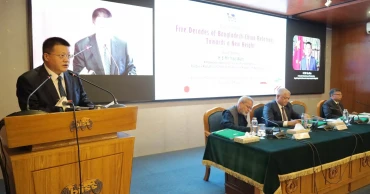
Bangladesh Institute of International and Strategic Studies (BIISS) organised the country lecture on ‘Five Decades of Bangladesh-China Relations: Towards a New Height’ at the BIISS auditorium.
BIISS Director General Major General Iftekhar Anis delivered welcome remarks while its Chairman AFM Gousal Azam Sarker chaired the session. Executive Director of the Centre for Alternatives, Bangladesh Imtiaz Ahmed made a presentation.
Senior officials from different ministries, serving and retired military officials, diplomatic missions, media, researchers, academicians and students from various universities, representatives from different think tanks, international organisations, participated in the country lecture and shared their opinions, comments, suggestions, and observations during the open discussion session.
In the Lecture, participants expressed their firm belief that as Bangladesh progresses toward its development goals and China continues its global outreach, the next chapter of this relationship promises even greater collaboration and mutual prosperity.
By embracing innovation, trust and shared vision, they said, Bangladesh and China can forge a future that benefits their peoples and the broader Asian region.
1 year ago
Dhaka, Beijing call for transforming high-level talks into actionable projects
Bangladesh and China on Sunday expressed a shared commitment to transforming recent high-level discussions into actionable projects across a range of sectors, including infrastructure, trade, healthcare, education and culture.
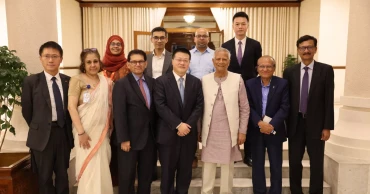
“Our top priority now is to move forward with the plans we discussed during the China visit,” Chief Adviser Professor Muhammad Yunus when Chinese Ambassador to Bangladesh Yao Wen met at the State Guest House Jamuna to review the outcomes of his (Dr Yunus) recent visit to China and outline next steps for accelerating Bangladesh-China cooperation.
“We want to make sure the momentum is not lost,” Chief Adviser’s Deputy Press Secretary Apurba Jahangir quoted the Chief Adviser as saying.
The Chinese Ambassador echoed the Chief Adviser’s sentiment, saying, “This is also our top priority. We had one of the highest-level agenda meetings in China, and we do not want to wait another two to three years just to sign agreements—we want to implement them quickly.”
One of the topics discussed was the development of the Mongla and Anowara economic zones.
BIDA Executive Chairman Chowdhury Ashik Mahmud Bin Harun informed that preparations are underway and, once completed, the zones will be handed over to developers to begin implementation.
Both sides reaffirmed their commitment to launching a long-term, 50-year master plan on water management, including work on the Teesta River system.
French Ambassador Masdupuy welcomes Rani Yan to Embassy
The two sides also discussed a plan to procure four new vessels from China, with the Chinese side assuring that the process would be completed by June this year.
The Chinese Ambassador also said that China’s Commerce Minister will visit Bangladesh soon, accompanied by a 100-member delegation of investors aiming to explore new investment opportunities.
“We will organise a mini investment summit focused on Chinese investors to strengthen sector-specific collaboration,” said BIDA Chairman Ashik.
Healthcare cooperation featured prominently in the discussion.
The Chinese side reaffirmed their commitment to building a 1,000-bed hospital in Bangladesh, as initially proposed during the China visit. They also highlighted ongoing support in establishing a specialised burn unit in Chittagong.
The Chinese Ambassador informed that progress is being made to launch a direct Kunming–Chittagong flight, and efforts are underway to expedite medical visas for Bangladeshi patients.
The Chief Adviser stressed the importance of cultural exchange, proposing the establishment of a Chinese Cultural Centre and Language Institute to allow young Bangladeshis to engage more closely with Chinese language and culture.
The Chief Adviser also raised the possibility of expanding jute exports to China and urged greater Chinese investment in the locomotive sector. He proposed setting up locomotive manufacturing and maintenance hubs in both Chattogram and Syedpur, alongside capacity-building workshops and training programmes.
Agricultural trade was another area of progress. Bangladesh will begin exporting mangoes to China this season, with jackfruit exports scheduled for next year. “I’ll send a basket of fresh mangoes to President Xi myself,” said Chief Adviser Dr Yunus.
The meeting was also attended by Foreign Adviser Md Touhid Hossain, National Security Adviser Dr Khalliur Rahman, BIDA Chairman Ashik Mahmud Bin Harun, Special Assistant Faiz Taieb, Cabinet Secretary SiraZ Uuddin Miah and SDGs Affairs Principal Coordinator Lamiya Morshed.
1 year ago
Dhaka seeks 50-year masterplan from Beijing for water management
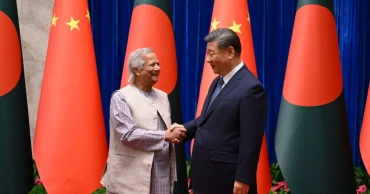
Chief Adviser Professor Muhammad Yunus on Friday sought a fifty-year master plan from China to manage the river and water system in Bangladesh, which is crisscrossed by hundreds of rivers.
The chief adviser made the call when Water Resources Minister of China Li Guoying met him at a state guest house on the third day of his four-day visit to the Asian country.
Prof Yunus praised the Chinese water and flood management system, saying the country has done wonders in managing some of the intractable water issues, CA’s Deputy Press Secretary Abul Kalam Azad Majumder told UNB.
“We have the same problem that you have. So, we'll be happy if you share your experiences”, the chief adviser told the Chinese minister.
“Bangladesh is a delta country; we have a country crisscrossed with hundreds of rivers. Water gives us life, but sometimes it becomes an enemy. Now that the population has increased manifold, we have to remain careful what kind of damages it causes to the ecosystem,” he added.
Calling China the master of water management, the chief adviser said that Bangladesh has a lot to learn from the country and urged China to share the vision of President Xi Jinping in water management with the country.
“We have come here to learn from you: how we can make water resources useful to people,” he said.
Prof Yunus said that the increase of population and demand for development are people grabbing lands by riversides.
Dhaka, Beijing sign 8 MoUs, 1 deal on economic, technical cooperation
The same demand has increased in upper riparian India, he said, adding that siltation was also causing a problem creating land in the middle of rivers, sinking them sometimes, leading them to death.
The Chinese minister acknowledged that China and Bangladesh share a similar challenge in water management. He promised technical support and expertise to Bangladesh.
“To manage water is a key management issue for Bangladesh; China is facing similar challenges,” he said, acknowledging that 85 per cent of Bangladesh’s people live in flood-prone plains, which has made water management complicated for the country.
He said that President Xi has put forward a master plan for China which the country was using to overcome the challenges in water management.
“We need your help to design the plan for us,” the chief adviser said.
He added that Bangladesh’s problem lies not just with one river but with the system.
He mentioned the Teesta River system and cleaning the polluted water in rivers surrounding Dhaka for particular help.
The chief adviser is currently on a four-day visit to China, holding meetings with Chinese leaders and investors to boost mutual cooperation with the country.
1 year ago
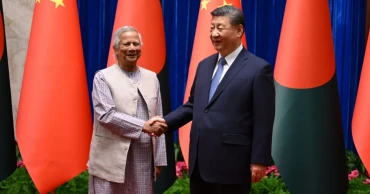
Dhaka, Beijing sign 8 MoUs, 1 deal on economic, technical cooperation
Bangladesh and China on Friday signed nine instruments, including the agreement on "economic and technical cooperation", between the two governments and other cooperation documents on development, translation and publication of classics, exchanges and cooperation on cultural heritage, news exchange and media and health sector.
The two countries signed eight MoUs on translation and production of classics, exchanges and cooperation on cultural heritage, news exchange, media, sports and health sectors, Chief Adviser's Deputy Press Secretary Abul Kalam Azad Majumder told UNB.
Besides, five announcements were made on the launching of formal negotiations on investment, the announcement of the commencement of the China Industrial Economic Zone, the signing of a commercial agreement for the modernisation and expansion of Mongla port, the building of a robot physiotherapy and rehabilitation centre, and the donation of a cardiac surgery vehicle, he said.
The two sides spoke positively of the signing of the Implementation Plan of the MoU on Exchange of Hydrological Information of the Yarlung Zanbo-Jamuna River.
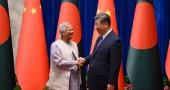
Bangladesh welcomed Chinese companies to participate in the Teesta River Comprehensive Management and Restoration Project (TRCMRP), according to the joint media statement issued after the bilateral meeting between Chief Adviser Prof Muhammad Yunus and Chinese President Xi Jinping.
Bangladesh welcomed Chinese companies to participate in the Mongla Port Facilities Modernization and Expansion Project, and stands ready to work with the Chinese side to further develop the Chinese Economic and Industrial Zone (CEIZ) in Chattogram.
The two sides underscored the importance to initiate negotiations on the China-Bangladesh Free Trade Agreement at an early date and officially start negotiations on optimising the China-Bangladesh Investment Agreement.
The two sides agreed to realise the early export of high-quality products of Bangladesh to China including fresh mangoes and other agricultural and aquatic produce as soon as possible.
Beijing pledges $2.1 billion in investments, loans, grants for Bangladesh
China welcomed Bangladesh to make full use of platforms such as the China International Import Expo, China-South Asia Expo, and China International Supply Chain Expo to expand cooperation with China. Bangladesh reaffirmed its readiness to create a favorable investment environment for Chinese companies.
The two sides agreed to strengthen cooperation in such areas as hydrological forecasting, flood prevention and disaster reduction, river dredging, integrated management of water resources, water resources development and related technology sharing.
The two countries agreed to make concerted efforts to tackle climate change and tap the potential for blue economy cooperation. The two sides agreed to strengthen exchanges on maritime affairs and hold a new round of Dialogue on Maritime Cooperation at an appropriate time.
They agreed to jointly celebrate the 50th anniversary of the establishment of diplomatic relations and the Year of China-Bangladesh People-to-People Exchanges in 2025.
The two sides agreed to deepen exchanges and cooperation on culture, tourism, media, education, health care and youth, and between local governments and think tanks, to enhance mutual understanding between the two peoples.
Bangladesh expressed appreciation for the convenience provided by China for Bangladeshi patients to seek medical treatment in Yunnan Province, and commended the vision of building a community with a shared future for mankind and appreciates the Global Development Initiative.
Bangladesh also takes note of the importance of the Global Security Initiative and the Global Civilization Initiative proposed by President Xi Jinping.
Both sides agreed to strengthen international cooperation, promote unity and self-reliance among the Global South and jointly address global challenges.
The year 2025 marks the 80th anniversary of the end of the Second World War and the founding of the United Nations.
Both sides reaffirmed their commitment to the purposes and principles of the U.N. Charter, the practice of true multilateralism and greater democracy in international relations.
Both the countries will jointly advocate an equal and orderly multi-polar world and a universally beneficial and inclusive economic globalisation.
They also agreed to keep strengthening coordination within the UN and other multilateral mechanisms and jointly safeguard the common interests of developing countries and uphold international fairness and justice.
Chief Adviser Dr Yunus expressed his sincere appreciation to President Xi Jinping and the Chinese people for the warm hospitality extended to him and the Bangladeshi delegation, and invited the Chinese leadership to visit Bangladesh at a mutually convenient time.
Bangladesh appreciated China's constructive role in promoting peace talks on Myanmar and in promoting the resolution of the issue concerning the forcibly displaced people from the Rakhine State of Myanmar who have taken shelter in Bangladesh.
China commended Bangladesh for providing humanitarian assistance for the displaced people from Rakhine State, and supported Bangladesh and Myanmar in finding among others a mutually acceptable solution through friendly consultations. China will continue to provide support for the repatriation to the best of its capabilities.
At the invitation of the Secretary-General of the Boao Forum for Asia, Chief Adviser Prof Muhammad Yunus attended the Boao Forum for Asia Annual Conference 2025 in Hainan, China from 26 to 27 March 2025, and then at the invitation of the Government of the People's Republic of China, the Chief Adviser is visiting Beijing from 27 to 29 March 2025.
Ding Xuexiang, Vice Premier of the State Council of the People's Republic of China, met with Chief Adviser Professor Yunus on the sidelines of the Boao Forum for Asia Annual Conference 2025 in Hainan Province.
Han Zheng, Vice President of the People's Republic of China also met with Chief Adviser Professor Yunus in Beijing.
No meet with Yunus features in Modi's BIMSTEC schedule in Bangkok
In a warm and friendly atmosphere, the two sides had in-depth exchanges of views on bilateral relations and international and regional issues of mutual interest and reached extensive consensus.
Dr Yunus attended the opening ceremony of the Boao Forum for Asia Annual Conference 2025 and delivered a speech.
The Chinese side welcomed the interim government of Bangladesh led by Professor Muhammad Yunus and noted the reform and progress made by the interim government since August 2024.
The Bangladesh side thanked the Government of the People's Republic of China for welcoming the interim government of Bangladesh and extending necessary support to carry forward bilateral relations.
Both sides reconfirmed equal commitment to nurturing the Comprehensive Strategic Cooperative Partnership with utmost importance.
They also agreed that since the establishment of diplomatic relations between China and Bangladesh 50 years ago, relations between the two countries have maintained healthy and stable development regardless of changes in the international and regional landscape.
The two sides agreed to hold fast to the Five Principles of Peaceful Coexistence, carry forward their traditional friendship, deepen political mutual trust and synergy between development strategies, keep moving forward in the China-Bangladesh Comprehensive Strategic Cooperative Partnership, and deliver greater benefits to the two countries and their peoples.
1 year ago