Myanmar’s Rakhine State
Dhaka seeks fitting measures, security in Rakhine to avoid another cycle of displacement
State Minister for Foreign Affairs Shama Obaed Islam on Sunday laid emphasis on creating conducive conditions in Myanmar’s Rakhine State, with required security measures and the rights of the Rohingyas in place, so that those now taking shelter in Bangladesh can return to their place of origin safely.
“We need appropriate conditions there. We need security there; we need respect for identity (Rohingyas) and rights there. We need legal recognition for the Rohingyas there; we need freedom of movement there; we need access to livelihoods, education and healthcare,” she said.
Speaking at a programme in the city as the special guest, Shama Obaed called upon the United Nations (UN), Association of Southeast Asian Nations (ASEAN), development partners and other international stakeholders to support practical, confidence-building and humanitarian-development initiatives in Rakhine State of Myanmar.
Bangladesh is currently hosting over 1.3 million Rohingyas in Cox’s Bazar and Bhasan Char Island, and not a single Rohingya refugee has officially been returned to their homes in Rakhine since the biggest influx witnessed in August 2017.
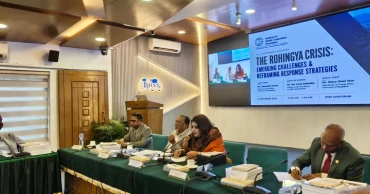
The Institute for Global Cooperation Foundation (IGCF) organised the roundtable discussion titled “The Rohingya Crisis: Emerging Challenges & Reframing Response Strategies” at the auditorium of the Bangladesh Institute of International and Strategic Studies (BIISS).
Home Minister Salahuddin Ahmed attended the programme as the chief guest, while Prime Minister’s Adviser on Public Administration Md Ismail Zabihullah spoke as the guest of honour.
“We need confidence that return will not result in another cycle of displacement. We need dialogues aiming towards reconciliation. This is where we seek stronger international engagement,” said the State Minister.
She expressed optimism that with determined diplomacy, strong national coordination and sustained international support, Bangladesh can once again turn the aspiration of repatriation into reality.
Shama Obaed said Bangladesh’s diplomatic efforts to resolve the Rohingya crisis have continued on multiple fronts, with the government engaging bilaterally with Myanmar as well as through the United Nations, ASEAN, OIC and other international partners.
“We remain engaged bilaterally with Myanmar. We are working through the United Nations and its relevant mechanisms. We remain engaged with ASEAN and regional partners. We continue our engagement with the OIC, international partners, legal bodies, and humanitarian and development organisations,” she said.
“Our objective is to maintain international attention, strengthen humanitarian support, promote accountability and, above all, create conducive conditions for return,” she added.
Regarding bilateral engagement with Myanmar, Shama Obaed said Bangladesh has prioritised expediting the verification process of the Rohingyas to move towards actual repatriation.
“Verification cannot become an open-ended administrative exercise. We need to expedite verification on the basis of the existing bilateral arrangements while addressing the practical realities of those born in the camps and those who have arrived from Rakhine since 2017,” she said.
The State Minister said the establishment of the National Strategy Formulation Committee on Rohingya Affairs under the Prime Minister’s leadership is a strategic way forward and demonstrates the highest level of political commitment.
“The committee’s objective is to develop a coordinated strategy for swift and sustainable repatriation, bringing together relevant ministries, agencies and security institutions,” she said.
“This is an important shift from managing displacement to strategically pursuing its resolution,” Shama Obaed said.
She said Bangladesh also needs to remain realistic about the humanitarian dimension of the crisis.
“Bangladesh will continue to fulfill its humanitarian responsibilities, but humanitarian support is becoming increasingly difficult to sustain as international funding declines,” she said.
She said Bangladesh is urging donors and partners to scale up their efforts to preserve the lives of the displaced Rohingyas.
“For us, there is another strategic challenge. We need to maintain the humanitarian character of our response while ensuring that such assistance in the camps does not unintentionally encourage further displacement and complicate the scenario for prospective return,” Shama Obaed said.
UNHCR Representative in Bangladesh Ivo Freijsen, BIISS Director General Major General A S M Ridwanur Rahman, Refugee Relief and Repatriation Commissioner (RRRC) Mohammad Mizanur Rahman, Refugee Cell Chief and Joint Secretary of the Ministry of Disaster Management and Relief Mohammad Nazmul Abedin, Chairman of the Department of Peace and Conflict Studies at Dhaka University Prof Dr Sazzad Siddiqui, Prof Dr Niloy Ranjan Biswas of DU’s Department of International Relations, Jahangirnagar University Prof Dr Nurul Huda Sakib, IUB Prof Dr Kazi Mahmudur Rahman, ULAB Assistant Professor Abantee Harun, ActionAid Bangladesh Country Director Farah Kabir, among others, spoke at the roundtable.
The roundtable began with a welcome address by IGCF Chief Executive Officer (CEO) Chowdhury Adnan Rahman.
Prof Dr Bulbul Siddiqi of the Department of Political Science and Sociology at North South University moderated the event.
1 month ago
Govt kept people in the dark about Rakhine corridor: BNP’s Hafiz
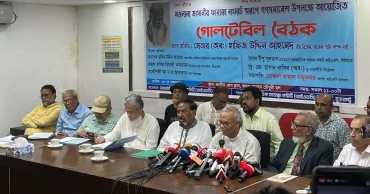
BNP Standing Committee member Major (retd) Hafiz Uddin Ahmed on Tuesday alleged that the government has kept the public and political parties in the dark about the humanitarian corridor to Myanmar’s Rakhine State and warned that it could drag Bangladesh into a war.
“We are deeply worried that the current government is talking about a humanitarian corridor (to Rakhine). We don’t know what kind of corridor it will be—the people don’t know, the political parties don’t know—what its purpose is. Are we going to get involved in a new war?” he told a discussion.
On such a crucial issue, the BNP leader said the government should have discussed it with political parties.
Reforms must be democratic, not imposed: Amir Khosru
International Farakka Committee, Bangladesh, arranged the roundtable discussion at the Jatiya Press Club, commemorating populist leader Maulana Abdul Hamid Khan Bhasani’s long march towards the Farakka Dam 49 years ago.
Hafiz noted that the Foreign Affairs Adviser and the Chief Adviser’s Press Secretary made conflicting statements regarding the corridor.
“Someone said that an agreement has been made but its conditions cannot be disclosed. One of its advisers said they have not given a final opinion on the corridor. So, people are in the dark. What kind of government is this!” he said.
Fakhrul off to Thailand for urgent eye treatment
The BNP leader said the people of Bangladesh ousted the mafia regime of Sheikh Hasina through a 16-year struggle for the restoration of democracy. “Why should we still remain in the dark? The most popular party, BNP, also does not know what kind of corridor it is or what will be done with it.”
He said there is no alternative for Bangladesh but to gain strength by utilising its military and the younger generation.
“Myanmar is a country of six crore people, while we are a country of 18 crore. What is the purpose of maintaining our large army? Will it only be used to rescue empty canals and rivers, distribute relief, and build bridges? Or is its main task to safeguard our independence by empowering the people? A state decision is needed on this matter,” the BNP leader said.
He said strong unity among the people is essential, as Bangladesh has a very vibrant young population.
“We, being imbued with nationalist spirit, must turn Bangladesh into a powerful country. We want to remain united; we will not be involved in any kind of aggression. Our goal is overall economic emancipation and progress. To achieve this, we need an elected government, discarding the current amateur one,” the BNP leader said.
Speaking at the programme, BNP Senior Joint Secretary General Ruhul Kabir Rizvi said India is unilaterally withdrawing water from many common rivers, violating the internal rules and norms.
He criticised India for its aggressive attitude towards its neighbours stance and for depriving Bangladesh of its fair share of water from common rivers, including the Ganges, through the construction of the Farakka Barrage and other dams.
Rizvi said Bangladesh did not take any side during the recent brief conflict between India and Pakistan.
He, however, lamented that the Indian media launched various negative campaigns, attempting to associate Bangladesh with Pakistan.
1 year ago

75,971 Rohingya babies born in last three years: Save the Children
Save the Children has said an estimated 75,971 children under three years or nine percent of the total Rohingya population are now living in the Rohingya camps in Cox’s Bazar district.
6 years ago