Museums
Museums become bridges between civilizations, bringing world cultures closer to people
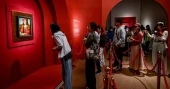
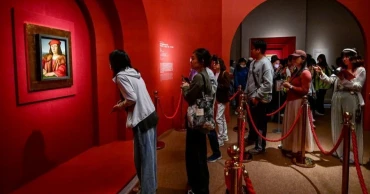
Museums are increasingly playing a vital role in connecting people with different civilizations, allowing visitors to explore the history, culture and traditions of distant countries without leaving their own cities.
From ancient Cambodian artifacts in Beijing to royal treasures from Kuwait in northwest China, museums across the country are attracting growing numbers of visitors eager to learn about other cultures and gain deeper cultural experiences.
At the Meet You Museum in Beijing’s 798 Art Zone, an exhibition featuring 122 artifacts from the National Museum of Cambodia is giving Chinese visitors a rare opportunity to explore the rich heritage of the Angkor civilization. The exhibition, which opened on May 1, will continue until August 30.
Li Duo, who has a master's degree in archaeology, said the exhibition offers a chance to closely experience another great civilization and better understand its history and achievements.
“Being able to encounter another major civilization without traveling abroad shows the true value of museums,” she said.
The exhibition combines historical artifacts with modern technology. According to Wang Haixuan, vice president of the Beijing Zhongchuang Tourism & Culture Group, digital displays recreate the engineering wonders of Angkor Wat, while interactive systems allow visitors to engage with characters from ancient myths.
The museum has also organized exhibitions on other ancient civilizations, including a popular Egyptian exhibition last year.
“Our aim is to provide opportunities for people to learn about cultures from around the world,” Wang said, adding that such exhibitions are especially popular among young people, families and museum enthusiasts.
He described museums as bridges linking the past with the present and connecting China with the wider world through cultural exchange and dialogue.
According to China's National Cultural Heritage Administration, the country had 7,188 registered museums by the end of 2025, with more than 91 percent offering free admission. Together, they welcomed around 1.56 billion visits last year.
Across China, both public and private museums are increasingly hosting international exhibitions, bringing global cultures closer to domestic audiences.
At the Gansu Provincial Museum in Lanzhou, visitors can explore "Golden Dust of Time: Exhibition of the Royal Collection From Kuwait," which features 130 groups of artifacts from the Kuwaiti royal collection, including gold ornaments, sculptures and ceremonial vessels.
Liu Chunxia, a tourist from Guangzhou, said the exhibition helped her gain a deeper understanding of Kuwaiti history and culture despite never having visited the country.
“These artifacts show the artistic skills, beliefs and lifestyles of people who lived thousands of years ago,” she said.
Experts say the growing popularity of such exhibitions reflects a rising demand among Chinese visitors for cultural and educational experiences as living standards improve.
Ban Rui, director of the Gansu Provincial Museum, said museums are evolving from institutions focused mainly on local history into platforms that encourage exchanges between civilizations.
Organizing international exhibitions often involves high costs and complex logistics, including transportation, insurance and promotion. To overcome these challenges, many museums are increasingly working with state-owned enterprises and private-sector partners to expand access to overseas exhibitions.
This year alone, Chinese museums have hosted exhibitions from countries including Italy, the Czech Republic, Syria, Britain, Greece and Kuwait.
Shanghai is also preparing to launch a major exhibition titled "Ancient Civilizations of the Americas" in July. The 16-month exhibition at the Shanghai Museum will showcase the history and culture of ancient American civilizations and continue the museum’s efforts to introduce world cultures to Chinese audiences.
At the same time, Chinese cultural heritage is reaching wider international audiences.
The culture of Dunhuang, famous for its historic Mogao Grottoes, has become an important part of China's cultural exchanges abroad. Through digital technology, reconstructed caves and immersive exhibitions, audiences in countries such as France have been able to experience the beauty of Dunhuang's art and history.
Chai Qilin of the Dunhuang Academy said overseas visitors have shown strong interest in Chinese cultural exhibitions and often express a desire to see more similar events.
“These exhibitions help people gain a deeper and more direct understanding of Chinese culture,” he said.
The Shanxi Museum has also expanded its international presence, partnering with museums in countries including the United States, Australia, Russia, France, Greece and Mexico since 2012.
According to Zhang Huiguo, deputy director of the museum, ancient Chinese bronze and jade artifacts have attracted significant attention abroad because of their unique craftsmanship and cultural significance.
The museum also uses interactive displays and immersive technologies to explain traditional Chinese architectural techniques and ancient bronze-making methods, making Chinese culture more accessible to international audiences.
In Mexico, museum experts highlighted similarities and differences between traditional Chinese silver craftsmanship and local silver-making traditions, helping visitors better understand both cultures.
Zhang said China's growing international influence has helped increase global interest in Chinese culture, from traditional Hanfu clothing and Chinese cuisine to exhibitions showcasing the country's long history and cultural heritage.
“International exhibitions are not only about promoting cultural diversity,” he said. “They are also about strengthening cultural connections and people-to-people exchanges around the world.”
4 months ago
9/11 artifacts share ‘pieces of truth’ in victims’ stories
For nearly six years, Andrea Haberman’s ashen and damaged wallet lay mostly untouched in a drawer at her parents’ Wisconsin home, along with a partly melted cell phone, her driver’s license, credit cards, checkbook and house keys. Flecks of rust had formed on the rims of her eyeglasses, their lenses shattered and gone.
Those everyday items were the remnants of a young life that ended when a hijacked jetliner struck the north tower of the World Trade Center on Sept. 11, 2001. Haberman was 25 and about to be married when she was killed while on a business trip from Chicago — her first visit to New York City.
Her belongings, still smelling of Ground Zero, evoked mostly sorrow for Haberman’s family. To ease their pain, they donated the artifacts to the 9/11 Memorial & Museum.
“These are not the happy things you want to remember someone by,” said Gordon Haberman, her father.
Read: From election to COVID, 9/11 conspiracies cast a long shadow
The collection of some 22,000 personal artifacts — some on display at the 9/11 museum, and others on display at other museums around the country — provide a mosaic of lost lives and stories of survival: wallets, passports, baseball gloves, shoes, clothes and rings.
“Each person who makes up part of that tally was an individual who lived a life,” said Jan Ramirez, the museum’s chief curator and director of collections.
“We knew that families — the people that have lost a loved one that day — were going to need to have a place, have a way, to remember the person that never came home from work, that never came home from a flight,” Ramirez said.
Many of those personal effects were plucked from the ruins of what was once the Twin Towers. Other items were donated by survivors or by the families of those who perished.
A woodworking square, screwdriver, pry bar and a toolbelt represent Sean Rooney, a vice president at Aon Corp. who died in the South Tower. Rooney’s essence was that of “a builder,” his sister-in-law Margot Eckert said, making the carpenter’s tools donated to the museum the “perfect antidote to the destruction.”
Rooney had phoned his wife, Beverly Eckert, at their home in Stamford, Connecticut, after being trapped by fire and smoke on the 105th floor. He spent his last breaths recounting happier times, whispering, “I love you,” as he labored for air.
His remains were never found.
5 years ago
.jpg)
Museums, archaeological sites to reopen from Wednesday
After six months of closure due to the ongoing COVID-19 pandemic, the government has decided to reopen all museums and heritage sites under the Department of Archaeology on a limited scale from Wednesday.
6 years ago