digital technology
Digital technology and smart machines reshape farming in China's northeast granary
Digital technology, artificial intelligence and smart agricultural machinery are transforming farming across northeast China's Heilongjiang Province, one of the country's most important grain-producing regions.
For 16 consecutive years, Heilongjiang has ranked first in China in total grain production. Its farming sector is already highly mechanized, with the mechanization rate for plowing, planting and harvesting reaching 99.28 percent.
Now, the province is moving toward smarter farming, using AI, drones, remote sensing and advanced machinery to help farmers monitor crops, improve efficiency and make more informed decisions.
The shift is part of China's broader efforts to strengthen food security and modernize rural areas.
Digital technology changes farming
At Beidahuang Information Company in Harbin, a large digital map tracks around 48 million mu, or about 3.2 million hectares, of farmland.
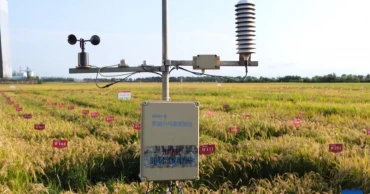
The system receives real-time information on soil conditions, crop growth and agricultural machinery. Satellite technology, the Internet of Things and AI are increasingly being used throughout the farming process, from planting to harvesting.
Wang Hao, deputy general manager of the company's market operation center, said technology has made it possible to monitor much larger areas in less time.
Previously, a farmer could inspect about 200 mu of farmland in a day on foot. With drones and remote sensing, crop conditions across vast areas can now be updated every five days, he said.
The data helps farmers make decisions on fertilization, pest control and other farm activities.
The company has developed more than 60 digital systems for agricultural management. Its AI model for cold-region crops uses information on soil, weather and crop growth to help create planting plans and recommend appropriate fertilizer use.
The company's agricultural service app has also helped improve efficiency and reduce management costs, with online transactions through the platform exceeding 100 billion yuan, or about $14.74 billion.
However, Wang said large-scale adoption of smart agriculture still faces challenges, including limited data, differences in local farming conditions and the need to test AI systems in different environments.
Smart machines enter the fields
Smart agricultural equipment is also becoming increasingly common in Heilongjiang.
At one farming base, a four-wheel laser weeding robot moves through crop rows using cameras and sensors to identify weeds. The system then uses lasers to remove the unwanted plants without damaging crops.
Li Yongwei, deputy general manager of Harbin Huagong Zhiyun Technology Co., Ltd., said traditional weeding often depends on manual labor or chemicals, both of which can be costly or harmful to the environment.
He said the laser technology can remove more than 95 percent of weeds while keeping crop damage below 0.1 percent. It can also reduce weeding costs by up to 70 percent compared with manual work.
Agricultural machinery is also becoming more advanced.
At Heilongjiang Dewo Technology Development Co., Ltd., electric-drive precision seeders allow farmers to monitor and adjust air pressure and seed spacing in real time through smart terminals.
According to the company, the machines can operate about 50 percent faster than traditional mechanical seeders while reducing seed damage.
Dewo now accounts for more than 60 percent of China's high-end electric-drive seeder market and has begun exporting its equipment overseas.
The company has supplied potato farming machinery to countries including Russia, Kazakhstan, Peru and Zimbabwe, while also exporting seeders to the Republic of Korea.
Push for intelligent farming
Heilongjiang recorded its 22nd consecutive bumper harvest in 2025, producing a record 82 million tonnes of grain. The province also had around 676,000 intelligent agricultural machines, the highest number in China.
The provincial government plans to further expand the use of agricultural robots, smart farming equipment and other advanced technologies during China's 15th Five-Year Plan period from 2026 to 2030.
Construction also began in August on a national pilot base for AI applications in crop farming, aimed at solving technological challenges and developing AI systems that can be used on a larger scale.
The move reflects China's wider push to modernize agriculture through better farmland, improved seeds, advanced machinery and new farming methods.
China is also expanding the use of drones, IoT technology and robots in rural areas as part of efforts to improve agricultural productivity and support rural development.
Hu Jinyou, a professor at China Agricultural University, said relying only on manual labor and traditional farming methods is no longer practical.
Although smart agriculture still needs further improvement, he said the deeper integration of AI and farming is an irreversible trend, with a new generation of educated farmers expected to make digital farm management increasingly common.
1 month ago
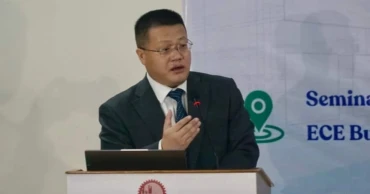
Hopeful of more “united, stable, democratic, prosperous Bangladesh”: Ambassador Yao
Stressing that Dhaka-Beijing relationship is a people-centric one, Chinese Ambassador to Bangladesh Yao Wen on Tuesday expressed optimism that Bangladesh can overcome all the difficulties and challenges by working together to bring a new Bangladesh which is “more united, stable, more democratic and prosperous.”
While responding to a question at a seminar, he also hoped that with the leadership of Chief Adviser Prof Muhammad Yunus, all major political parties will work in a cooperative approach for a stable and prosperous Bangladesh.
“China and Bangladesh are best friends and trustworthy partners. So, whatever change is taking place internationally or domestically in Bangladesh, our policy remains steadfast,” he said, adding that no matter who forms the government, China wants to be their partner and their policy is not related to any particular government.
Ambassador Yao said they believe their cooperation is for the benefit of all the Bangladeshi people and the people of China as well.
The Ambassador referred to visits of top leaders of Bangladesh to China over the past decades. “So, we have a tradition to have good relations with traditional high level visits.”
Replying to a question on the Chief Adviser’s upcoming visit to China from March 26-29, he said China invites all prime ministers or heads of government, and that he cannot make any comment on the priorities of the visit at this point.
Nepal invites Bangladesh to attend 'Sagarmatha Sambaad'
He said there is no universal form of democracy and it can vary from country to country and the people of the particular country can decide on it.
The Centre for Alternatives hosted the seminar titled "National Image of China in Bangladesh" at a city hotel, where its Executive Director and international affairs expert Dr Imtiaz Ahmed presented a paper.
Former Rector of Bangladesh Foreign Service Academy Mashfee Binte Shams, Dhaka University Prof Dr Rashed Al Mahmud Titumir and independent researcher, analyst Syed Shahnawaz Mohsin and former DU International Relations Department Prof Dr Amena Mohsin spoke at the seminar.
On the Rohingya issue, the envoy said China, as the best friend of both Bangladesh and Myanmar, is determined to play their role to help and he still believes there is no other option except repatriation. “That's the final solution. So, we are willing to play a role.”
Ambassador Yao said they are bringing together Myanmar and Bangladesh to talk for the solution and they almost became successful. “But due to the internal conflict inside Myanmar, especially in Rakhine state, all our efforts have to be suspended.”
He, however, said they never give up and they are doing their part to have ceasefire arrangements inside Myanmar and they are working both with the Myanmar military and ethnic minority groups.
The Ambassador laid emphasis on collective international efforts and they need the common standing between Bangladesh and Myanmar.
Ready to encourage more investment
Ambassador Yao said China is ready to encourage more companies to increase their investment in Bangladesh in the fields of textiles and garments, clean energy, electric vehicles and digital technology.
Yao said China promised to continuously expand its opening up to Bangladesh and provide it with zero-tariff treatment for all taxable items before Bangladesh graduates from the status of least developed country.
So far, 14 Chinese companies have invested a total of 230 million USD in Bangladesh since the establishment of the interim government.
"Let’s work together to tell a vibrant and passionate story of China-Bangladesh friendship. Let’s make the tree of China-Bangladesh comprehensive strategic cooperative partnership continue to bear more fruitful results in the new era," Ambassador Yao said.
The seminar highlighted that Bangladesh and China can work together toward a more balanced trade relationship, attract greater Chinese investment in Bangladesh’s industrial and technology sectors, and foster public private partnerships for sustainable infrastructure development.
It was mentioned that China's role in regional diplomacy, particularly concerning the Rohingya crisis, is recognised, but expectations for a more proactive stance persist.
Russia seeks continued cooperation in Bangladesh’s gas exploration efforts
It was also highlighted that China's relationship with Bangladesh is focused on the benefits of people.
Ambassador Yao said they need to make unremitting efforts for a closer brotherhood between the two peoples - Bangladesh and China.
This year marks the 50th anniversary of Bangladesh-China diplomatic relations.
"Bilateral relations between two countries face a historical opportunity to build on the past and forge ahead into the future," said the Chinese envoy.
Since the beginning of this year, Bangladesh and China have made frequent exchanges in various fields and at several levels.
"Yesterday (March 10), we saw off the first group of Bangladeshi patients, doctors and travel agencies to Kunming, Yunnan Province of China, for medical check-ups, treatment, and hospital reviews," Ambassador Yao said, adding that in the future, they will further expand their cooperation, adding more Chinese cities and high-level hospitals to our medical cooperation to provide Bangladeshi patients with more diverse and quality medical choices.
He said they welcome scholars from both countries to further strengthen in-depth research on bilateral relations, accurately capture public opinion trends, strengthen friendly narratives to resolve misunderstandings and build a solid foundation for the close ties between the Chinese and Bangladeshi peoples.
On behalf of the Chinese Embassy in Bangladesh, Ambassador Yao congratulated the Centre for Alternatives for successfully conducting the survey on the national image of China in Bangladesh for three consecutive years.
With various charts and models, the report shows vividly the Bangladeshi people's cognition and friendly feelings towards China, said the envoy.
What deserves attention is that some positive trend changes are reflected in this report, he said. "And it also puts forward valuable suggestions for areas that need further enhancement."
Dr Yunus hopes to attract Trump, Musk for investment in Bangladesh
Sharing his three thoughts and views on the public opinion towards China reflected in the report, Ambassador Yao said they need to uphold the unshakable foundation of the ties between our two peoples, which is getting better with each day passing by.
He said 99 percent of the people interviewed approve of and support the friendly relationship between China and Bangladesh, showcasing the broadness of the consensus.
Around 60.1 percent of Bangladeshi people thought positively of China in 2022, which rose to 66.7 percent in 2024.
About 50 percent of Bangladeshi people recognised the development of China's economy, science and technology in 2022, and the figure surged to 85 percent in 2024.
The Bangladeshi people widely welcome Chinese investment in Bangladesh and speak highly of the important role of bilateral cooperation in Bangladesh's national development, construction and poverty alleviation.
"Bangladeshi people also evaluate positively the "Belt and Road" cooperation between the two countries, and believe that it has a bright future. What’s behind all the data is China's adherence to the policy of friendship and good-neighborliness for all Bangladeshi people," said the Ambassador.
He said the enthusiasm shown by the Bangladeshi people has greatly increased their confidence in further promoting the development of the Bangladesh-China comprehensive strategic cooperative partnership.
Secondly, the envoy said, they need to pay great importance to the opinions and suggestions put forward by the Bangladeshi people on strengthening people-to-people exchanges and cooperation.
He said Bangladeshi people admire China's unprecedented development achievements, wish to learn more about China's experience in state governance, and would like to have a more comprehensive understanding of China’s major initiatives such as the idea of a Community with a Shared Future for Mankind and the Global Development Initiative.
"We are pleased to see that 75 percent of the Bangladeshi people are willing to visit in person or send their children to China to receive higher education, up by 5 percentage points compared to that in 2022," said the envoy.
Around 29 percent of the Bangladeshi people showed great interest in going to China for medical treatment, a significant increase of 13 percent in comparison with 2022.
China Bangladesh's most reliable friend, says Chinese envoy
"This indicates that the Bangladeshi people are looking forward to traveling, studying, and doing business in China, so that they could experience and understand China’s traditional culture and social development better by themselves," Ambassador Yao said.
"However, at the same time, we also see the challenges for people-to-people exchanges. The frequency and effect need to be strengthened," he added.
To facilitate the exchanges and interactions between the two sides, the envoy said direct flights between the two capitals have been launched and are being operated.
Now there are as many as 58 flights per week between the two countries, which can accommodate more than 11,000 passengers, the Ambassador said.
The Chinese government has introduced a series of measures to simplify the procedures for Bangladeshi people to visit China, he said.
1 year ago

France happy with Bangladesh’s commitment for acquisition of 10 A350 from Airbus
France has thanked Bangladesh for its commitment concerning the acquisition of 10 A350 from Airbus.
The two countries underlined the importance of continued cooperation on improved air traffic management in all airports of Bangladesh.
Both countries welcomed enhanced cooperation in strategic sectors, according to the joint statement on Bangladesh-France partnership for peace, prosperity and people.
Bangladesh and France regard sovereignty and strategic autonomy as key principles for a stable, multi-polar world.
Also read: Bangladesh, France are opening up new areas of cooperation: PM Hasina
Likewise, as a contribution to the 2041 Vision of a Smart Bangladesh, the two countries welcomed the conclusion of a space partnership between Airbus DS and Bangladesh Satellite Company Ltd. (BSCL) that will strengthen Bangladesh’s position as a Space nation after it masters its own sovereign earth observation satellite.
Bangladesh and France have agreed to cooperate in the fields of ICT and digital technology, including artificial intelligence.
In this regard, France invited Bangladesh to consider joining initiatives such as the Global Partnership on Artificial Intelligence.
They also stressed the importance of joining their efforts towards an enhanced management of cybersecurity issues for a global, open and secure cyberspace governed by international law.
Also read: Dhaka, Paris willing to step up defence cooperation, take relations to “strategic” level
France will work towards identification of technical assistance to Bangladesh in dealing with cybersecurity threats and will work together on the Global Digital Compact under the aegis of the UN.
Bangladesh and France share a deep-seated friendship, based on shared democratic values, promotion of human rights, sustaining peace and sustainable development.
This friendship is rooted in multi-layered historical ties that notably saw André Malraux, France’s former Minister of Culture, launch his memorable call for supporting Bangladesh during the Liberation War in 1971 and his subsequent meeting with Father of the Nation Bangabandhu Sheikh Mujibur Rahman in Dhaka in April 1973.
Building on Prime Minister Sheikh Hasina’s visit to France in November 2021, at her invitation, President Emmanuel Macron paid a bilateral visit to Bangladesh from 10-11 September 2023. The President of France and the Prime Minister of Bangladesh met on Monday in Dhaka to give a strong impetus to the bilateral relations, and stated their common conviction to develop a trusted and meaningful partnership fostering strategic autonomy - in support of global peace and security, resilience and prosperity, and people-centric connectivity.
Also read: France respects Bangladesh's sovereign policy independence: PM Hasina says after talks with President Macron
3 years ago
.jpg)
Virtual court activities to be introduced at district level: PM
Prime Minister Sheikh Hasina on Sunday said the government will introduce activities of virtual courts at district level during this coronavirus situation to ensure judicial services for the justice seekers.
5 years ago
.jpg)
Int'l cooperation on digital technology essential to defeat COVID-19: UN
UN Secretary-General Antonio Guterres has said international cooperation on digital technology is essential to help defeat COVID-19 and achieve the 2030 Agenda for Sustainable Development.
6 years ago
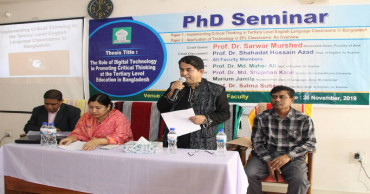
IU holds seminar on digital technology
A Seminar on the role of digital technology in promoting critical thinking at the tertiary level education in the country was held at Islamic University in Kushtia on Tuesday.
6 years ago