Bangladeshi migrant
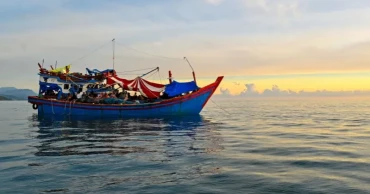
Over 250 missing after migrant boat sinks in Andaman Sea on Malaysia route including Bangladeshis
At least 250 people, including Rohingya refugees and Bangladeshi nationals, are missing after a boat sank in the Andaman Sea while heading to Malaysia, according to the United Nations refugee and migration agencies.
The UNHCR and International Organization for Migration said the boat departed from Teknaf in Cox’s Bazar carrying many passengers when it reportedly sank due to heavy winds, rough seas and overcrowding.
The exact timing of the incident remains unclear. However, on April 9, a Bangladesh-flagged vessel rescued nine people who were found “clinging to drums and wooden debris” to stay afloat, according to the Bangladesh Coast Guard.
Bangladesh Coast Guard spokesperson Lt Com Sabbir Alam Suzan told the media on Wednesday that the nine survivors included three Rohingya refugees and six Bangladeshi nationals. They were rescued by the Bangladesh-flagged vessel M.T. Meghna Pride after being spotted floating at sea following the capsize.
He said the survivors were later handed over to the coast guard and taken to Teknaf police station. The rescued group comprised eight men and one woman, all are safe.
Suzan added that the rescue was not part of any official search operation, as the incident occurred outside Bangladesh’s territorial waters. He said the M.T. Meghna Pride, which was travelling from Chittagong to Indonesia, came across the survivors during its voyage.
UNHCR communications officer in Cox’s Bazar, Shari Nijman, said on Wednesday that the agency had no further updates on the situation.
A separate Bangladesh Coast Guard media official, speaking to the media by phone on condition of anonymity, confirmed that the rescued individuals were all safe after being handed over to authorities in Teknaf.
The agencies said the incident highlights the prolonged displacement of Rohingya refugees and the lack of durable solutions to their situation.
They noted that ongoing violence in Myanmar’s Rakhine State has made safe repatriation uncertain. Limited humanitarian aid, along with restricted access to education and employment in refugee camps, continues to push vulnerable Rohingya to undertake dangerous sea journeys in search of better opportunities abroad, often driven by false promises of higher wages.
UNHCR and IOM urged the international community to increase funding and solidarity to ensure life-saving assistance for Rohingya refugees in Bangladesh, which currently hosts more than 1 million displaced Rohingya from Myanmar.
#From Agencies
6 months ago
.jpg)
Returnee migrants: Almost half still unemployed, 28% in debt after a year
Nearly 48% of the Bangladeshi migrant workers, who were forced to return home last year due to the Covid-19 pandemic, are now dependent on loans and relatives' support in the absence of any regular source of income, says a Brac survey.
Many of them returned due to fear of getting infected, some lost jobs as companies closed operations, some returned permanently, while others returned on leave.
Also read: 70pc Bangladeshi returnee migrants struggling to find jobs: IOM
Many of them could not get back to their old jobs or migrate again to find a new job because of global lockdown.
This has left 98% of such returnees with severe anxiety, depression, and psychological disorders.
Read WB approves $200 million to help Dhaka support urban poor, migrants
The other 52% have started small businesses or are working as day labourers to make a living, said the Brac Migration Program survey titled "Searching and Analysing the Socio-economic Status of Returnees."
Brac surveyed 417 Bangladeshi returnees across seven divisions from March to April 2021 to explore and analyse their socio-economic and psycho-social situation, one year after their return to Bangladesh amid the pandemic.
Also read: MoU signed for helping returnee migrants
The majority of the respondents were returnees from Saudi Arabia, UAE, Qatar, Bahrain, Oman, Kuwait, and others returned from Italy, the UK, and Malaysia.
Around 19% of the respondents said they had returned to Bangladesh after losing their job, whereas 16% were forced to return, 16% returned due to the fear of Covid-19, 12% returned permanently, 2% returned due to illness, and 35% returned on leave.
Some 28% of the respondents claimed to be already in debt.
Also read: Over half of returnee migrants in need of financial aid now: Brac
Nearly 5 lakh people had to return to Bangladesh from their host countries due to the pandemic which has been raging since the end of 2019, the study says.
More than 10 million Bangladeshi expatriates are working across the globe now. The country’s remittance inflow reached $22 billion last year despite the virus outbreak, the highest on record.
Read Govt to expats: Don’t come during lockdown, except for emergencies
5 years ago

Transcending borders, through films
Over the past decade and a half, this migrant worker from Bangladesh has mesmerised the audience in South Korea with his prowess on the screen. Yet Bangladesh-born Korean superstar Mahbub Alam, also known as Mahbub Lee, holds the distinction of being unknown to many in his own land of birth.
For Mahbub, it was a long journey and rarely an easy one. When he migrated to South Korea in 1999 to fund his ailing mother's treatment in Bangladesh, little did this alumnus of Government Tolaram College in Narayanganj know what lay in store for him.
Also read: Forbes Asia's 100 Digital Stars features Bangladeshi actress pori moni.
Thanks to his elder brother who was in Korea then, he got a job in a garment factory. Seven months later, his mother passed away in Bangladesh. While his elder brother returned to his home country, Mahbub chose to stay back. And his urge to protect fellow garment factory workers from exploitation in Korea prompted him to participate in social movements.
“I first came to Korea in 1999 and I worked in a textiles and garment factory, where my job involved pressing film covering onto the fabrics. It was hard work, using a lot of industrial chemicals,” Mahbub said in an interview with AsiaRights.
"At first, I wasn’t involved in any activism, but after about three years I started to do voluntary work in the Bangladeshi migrant community, taking up issues like industrial accidents and non-payment of wages. Many migrant workers in Korea work in very small firms, and their bosses sometimes cheat them out of their wages," he said.
Also read: How a Bangladeshi woman scripted a success story in vermi venture.
"I became secretary of the Bangladesh Mutual Association, which dealt with these sorts of social problems. Then in 2002, the Migrant Workers Trade Union was established. It was organised under the umbrella of the Korean Confederation Trade Union. We started going to rallies, and I became busy in the Union, writing publicity material for them and so on.”
But Mahbub was quick to realise that stories of unjust treatment of garment workers in the South Korean apparel industry must surface in the mainstream media in order to drive a lasting change for them. So, he decided to test his luck at something new -- making documentary films on the plight of workers in the Korean garment industry.
5 years ago

KL urged to bring back stranded Bangladeshis to their workplaces
Dhaka has urged Kuala Lumpur to do the needful for bringing back the stranded Bangladeshi workers to their old and new places of work in Malaysia on humanitarian grounds.
5 years ago