Bay of Bengal Industrial Growth Belt
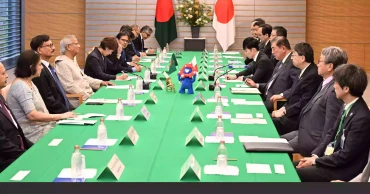
Japan reaffirms support for Dr Yunus-led interim govt and Bangladesh’s reform drive
Japanese Prime Minister Ishiba on Friday reaffirmed Japan’s full support for the interim government of Bangladesh, led by Professor Yunus, in its nation-building efforts, reform initiatives, and commitment to a peaceful transition.
“Prime Minister Ishiba reiterated Japan’s full support to the Interim Government of Bangladesh led by Professor Yunus for its nation-building efforts, its reform initiatives, and its endeavor towards a peaceful transition in Bangladesh,” said a Japan-Bangladesh joint press statement.
Ishiba made the assurance during a bilateral meeting with Prog a Yunus at his office in the morning.
Prof Yunus expressed gratitude to the Japan government for its continued support to foster sustainable economic growth and development in Bangladesh in advancing Japan-Bangladesh bilateral relations, especially for the projects under the Bay of Bengal Industrial Growth Belt (BIG-B) Initiative, including Moheshkhali-Matarbari Integrated Infrastructure Development Initiative (MIDI).
Recalling the long-standing friendship since the independence of Bangladesh, both sides reaffirmed their commitments to the Strategic Partnership between the two countries.
They also reiterated their shared vision for a Free and Open Indo-Pacific (FOIP) to ensure peace, stability and shared prosperity for all.
During the meeting, both sides held discussions on international and regional matters and reaffirmed their commitment to enhance cooperation for ensuring peace and stability in the region and beyond, upholding the principles of the United Nations Charter.
Both sides also affirmed their support to multilateralism based on the rule of law, as well as to democracy.
The two leaders held in-depth discussion on bilateral relations and issues of mutual interest in a candid manner.
In this regard, both sides welcomed the signing of the Exchange of Notes for the Development Policy Loan for Economic Reform and Strengthening Climate Change Resilience, and the Loan for the Project for the Construction of Dual Gauge Double Line Between Joydebpur-Ishurdi Section (I).
The two sides also welcomed the signing of MoUs and MoC including ones on One Stop Service (OSS) system in BIDA, installation of pre-paid gas meter, setting up factory for battery-run cycles, launching a pilot project for information security, and land agreements with the Bangladesh Special Economic Zone (BSEZ), to promote Japanese investment in Bangladesh.
They underscored the importance of concluding the Economic Partnership Agreement (EPA) in mutually beneficial way and instructed their respective ministries and negotiating teams to accelerate negotiations to reach an agreement at the earliest possible time.
Both sides reiterated their commitment to further strengthening political and security cooperation, including early delivery of five patrol boats to Bangladesh Navy under Japan’s Official Security Assistance (OSA).
They welcomed that the two governments agreed in principle on the agreement concerning the Transfer of Defence Equipment and Technology, and expressed their hope for early conclusion of the Agreement.
Prof Yunus seeks JICA’s greater support for MIDI
The leaders discussed ways to promote people-to-people exchanges, including skilled human resources, and concurred in strengthening cultural ties between the two countries.
In this regard, Professor Yunus thanked Prime Minister Ishiba for Japan’s continued support for human resource development in Bangladesh, including the Project for Human Resource Development Scholarship.
Prime Minister Ishiba commended Bangladesh for temporarily sheltering the Forcibly Displaced Persons from Rakhine State, Myanmar, and extending continued humanitarian assistance to them.
Professor Yunus appreciated Japan’s humanitarian assistance for these Forcibly Displaced Persons, including those in Bhasan Char.
Japan reaffirmed its sustained efforts on this issue.
Both sides shared the view that a sustainable, safe, voluntary, and dignified repatriation of the displaced persons to Myanmar is the ultimate solution to this crisis for peace and stability across the region.
They also recognised the importance of sincere dialogue among all relevant stakeholders to resolve the crisis.
Prof Yunus seeks Mahathir’s support for Bangladesh’s ASEAN membership
1 year ago
.jpg)
BIG-B important for Bangladesh, others with enhanced connectivity: Japanese economist
The Initiative of BIG-B or the Bay of Bengal Industrial Growth Belt is very important for enhancing and strengthening the relations between Bangladesh and Japan; and beyond ensuring an enhanced connectivity in the region for greater economic progress, says a leading Japanese economist.
“I understand the BIG-B Initiative is very important in regard to enhancing and strengthening the relations and cooperation with Bangladesh,” Daisuke Shintani, Chief Economist of Asia, China & Oceania Department of Mitsui & Co. Global Strategic Studies Institute told UNB in an interview.
He said an enhanced connectivity in all the countries in Asian region will help bring more economic benefits to the people of the region.
The year of 2022 will mark the 50th anniversary of the establishment of diplomatic relations between Japan and Bangladesh.
Towards this milestone year, for further strengthening bilateral relations, Bangladesh and Japan want to make the utmost efforts for further promoting trade and investment with an improved business environment, as well as further deepening mutual understanding and ‘exchange of people’ between Japan and Bangladesh.
From this year, which marks the 50th anniversary of independence, JICA's projects of large-scale infrastructure will gradually be completed one after another to promote Bay of Bengal Industrial Growth Belt (BIG-B) initiative. Dhaka Mass Rapid Transit (MRT) Line 6 will be partially open in December this year.
After that, the Special Economic Zone in Araihazar, Hazrat Shahjalal International Airport Expansion, Matarbari Deep Sea Port and Power Plant Stations, as well as Bangabandhu Railway Bridge will start operating, according to the Japanese Embassy in Dhaka.
Japanese economist Shintani said the development of Bangladesh’s three major cities -- Dhaka, Chattogram and Cox’s Bazar -- using Japanese experience and the implementation of mega projects will help Bangladesh grow further in a faster way.
Japanese Ambassador to Bangladesh Ito Naoki said the completion of these projects will change the face of the nation and profoundly contribute to the stability and prosperity of Bangladesh. “This country will move one step closer to the realisation of the Golden Bengal,” he said as Bangladesh celebrated 50 years of Independence.
Also read: Economic ties with Bangladesh to make leap: Japanese PM
5 years ago

Economic ties with Bangladesh to make leap: Japanese PM
The economic relations between Bangladesh and Japan, marked by a great potential, will make a further leap forward in the years to come, Japanese Prime Minister Yoshihide Suga said Wednesday.
5 years ago