Economic Reporters’ Forum (ERF)
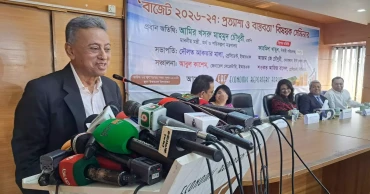
Budget to address rising poverty, expand economic opportunities: Amir Khosru
Finance Minister Amir Khosru Mahmud Chowdhury on Tuesday said the proposed national budget seeks to address rising poverty, expand economic opportunities for marginalised groups and reduce bureaucratic obstacles to business, despite being prepared under exceptionally difficult circumstances.
“preparing a national budget within one and a half months of assuming office was almost impossible, noting that the process normally takes at least six months,” he said while speaking at a pre-budget discussion meeting organised by Economic Reporters’ Forum (ERF) at its auditorium.
Finance Minister Amir Khosru returns home after hospital treatment
He said the government inherited a fragile economy marked by declining indicators, weak investment, growing unemployment and rising poverty, but was nonetheless required to present a budget within the constitutional timeframe.
“The economy has reached a level where significant intervention is needed to restore stability and put it back on the path to prosperity,” he said, likening the situation to priming a tube well by pouring water into it before groundwater can be drawn.
Responding to criticism over the size of the budget amid economic challenges, Khosru said the government was investing heavily to revive economic activity and rebuild confidence.
He said the budget prioritises low-income and disadvantaged groups who have traditionally been overlooked in national fiscal planning.
Among the key initiatives, he highlighted the expansion of the Family Card programme, under which financial assistance will be transferred directly to women heading households through bank accounts, minimizing opportunities for corruption and political influence.
The minister claimed that a pilot project recorded only a 1-1.5 percent deviation rate and expressed confidence that the programme could achieve near-perfect targeting in future.
He also underscored the government’s focus on farmers through the
introduction of Farmer Cards, aimed at strengthening food security and improving rural livelihoods.
On healthcare, Khosru said the government is moving towards universal primary healthcare, noting that Bangladeshis spend a disproportionately high share of their own income on medical treatment.
He said the programme would be implemented through partnerships involving the private sector and non-governmental organisations rather than relying solely on government agencies.
The finance minister also announced significant support for what he termed the “creative economy”, including artisans, weavers, folk craftsmen, performers, theatre artists and other cultural workers.
Under the initiative, targeted groups will receive skills training, access to finance, design assistance, branding support and opportunities to market products online, drawing inspiration from successful international models such as Thailand’s “One Village, One Product” programme.
Khosru said economic growth should not be measured solely through industrial production, arguing that creative industries and cultural activities also contribute significantly to gross domestic product (GDP).
“Our vision is the democratisation of the economy,” he said. “Economic participation and the benefits of growth must reach every citizen and every community.”
The minister reiterated the government’s commitment to strengthening the private sector, describing it as the primary driver of economic growth while positioning the state as a facilitator rather than a regulator.
He announced plans to simplify regulatory procedures through a one-stop service system under which multiple approvals would be processed within specified timeframes. Applications not acted upon within the prescribed period would be deemed approved, he said.
Calling for a “deregulated economy”, Khosru said excessive controls had constrained businesses, citizens and institutions for years.
On budget implementation, he acknowledged concerns over low execution rates and said the government would introduce digital monitoring systems across ministries.
According to the minister, all development projects will be tracked through dashboards at the ministry, finance ministry and Prime Minister’s Office levels, allowing delays and bottlenecks to be identified in real time.
He said future project selection would be guided by four criteria: value for money, return on investment, job creation and environmental sustainability.
The government has already reviewed around 1,300 ongoing projects inherited from previous administrations and plans to cancel those that fail to meet the new standards while repurposing others to improve economic returns, he added.
Turning to the capital market, Khosru said the government is restructuring the securities regulator and expects to appoint a new professional leadership team within weeks.
He said reforms would help attract quality listed companies, reduce pressure on the banking sector and enable businesses to raise long-term financing through the capital market.
The minister also said international financial institutions and major investment firms, including global fund managers, had expressed interest in Bangladesh as economic reforms gather pace.
Khosru expressed confidence that the budget’s inclusive approach, coupled with stronger governance and implementation mechanisms, would help restore stability and lay the foundation for sustainable and equitable economic growth.
CPD Executive Director Fahmida Khatun, East Coast Group Chairman Azam J Chowdhury and Bangladesh Textile Mills Association (BTMA) president Showkat Aziz Russell also spoke at the programme as special guests.
ERF president Doulut Akter Mala presided over the discussion and general secretary Abul Kashem conducted it.
4 months ago

Digital infrastructure key to attracting more remittance through legal channels, speakers say
Speakers said on Wednesday that developing convenient digital infrastructure is very vital to attract more remittance through legal channels for sustainable foreign exchange reserves.
They made the statement in a discussion on ‘Remittance through the legal channel: Prospects of digital platforms’ organised by the Economic Reporters’ Forum (ERF) at its auditorium in the capital on Wednesday.
Planning Minister MA Mannan was the chief guest on the occasion. Economists, bankers and experts made various recommendations for a better strategy to attract more remittance amid concern over dwindling stock of foreign currency.
Read more: Banks to stop charging any fees for handling remittances
Mannan said that the people in the country do not show much interest to go to banks for transactions when they receive remittance from their family members working abroad because of social and psychological factors.
Rather, they choose illegal channels to receive remittance as a quick and comfortable remedy.
He said that the government has taken initiatives for developing digital infrastructure to bridge the gap between the earners and the receivers, but it often gets protracted to reform the sector.
He also said that transactions with foreign countries are closed three days a week on the banking channels. Because of this, many people are choosing hundi as a convenient alternative, he said.
Read more: Falling exports-remittances: Double blow to Bangladesh economy
“The government wants to break these traditions and start a trend. The Ministry of Finance and the Bangladesh Bank are working on this,” he said.
Policy Research Institute (PRI) Executive Director Ahsan H. Mansur said the exchange rate of the dollar needs to be stable and balanced to increase remittances through legal channels.
“Migrant workers are more inclined to send remittances through hundi when the difference of dollar exchange rate higher in illegal channels than the legitimate way,” he said.
Managing Director of Islami Bank Bangladesh Limited Mohammed Monirul Moula said if the problem in sending money to the relatives of expatriates in the country is removed, it will be easier to deal with the existing foreign exchange and reserves crisis.
“If remittances can be sent through digital mode, it will be possible to meet the foreign exchange deficit in the next two to three months,” he said.
Read more: Remittances fall again in Oct, this time to 8-month low
Professor of the economics department of Dhaka University and chairman of SANEM Dr. Bazlul H Khandkar presented a keynote paper on the topic.
Chairman Policy Exchange of Bangladesh Masrur Riaz, Sharmin Nilormi, professor of economics, Jahangirnagar University, former executive director of Bangladesh Bank and former deputy head of BFIU Iskandar Mia, BKash Chief External and Corporate Affairs Officer Major General (retd) Sheikh Md. Monirul Islam, and economist Khondker Shakhawat Ali, among others, spoke at the function.
3 years ago
.jpg)
It's high time Bangladesh and China sign FTA with investment deal: Speakers
Bangladesh and China should soon sign a comprehensive bilateral Free Trade Agreement (FTA) to boost especially Dhaka’s exports to hugely potential Chinese market, speakers at a discussion said on Wednesday.
Commerce Minister Tipu Munshi who attended the virtual discussion as the chief guest said though there has been some progress towards signing an FTA with China, more efforts are needed to conclude the negotiation and materialize the the FTA.
"I believe this will help Bangladesh to face the LDC graduation challenges," he said.
Speaking as special guest Chinese Ambassador to Bangladesh Li Jiming said it is high time to really consider an FTA combined with an Investment deal between Bangladesh and China.
Read:Bangladesh, Oman keen to expand economic partnership
He pointed out that there is a huge potential for Bangladesh to boost its exports to China.
The discussion titled “Bangladesh-China Economic and Trade Relations in the aftermath of the COVID-19 Global Pandemic” was organized jointly by Economic Reporters’ Forum (ERF) and Bangladesh China Chamber of Commerce & Industry (BCCCI).
Executive Chairman of Bangladesh Investment Development Authority (BIDA) Md. Sirazul Islam and Bangladesh Ambassador to China, Mahbub Uz Zaman also joined it as the special guests.
Eminent Trade Economist Dr. Mohammad Abdur Razzaque presented the keynote paper.
The bilateral trade between the two countries heavily favours China.
Out of around $12.09 billion bilateral trade in FY20, Bangladesh's export to China only accounted for $0.60 billion while imports from China totalled a mammoth $11.49 billion.
Minister Tipu said as part of its unilateral market access schemes for LDCs, China has allowed duty-free access to Bangladesh for 97 per cent of its tariff lines which became effective from July 1, 2020.
Read:Pragmatic talks underway over vaccine procurement, coproduction: Ambassador Li
Under this initiative, 8,256 Bangladeshi products enjoy zero tariff facility for exports in this market. "I strongly believe that by fully utilizing this DFQF facility, the trade imbalance can be reduced in a greater extent."
The commerce minister said Bangladesh gives utmost priority to its relations with neighbouring and regional friendly countries like China while the relationship between the two countries has developed robust based on mutual trust and interests.
Ambassador Li said both the entrepreneurs and businesses of China and Bangladesh suffered from the pandemic as the bilateral trade witnessed a fall of 13.6 per cent in 2020 from the last year.
He, however, termed attainment of Bangladesh's 6.1 per cent GDP growth in the outgoing fiscal year as "very encouraging".
The Chinese Ambassador said although there is a huge trade imbalance, but there would be more exports from Bangladesh to China in the coming days.
Li said he was fully confident that under the Chinese Belt and Road initiative, there would be more areas of cooperation in different fields like in 5G communication, high-speed railway as well as the G to G and PPP initiatives would get momentum in the post pandemic era.
BIDA Executive Chairman Md Sirazul Islam said that the Authority would facilitate and expedite investment from Chinese investors. "We want to see more FDI from China. BIDA is always ready to support Investment promotion and in policy advocacy,"
Read:Big-B Initiative to bring more investment to Bangladesh: Shahriar
He sad it would be a real game changer if Bangladesh could tap the potential Chinese market. "If we can explore even 1% potential of Chinese market, then the exports of Bangladesh to China will total $25 billion."
Ambassador Mahbub Uz Zaman said there is an excellent platform for cooperation between the two countries for further consolidating the bilateral relations.
"Chinese investments to Bangladesh have been playing an important role and have also been contributing towards employment generation" Mahbub said adding that the Chinese investors are looking forward to invest in the special economic zones in Bangladesh.
Dr. Razzaque suggested that Bangladesh increases its RMG exports to China. It can expand cooperation with China in artificial intelligence, robotics, and can set up technological hub with China.
He said that establishing a full-fledged FTA is an option to retain the available market access in China, but it comes with reciprocity.
He said there are estimates to suggest that a comprehensive bilateral FTA would have an overall positive impact on Bangladesh’s exports by 22 per cent of current exports to China.
On the other hand, Chinese exports to Bangladesh could increase by about 16 per cent.
Read:Korea supports strengthening digital investigation capability of Bangladesh Police
Any FTA deal with China should be backed by an investment agreement from which Bangladesh should be able to expand its exports and can keep bilateral trade deficits within reasonable, said Dr Razzaque.
ERF President Sharmeen Rinvy and Joint Secretary General BCCCI, Al Mamun Mridha delivered welcome remarks.
BCCCI President Gazi Golam Murtoza chaired the event while ERF General Secretary, S M Rashidul Islam moderated the function.
Senior Vice President, BCCCI Brig. Gen. Shah Md. Sultan Uddin Iqbal offered the vote of thanks.
5 years ago