Ballistic missile
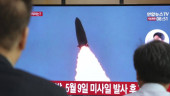
North Korea fires suspected ballistic missile toward sea
North Korea fired a suspected ballistic missile toward the sea on Thursday, Japan said, a day after Pyongyang rejected a US decision to scale back military exercises with South Korea.
Japan’s Prime Minister’s Office said it detected the suspected launch but did not provide further details.
South Korean media, citing the military, reported that North Korea fired an unidentified projectile from its east coast.
The launch came a day after the US and South Korean militaries announced plans to reduce the scale of their 11-day Ulchi Freedom Shield exercises.
The decision followed an order from US President Donald Trump to the Pentagon to “substantially reduce” the drills. Trump cited his improved relations with North Korean leader Kim Jong Un and South Korea’s refusal to support the United States over the war in Iran.
However, Kim Yo Jong, the powerful sister of North Korean leader Kim Jong Un, rejected the US move on Wednesday.
She said reducing the size and duration of the exercises would not change what she called their “provocative, aggressive nature.”
Kim Yo Jong also warned that Washington should not expect Pyongyang to view the move as a sign of goodwill.
She pointed to other military exercises conducted by the US and South Korea earlier this year and criticised South Korea’s efforts to introduce nuclear-powered submarines.
2 months ago
China's ballistic missile launch seen as signal to US, say experts
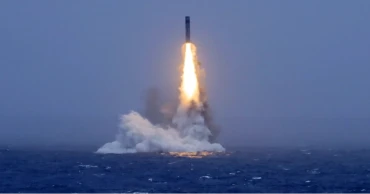
China's recent launch of a ballistic missile into the South Pacific was widely seen by security experts as a clear message to the United States, highlighting Beijing's growing nuclear capabilities despite criticism from countries in the Pacific region.
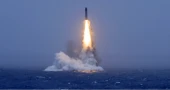
The missile, launched on Monday from a nuclear-powered submarine, marked one of the few public tests of a nuclear-capable weapons system by China. It came two years after a similar launch over international waters in the Pacific.
While several Pacific island nations criticised the test, saying the region should not become a stage for rivalry between major powers, analysts said the main audience for the launch was Washington.
"The key message is that the People's Liberation Army is becoming a stronger military force with a powerful strategic nuclear capability," said Tong Zhao, a senior fellow with the Nuclear Policy Program at the Carnegie Endowment for International Peace.
The launch showcased the sea-based part of China's nuclear triad — its ability to launch nuclear weapons from land, sea and air. It also demonstrated what military experts call a "second-strike capability," meaning China could still retaliate with nuclear weapons even if it were attacked first.
Dominic Meagher, a research fellow at Australia's Crawford School of Public Policy, said the submarine launch showed that China's nuclear forces could respond from anywhere, making them harder to eliminate in a first strike.
China described the launch as part of its annual military exercises, leading experts to believe similar tests could become more common.
"I see this as part of a broader strategy rather than a one-time event," said K. Tristan Tang, a nonresident fellow at the National Bureau of Asian Research.
The missile test comes as China continues expanding its fleet of nuclear-powered submarines. According to the International Institute for Strategic Studies, China has built these submarines at a faster pace than the United States over the past five years.
Pacific nations raise concerns
The launch drew criticism from Pacific countries because the missile landed in waters covered by the South Pacific Nuclear Free Zone, created under the 1986 Treaty of Rarotonga.
The region has a painful history of nuclear testing. The United States, Britain and France carried out nuclear tests in the Pacific during the last century, leaving lasting environmental damage and health problems, including cancers and birth defects that some island communities say continue to affect generations.
Meagher said those experiences led to international agreements aimed at preventing future nuclear testing in the region.
Solomon Islands Prime Minister Matthew Wale criticised China's action, saying while China is an important partner, "this is not something a friend does" and is not good for the region.
Although the United States still conducts missile tests in the Pacific, Meagher noted that they avoid the treaty-protected nuclear-free zone.
Regional powers question lack of notice
Australia and New Zealand said they received very little advance warning about the launch, while Japan criticised China for not being transparent.
Australia and New Zealand have become increasingly concerned about China's growing influence in the Pacific, where Beijing has strengthened ties with several island nations through security and development agreements.
Australian Prime Minister Anthony Albanese, speaking during a visit to the Solomon Islands on Tuesday, described the launch as "a provocative act" that could increase tensions in the region.
"The fact that this test took place with very little notice is a real concern," he said.
China defended the launch, saying it had informed relevant countries in advance and that the exercise was conducted openly and transparently.
Experts noted that while the Hague Code of Conduct encourages countries to provide at least 24 hours' notice before ballistic missile launches, the code is voluntary and China is not a member.
Uncertainty over missile type
Questions also remain over exactly which missile was launched.
Taiwan's National Security Council said it was likely a JL-2 submarine-launched ballistic missile fired from waters off Guangdong province in southern China.
However, Chinese state media quoted military experts as saying the launch probably involved the newer JL-3 missile, which has a much longer range and is capable of reaching targets across the Pacific.
Analysts say that as China expands its military power, it is likely to face greater international scrutiny over its weapons development and military activities.
3 months ago
China's submarine missile test raises regional concerns over growing military tensions
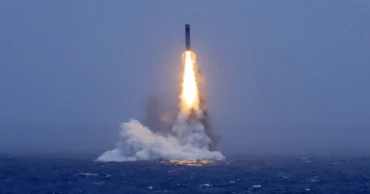
China's navy launched a long-range ballistic missile from a nuclear-powered submarine into the Pacific Ocean on Monday, a rare test that has sparked concern among the United States and several countries across Asia and the Pacific over Beijing's growing military capabilities.
Military experts say the test highlights China's improving ability to strengthen its nuclear deterrence strategy. It was the second time in recent years that China has fired a ballistic missile into international waters.
Although Beijing informed some countries before the launch, several governments said the notice was too short. Analysts also warned that the test could further increase tensions as military competition continues to grow across the region.
China confirmed the launch only after it had taken place. In a brief statement, state-run Xinhua News Agency said the missile was fired into the Pacific Ocean as part of routine annual military training. It said the launch complied with international law and was not aimed at any country or target.
China did not identify the missile, but said it carried a dummy warhead rather than a nuclear one. While launches into international waters are uncommon, the United States has also conducted similar missile tests.
On Tuesday, Xinhua released a photograph of the missile but provided no further details.
Defence experts believe it was likely either a JL-2 or JL-3 submarine-launched ballistic missile, although available images are not clear enough to confirm the model.
China's state-owned Global Times reported that the missile was "most likely" a JL-3, which has a range of more than 10,000 kilometres (6,200 miles). The JL-2 has a shorter range.
New Zealand said the missile landed in treaty waters within the South Pacific Nuclear Free Zone, arguing that the launch went against the spirit of the agreement.
The nuclear-free zone was created under the 1986 Treaty of Rarotonga, which bans nuclear weapons across the region. China joined the treaty's protocols in 1987, promising not to test or threaten to use nuclear weapons against countries covered by the agreement.
Australia, Japan and several Pacific nations voiced concern over the launch.
China urged other countries not to "overinterpret" the test, but experts said the concerns were understandable because Beijing provided limited information about the launch.
Drew Thompson, a senior fellow at the S. Rajaratnam School of International Studies in Singapore, said China's military expansion has not been matched by greater transparency, creating uncertainty about its intentions.
Australian Prime Minister Anthony Albanese said China had failed to give enough advance notice.
"There is no doubt that this is a provocative act by China which does destabilize the region," Albanese told reporters Tuesday while visiting Honiara in the Solomon Islands.
He said the launch involved a nuclear-capable intercontinental ballistic missile fired from a nuclear-powered submarine, adding that the world needs fewer nuclear weapons, not more.
New Zealand Foreign Minister Winston Peters also described the launch as "unwelcome and concerning."
Solomon Islands Prime Minister Matthew Wale said China remained an important friend but added that missile tests were not welcome in the Pacific.
"We don't want anybody testing their ICBMs in the Pacific Islands region. Be our friend, but don't threaten us," Wale told reporters.
The test comes as China continues to expand and modernize its military under President Xi Jinping.
China already has the world's largest standing army and the biggest navy by fleet size. Although its nuclear arsenal remains smaller than those of the United States and Russia, Beijing has been increasing its stockpile of nuclear warheads while developing longer-range missiles and more advanced drones.
China's official defence budget is expected to reach about $270 billion in 2026 after annual increases of around 7% over the past four years. Independent analysts believe actual military spending may be significantly higher. The Stockholm International Peace Research Institute estimated China's military expenditure at $313.7 billion in 2024.
Much of the region's security concerns are linked to Taiwan, the self-governed island that China claims as its own and has not ruled out taking by force. Beijing regularly sends warships and military aircraft near Taiwan, describing the missions as military exercises.
China's military buildup has prompted neighbouring countries to strengthen their own defences. Japan is moving away from its long-standing policy of limiting defence spending to 1% of GDP and plans to raise it to 2%. The Philippines has also expanded defence cooperation with the United States by allowing access to four additional military bases.
Emma Chanlett-Avery, director of Political-Security Affairs at the Asia Society Policy Institute, said the missile launch is likely to further strain already tense relations between China and Japan.
She noted that tensions have increased since Japanese Prime Minister Sanae Takaichi suggested last year that Japan could become involved in a conflict over Taiwan, prompting China to tighten export controls on Japan and accuse Tokyo of embracing "a new era of militarism."
3 months ago

Pakistan conducts ballistic missile test amid soaring tensions with India
Pakistan carried out a test launch of a ballistic missile on Saturday, escalating tensions with neighboring India following a deadly shooting last month targeting tourists in the contested Kashmir region.
The military said the surface-to-surface missile, part of the Abdali Weapon System, has a range of 450 kilometers (around 280 miles). The test was intended to verify the operational readiness of forces and the missile’s technical capabilities, including an upgraded navigation system and improved maneuverability.
Pakistan’s President Asif Ali Zardari and Prime Minister Shehbaz Sharif praised the successful test. These missile launches are typically directed toward the Arabian Sea or remote desert regions like southwestern Balochistan—not toward the Indian border.
India, which has accused Pakistan of involvement in the April 22 gun attack in Kashmir’s Pahalgam that left several tourists dead—a claim Islamabad has denied—has not responded to the missile launch.
Multiple countries send aircraft to help Israel battle widespread wildfire
India’s navy conducted its own military exercises on April 27, confirming it had performed anti-ship missile tests to demonstrate its platforms’ readiness for precision strikes.
Pakistan's Information Minister Attaullah Tarar recently claimed the country had “credible intelligence” that India was planning to launch an attack soon.
Kashmir remains a deeply contested territory, with both nations claiming it in full while controlling different parts.
1 year ago
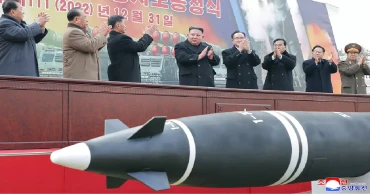
NKorea's Kim orders 'exponential' expansion of nuke arsenal
North Korean leader Kim Jong Un ordered the “exponential” expansion of his country's nuclear arsenal and the development of a new, more powerful intercontinental ballistic missile, state media reported Sunday, after he entered 2023 with another weapons test following a record number of missile firings last year.
Kim’s moves are in line with the broad direction of his nuclear weapons development program as he has repeatedly vowed to boost both the quality and quantity of his arsenal. Some experts said Kim will likely continue a provocative run of weapons tests this year before he would ultimately try to use his enlarged arsenal to wrest concessions like sanctions relief in future dealings with his rivals.
“They are now keen on isolating and stifling (North Korea), unprecedented in human history,” Kim said at a recently ended ruling party meeting, according to the official Korean Central News Agency. “The prevailing situation calls for making redoubled efforts to overwhelmingly beef up the military muscle to thoroughly guarantee the sovereignty, security and fundamental interests of (the country).”
Kim accused South Korea of being “hell-bent on imprudent and dangerous arms build-up” and openly trumpeting its preparations for war with North Korea. That, Kim said, highlights the need to mass-produce battlefield tactical nuclear weapons and calls for “an exponential increase of the country’s nuclear arsenal,” KCNA said.
Kim also set forth a task to develop another ICBM system “whose main mission is quick nuclear counterstrike," KCNA said, without elaborating.
Read more: North Korea's Kim lays out key goals to boost military power
Kim accused the United States of frequently deploying nuclear strike means in South Korea, boosting trilateral military cooperation with South Korea and Japan and pushing to establish a NATO-like regional military bloc.
Tactical nuclear weapons and a military reconnaissance satellite are among an array of weapons systems that Kim has vowed to introduce in recent years. Other weapons he wants include a multi-warhead missile, a more agile solid-fueled ICBM, an underwater-launched nuclear missile and a hypersonic weapon.
Outside worries about North Korea’s nuclear program have grown since the North last year approved a new law that authorized the preemptive use of nuclear weapons in a broad range of situations and openly threatened to use its nuclear weapons first.
During his speech at the party meeting, Kim reiterated that threat.
“(Kim's report) made clear that our nuclear force considers it as the first mission to deter war and safeguard peace and stability. However, if it fails to deter, it will carry out the second mission, which will not be for defense,” KCNA said.
The North’s increasing nuclear threats have prompted the United States and South Korea to expand their regular exercises and strengthen a trilateral security cooperation involving Japan. The U.S. military has warned any nuclear attack by North Korea against the United States or its allies and partners “will result in the end of that regime.
“It was during his 2018 New Year’s speech that (Kim) first ordered the mass production of warheads and ballistic missiles, and he’s doubling down on that quantitative expansion goal in the coming year,” said Ankit Panda, an expert with the Carnegie Endowment for International Peace.
Panda said the reference to a new ICBM appears to concern a solid-propellant system. “We should expect to see larger, solid propellant missiles tested soon,” he said.
Last month, North Korea said Kim supervised the test of a “high-thrust solid-fuel motor” for a new strategic weapon. Experts say the weapon refers to a solid-fueled ICBM, which can be launched more quickly than a liquid-fueled ICBM because the fuel in solid-propellant rockets is already loaded inside. All of North Korea's previously tested ICBMs use liquid propellants.
Read more: Kim claims N. Korean successes, wants to overcome challenges
Earlier Sunday, South Korea’s military detected the missile launch from the North’s capital region. The Joint Chiefs of Staff said in a statement the missile traveled about 400 kilometers (250 miles) before falling into the water between the Korean Peninsula and Japan.
The Joint Chiefs of Staff called the launch “a grave provocation” that hurts peace and security on the Korean Peninsula and around the world. It said South Korea closely monitors North Korean moves in coordination with the United States and maintains a readiness to overwhelmingly deal with any provocations.
The U.S. Indo-Pacific Command said in a statement that the launch highlights “the destabilizing impact” of North Korea’s unlawful weapons programs. It said U.S. commitments to defend South Korea and Japan “remain ironclad.”
North Korea test-fired more than 70 missiles last year. The North’s testing spree indicated the country is likely emboldened by its advancing nuclear program, though whether the country has functioning nuclear missiles remains a source of outside debate.
On Saturday, North Korea fired three short-range ballistic missiles toward its eastern waters.
North Korea’s state media confirmed Sunday that the country conducted the test-firings of its super-large multiple rocket launcher to test the weapon’s capability. KCNA said three shells fired from the launcher on Saturday accurately hit an island target off the country's eastern coast. It said North Korea fired another shell from the launcher toward its eastern waters Sunday.
Kim Jong Un said the rocket launcher put all of South Korea within striking distance and is capable of carrying a tactical nuclear warhead, according to KCNA.
Outside experts categorize weapons fired from the launcher as ballistic missiles because of their trajectories, ranges and other characteristics.
The North’s missile launch for a second straight day came after South Korea on Friday conducted a rocket test related to its plan to establish space-based surveillance to better monitor North Korea. On Friday, South Korea’s military said it test-launched a solid-fueled rocket, a type of a space launch vehicle that it plans to use to put its first spy satellite into orbit in coming years.
Animosities between the rival Koreas have deepened since early last week, when South Korea accused North Korea of flying drones across the countries’ heavily fortified border for the first time in five years and sent its own drones toward the North.
South Korea acknowledged it failed to shoot down any of the five North Korean drones it said were found south of the border. But South Korea has vowed to bolster its air defense network and get tough on future provocations by North Korea.
3 years ago

North Korea fires ballistic missile toward sea: Seoul officials
North Korea fired a ballistic missile toward the sea on Friday, Seoul officials said, as its rival South Korea was wrapping up an annual military drill that the North views as an invasion rehearsal.
South Korea’s Joint Chiefs of Staff said in a statement the missile flew toward North Korea’s eastern waters but gave no further details including how far the weapon flew.
The launch, the latest in a series of weapons tests by North Korea in recent weeks, came on the final day of South Korea’s annual 12-day “Hoguk” field exercises, which also involved an unspecified number of U.S. troops this year.
The South Korean and U.S. air forces plan to conduct a large-scale training next week.
North Korea sees such regular drills by Seoul and Washington as practice for launching an attack on the North, though the allies say their exercises are defensive in nature.
Friday’s launch came four days after the rival Koreas exchanged warning shots along their disputed western sea boundary, a scene of past bloodshed and naval battles.
The launch also came after U.S. Deputy Secretary of State Wendy Sherman during a visit to Tokyo this week issued a warning over North Korea’s escalating provocations and reiterated that the U.S. would fully use its military capabilities, “including nuclear,” to defend its allies Japan and South Korea.
There are also concerns that the North could up the ante in the coming weeks by conducting its first nuclear test since 2017. Rafael Grossi, chief of the International Atomic Energy Agency, said Thursday that a new nuclear test explosion by North Korea “would be yet another confirmation of a program which is moving full steam ahead in a way that is incredibly concerning.”
He said the U.N. agency has been observing preparations for a new test, which would be the North’s seventh overall, but gave no indication of whether an atomic blast is imminent.
3 years ago
.jpg)
North Korea fires ballistic missile amid rising animosities
North Korea launched a ballistic missile toward its eastern waters on Wednesday, South Korean and Japanese officials said, days after North Korean leader Kim Jong Un vowed to speed up the development of his nuclear weapons “at the fastest possible pace” and threatened to use them against rivals.
The launch, the North’s 14th round of weapons firing this year, also came six days before a new conservative South Korean president takes office for a single five-year term.
South Korea’s Joint Chiefs of Staff said in a statement that the missile was fired from the North’s capital region and flew to the waters off its eastern coast. It called North Korea’s repeated ballistic missile launches “a grave threat” that would undermine international peace and security and a violation of U.N. Security Council resolutions banning any ballistic launch by the North.
The statement said that Won In-Choul, the South Korean JCS chief, held a video conference about the launch with Gen. Paul LaCamera, an American general who heads the South Korea-U.S. combined forces command in Seoul, and they agreed to maintain a solid joint defense posture.
Japan also detected the North Korean launch and quickly condemned it.
“North Korea’s series of actions that threatens the peace, safety and stability of the international community are impermissible,” Japanese Prime Minister Fumio Kishida told reporters during his visit to Rome.
Also read: North Korea tests new weapon bolstering nuclear capability
Kishida said he’ll discuss the launch when he meets Italian Prime Minister Mario Draghi later Wednesday. “Naturally, we will exchange views on the regional situation in the Indo-Pacific and East Asia, and I will thoroughly explain the reality of the region including the North Korean missile launch today, to gain understanding about the pressing situation in the East Asia,” he said.
Japanese Vice Defense Minister Makoto Oniki said that the missile was believed to have landed in waters outside of the Japanese Exclusive Economic Zone. There has been no report of damage or injury reported from vessels and aircraft in the area.
It wasn’t immediately known what missile North Korea launched. South Korea’s military said the missile flew about 470 kilometers (290 miles) at the apogee of 780 kilometers (485 miles), while Oniki of Japan said it traveled about 500 kilometers (310 miles) at the maximum altitude of 800 kilometers (500 miles).
Observers say North Korea’s unusually fast pace in weapons testing this year underscores its dual goal of advancing its missile programs and applying pressure on Washington over a deepening freeze in nuclear negotiations. They say Kim eventually aims to use his expanded arsenal to win an international recognition of North Korea as a nuclear state that he believes would help force the United States to relax international economic sanctions on the North.
One of the North Korean missiles tested recently was an intercontinental ballistic missile potentially capable of reaching the entirety of the American homeland. That missile's launch broke Kim's self-imposed 2018 moratorium on big weapons tests.
There are signs that the North is also preparing for a nuclear test at its remote northeastern testing facility. If made, the nuclear bomb test explosion by North Korea would be the seventh of its kind and the first since 2017.
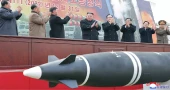
Last week, Kim Jong Un showcased his most powerful nuclear-capable missiles targeting both the United States and its allies during a massive military parade in capital, Pyongyang. During a speech at the parade, Kim said he would develop his arsenal at the “fastest possible pace” and warned that the North would preemptively use its nuclear weapons if its national interests are threatened.
North Korea has previously unleased harsh rhetoric threatening to attack its rivals with its nuclear weapons. But the fact that Kim made the threat himself and in a detailed manner have caused security jitters among some South Koreans. Taken together with North Korea’s recent tests of short-range nuclear-capable missiles, some experts speculate North Korea’s possibly escalatory nuclear doctrine would allow it to launch preemptive nuclear strikes on South Korea in some cases.
Wednesday’s launch came before the May 10 inauguration of South Korean President-elect Yoon Suk Yeol, who has vowed to boost Seoul’s missile capability and solidify its military alliance with Washington to better cope with increasing North Korean nuclear threats.
North Korea has a history of raising animosities with weapons tests when Seoul and Washington inaugurate new governments in an apparent bid to boost its leverage in future negotiations.
Also read: Ukraine: Missile attack kills 5 in Odesa
Yoon’s power transition office called the latest North Korean launch “a grave provocation” and urged Pyongyang to stop acts that raise tensions and threaten international peace. It said in a statement that the Yoon government will strongly respond to North Korean provocations in close cooperation with the international community.
Some experts say the Biden administration’s passive handling of North Korea as it focuses on Russia’s invasion of Ukraine and an intensifying rivalry with China is allowing more room for the North to expand its military capabilities.
The Biden administration’s actions on North Korea have so far been limited to largely symbolic sanctions and offers of open-ended talks. North Korea has rejected the administration’s offer for talks, saying it must first abandon its “hostile policy,” in an apparent reference to U.S.-led international sanctions and U.S.-South Korean joint military exercises.
4 years ago
.jpg)
North Korea fires suspected ballistic missile into sea
North Korea fired a suspected ballistic missile into the sea on Wednesday, the South Korean and Japanese militaries said, its first public weapons launch in about two months and a signal that Pyongyang isn’t interested in rejoining denuclearization talks anytime soon and would rather focus on boosting its weapons arsenal.
The latest launch came after North Korean leader Kim Jong Un vowed to further boost his military capability — without disclosing any new policies toward the United States or South Korea— at a high-profile ruling party conference last week.
South Korea’s Joint Chiefs of Staff said in a statement that North Korea fired a suspected ballistic missile toward its eastern waters on Wednesday morning. It said South Korean and U.S. intelligence authorities were trying to analyze more information about the launch.
In an emergency video conference, members of South Korea’s presidential national security team expressed concerns about the launch and said resuming talks with North Korea is important to resolve tensions, according to the presidential Blue House.
The Japanese Defense Ministry also detected the North Korean launch, saying the country likely fired a missile.
Read: China releases shortened negative lists for foreign investment
“We find it truly regrettable that North Korea has continued to fire missiles from last year,” Japanese Prime Minister Fumio Kishida told reporters.
Kishida said other details about the North Korean launch weren’t immediately available, including where the suspected missile landed and whether there had been any damage. He said he ordered officials to confirm the safety of ships and planes in the area where the suspected missile likely flew and fell.
Between September and November, North Korea performed a spate of weapons tests in what experts called an attempt to apply more pressure on its rivals to accept it as a nuclear power state in the hopes of winning relief from economic sanctions. The weapons tested included a submarine-launched ballistic missile and a developmental hypersonic missile. Since its artillery firing drills in early November, North Korea had halted testing activities until Wednesday’s launch.
The Biden administration has repeatedly said it is open to resuming nuclear diplomacy with North Korea “anywhere and at any time” without preconditions. The North has so far rebuffed such overtures, saying U.S. hostility remains unchanged.
Outgoing South Korean President Moon Jae-in said in his New Year’s address Tuesday that he would continue to seek ways to restore ties with North Korea and promote peace on the Korean Peninsula until his single five-year term ends in May. He has recently pushed for a political, symbolic declaration to end the 1950-53 Korean War as a way to reduce animosities.
U.S.-led diplomacy aimed at convincing North Korea to abandon its nuclear program collapsed in 2019 due to wrangling over how much sanctions relief should be given to the North in return for dismantling its main nuclear complex, a limited denuclearization step. Kim has since threatened to enlarge his nuclear arsenal, though his country’s economy has suffered major setbacks due to the COVID-19 pandemic, persistent U.S.-led sanctions and his own mismanagement.
Also read: North Korea holds key meeting as Kim marks 10 years in power
“Rather than expressing willingness for denuclearization talks or interest in an end-of-war declaration, North Korea is signaling that neither the omicron variant nor domestic food shortages will stop its aggressive missile development,” said Leif-Eric Easley, a professor at Ewha University in Seoul.
Kim Dong-yub, a professor at the University of North Korean Studies in Seoul, said that North Korea might have tested the hypersonic missile or a nuclear-capable KN-23 missile with a highly maneuverable and lower-trajectory flight. He said North Korea would likely move forward with its military build-up plans.
During last week’s plenary meeting of the Central Committee of the ruling Workers’ Party, Kim repeated his vows to boost his country’s military capacity and ordered the production of more powerful, sophisticated weapons systems. State media reports on the meeting said North Korea set forth “tactical directions” for North Korea’s external relations including with South Korea, but didn’t elaborate. The reports made no mention of the United States.
Last month, Kim marked 10 years in power. Since assuming control after his father and longtime ruler Kim Jong Il’s death in December 2011, Kim Jong Un has established absolute power at home and staged an unusually large number of weapons tests as part of efforts to build nuclear-tipped missiles capable of reaching the American mainland.
During Kim’s 10-year rule, North Korea has performed 62 rounds of ballistic missile tests, compared with nine rounds during his grandfather and state founder Kim Il Sung’s 46-year rule, and 22 rounds during Kim Jong Il’s 17-year rule, according to South Korean and U.S. figures. Four of the North’s six nuclear tests and its three intercontinental ballistic missile launches all occurred under Kim Jong Un’s rule.
4 years ago

North Korea fires ballistic missile into sea in latest test
North Korea fired a ballistic missile into the sea on Tuesday in a continuation of its recent weapons tests, the South Korean and Japanese militaries said, hours after the U.S. reaffirmed its offer to resume diplomacy on the North’s nuclear weapons program.
The South’s Joint Chiefs of Staff didn’t immediately say what kind of ballistic missile it was or how far it flew. Japan's coast guard issued a maritime safety advisory to ships but didn't immediately know where the weapon landed.
Read:North Korea says underwater-launched missile test succeeded
South Korea’s presidential office was planning to hold a national security council meeting to discuss the launch. A strong South Korean response could anger North Korea, which has been accusing Seoul of hypocrisy for criticizing the North's weapons tests while expanding its own conventional military capabilities.
Ending a monthslong lull in September, North Korea has been ramping up its weapons tests while making conditional peace offers to Seoul, reviving a pattern of pressuring South Korea to try to get what it wants from the United States.
Within days, President Joe Biden’s special envoy for North Korea, Sung Kim, is schedule to hold talks with U.S. allies in Seoul over the prospects of reviving talks with North Korea.
Read:UN meets on North Korea missile test which Europeans condemn
Nuclear negotiations between Washington and Pyongyang have stalled for more than two years over disagreements in exchanging the release of crippling U.S.-led sanctions against North Korea and the North’s denuclearization steps.
North Korean leader Kim Jong Un has vowed to strengthen his nuclear deterrent since his diplomatic fallout with then-President Donald Trump.
His government has so far rejected the Biden administration’s offers to restart dialogue without preconditions, saying that Washington must first abandon its “hostile policy,” a term the North mainly uses to refer to sanctions and U.S.-South Korea military exercises.
But while North Korea is apparently trying to use South Korea’s desire for inter-Korean engagement to extract concessions from Washington, analysts say Seoul has little wiggle room as the Biden administration is intent on keeping sanctions in place until the North makes concrete steps toward denuclearization.
“The US continues to reach out to Pyongyang to restart dialogue. Our intent remains the same. We harbor no hostile intent toward the DPRK and we are open to meeting without preconditions,” Sung Kim told reporters on Monday, referring to the North’s official name, the Democratic People’s Republic of Korea.
“Even as we remain open to dialogue, we also have a responsibility to implement the U.N. Security Council resolutions addressing the DPRK,” he said.
Last week, Kim Jong Un reviewed powerful missiles designed to launch nuclear strikes on the U.S. mainland during a military exhibition and vowed to build an “invincible” military to cope with what he called persistent U.S. hostility. Earlier, Kim dismissed U.S. offers for resuming talks without preconditions as a “cunning” attempt to conceal its hostile policy on the North.
The country has tested various weapons over the past month, including a new cruise missile that could potentially carry nuclear warheads, a rail-launched ballistic system, a developmental hypersonic missile and a new anti-aircraft missile. The test of the hypersonic missile on Sept. 28 came shortly before North Korean Ambassador Kim Song called for the Biden administration to permanently end joint military exercises with South Korea and the deployment of strategic military assets to the region in his speech to the U.N. General Assembly.
The North in recent weeks has also restored communication lines with the South and said it could take further steps to improve bilateral relations if Seoul abandons its “double-dealing attitude” and “hostile viewpoint" over its weapons development.
Some outside experts say North Korea aims to pressure South Korea not to criticize its ballistic missile tests, which are banned by U.N. Security Council resolutions, as part of its efforts to win international recognition as a nuclear power.
5 years ago
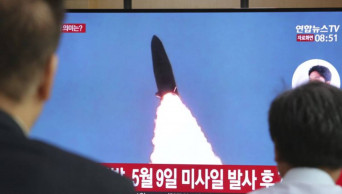
NKorea fires new ballistic missile in likely pressure tactic
South Korea, July 25 (AP/UNB) — North Korea fired a new type of short-range ballistic missile in two launches into the sea Thursday, South Korean officials said. They were North Korea's first weapons launches in more than two months and appeared to be a pressuring tactic as Pyongyang and Washington struggle to restart nuclear negotiations.
7 years ago